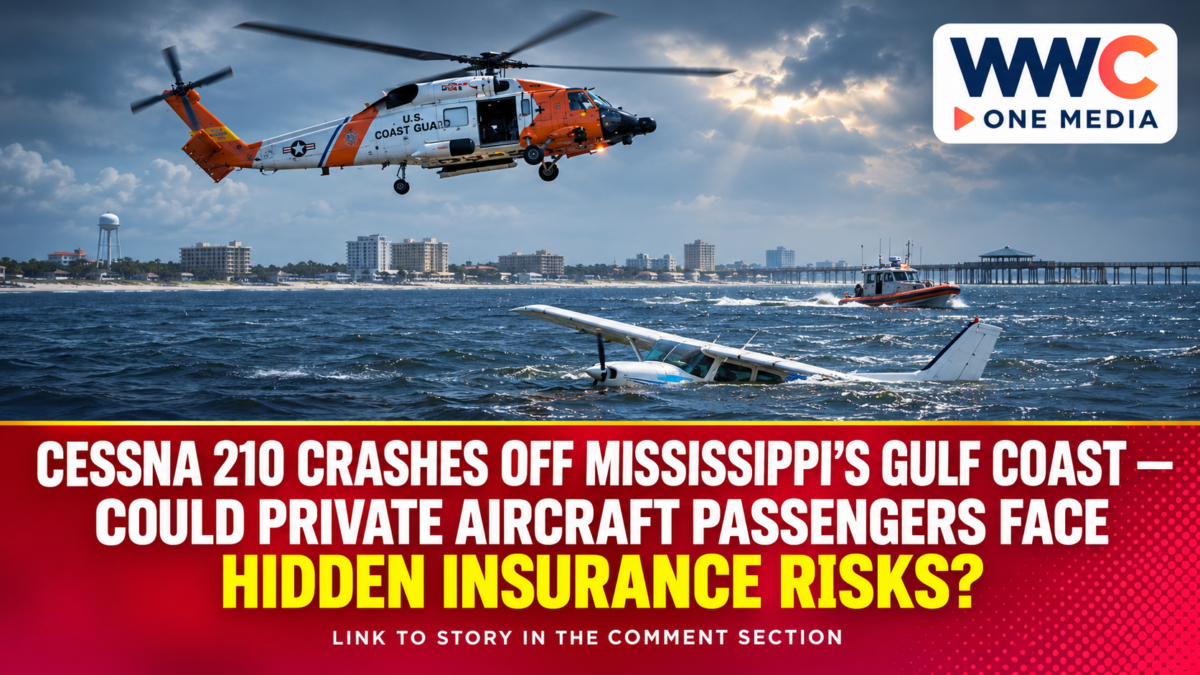
MISSISSIPPI, United States — A Cessna 210 aircraft crashed southwest of Pascagoula, Mississippi, on Nov. 24, bringing renewed attention to aviation safety and the financial protection available to passengers travelling aboard privately operated aircraft.
The Federal Aviation Administration confirmed that the Cessna 210 crash occurred at approximately 3:30 p.m. local time. The National Transportation Safety Board will lead the investigation, with assistance from the FAA.
Beyond determining what caused the accident, the incident provides an opportunity to examine a frequently overlooked aspect of private aviation: whether passengers have adequate financial protection when an aircraft accident occurs.
No aircraft-specific insurance documents have been made available in the public records reviewed for this article. The aircraft owner’s coverage, passenger liability limits and potential insurance claims therefore remain unverified.
Cessna 210 Crash Highlights the Importance of Aviation Investigations
The circumstances surrounding the Mississippi aircraft accident must be established through a formal investigation rather than speculation based on preliminary information.
The FAA has identified the aircraft model, the approximate time of the accident and its general location.
However, the publicly accessible statement does not establish the cause of the crash.
Questions involving aircraft condition, operational circumstances and possible contributing factors will require further evidence before investigators can establish reliable conclusions.
This distinction is also central to the ongoing Air India crash investigation, where preliminary findings must be distinguished from the conclusions of a completed technical investigation.
An accident investigation and an insurance assessment serve different purposes. Establishing why an aircraft crashed does not automatically determine how much compensation an insurance policy may provide.
Private Aviation Insurance May Contain Financial Protection Gaps
Passengers travelling aboard privately operated aircraft should not assume that purchasing travel insurance automatically provides protection against every aviation-related accident.
Insurance benefits depend on the contractual terms of the applicable policy, including its exclusions, conditions and financial limits.
One important consideration is whether the insurance agreement covers the particular type of aircraft operation involved.
A policy providing benefits for travel-related accidents may still impose restrictions that affect eligibility for compensation.
Aircraft liability insurance introduces a separate form of financial protection, which may respond to covered claims involving passengers or other affected individuals.
The amount recoverable, however, depends on the terms of the agreement and the circumstances surrounding the claim.
For passengers, the essential distinction is between having an insurance policy and having a policy that specifically covers the risk involved.
Why a $1 Million Insurance Policy May Not Provide $1 Million per Passenger
A federal review of general aviation insurance published in September 2015 identified important differences between overall aircraft liability limits and individual compensation limits.
One historical example involved coverage of US$1 million per accident, subject to a maximum of US$100,000 for each accident victim.
Under such an arrangement, the overall insurance limit would not necessarily represent the amount available to each individual claimant.
This distinction becomes particularly important when an aircraft accident involves multiple passengers.
Even where a policy appears to provide substantial financial protection, individual limits and other contractual restrictions may affect the amount recoverable.
The historical figures illustrate how an insurance policy can be structured. They do not establish current market-wide coverage standards or the insurance limits applicable to the Mississippi aircraft.
Passengers, aircraft owners and insurance intermediaries should examine both the overall liability limit and any individual restrictions when evaluating the adequacy of coverage.
US Aviation Insurance Requirements Have Historically Varied by State
A 2015 US government examination of aviation insurance requirements found significant differences across the country’s states.
The federal study identified 11 states with some form of general aviation liability insurance or financial-responsibility requirement as of April 2015.
Minnesota was identified at the time as the only state requiring minimum liability coverage for nearly all general aviation aircraft owners, with a minimum of US$100,000 per passenger seat.
The review also identified historical cases in which individuals affected by accidents involving uninsured or underinsured aircraft owners received little or no compensation.
These findings are historical and should not be interpreted as a comprehensive statement of aviation insurance laws in 2026.
Aircraft owners and operators must consider the requirements currently applicable to their jurisdiction and category of operation.
Determining whether any legal or contractual requirements applied to the Cessna 210 involved in the Mississippi accident would require additional documentation.
Aviation Insurers Face Rising Claims and Maintenance Costs
The Mississippi accident comes during a period of competitive conditions in the international general aviation insurance market.
WTW’s second-half 2026 industry outlook describes an insurance market with substantial available capital and competition among providers, alongside increasing pressure from claims expenses and economic uncertainty.
Aircraft maintenance costs remain an important concern.
Higher prices for replacement components, supply-chain disruptions and shortages of experienced maintenance personnel are contributing to more expensive repairs and longer aircraft servicing periods.
These developments affect the financial environment in which aircraft operators and insurers make decisions about coverage.
For aviation businesses, managing these expenses requires balancing competitive insurance premiums with appropriate financial protection and operational safety standards.
However, these industry-wide challenges do not establish that maintenance problems contributed to the Mississippi accident.
The importance of separating broader aviation risks from incident-specific evidence is also illustrated by the investigation into a Russian military aircraft crash, where definitive conclusions require evidence from the responsible authorities.
What Happens Next After the Mississippi Plane Crash?
The next significant development will be the release of incident-specific findings by US aviation investigators.
Aircraft insurance arrangements, applicable liability limits and any potential claims must be assessed separately through relevant contractual and legal documentation.
The distinction between confirmed accident information and unresolved questions is particularly important during the early stages of an investigation, as demonstrated by previous efforts to establish the official circumstances surrounding Papua New Guinea’s DC-3 crash history.
For passengers and aviation businesses across APEC economies, the broader issue is the importance of understanding financial protection before travelling or operating private aircraft.
A competitive insurance premium alone does not establish adequate coverage. The scope of protection, individual liability limits, exclusions and applicable legal requirements all deserve consideration.
Until further evidence becomes available, no conclusion should be drawn about the insurance adequacy, legal responsibility or cause of the Mississippi Cessna 210 accident.
Frequently Asked Questions
When did the Cessna 210 crash off Mississippi?
The FAA confirmed that the aircraft crashed southwest of Pascagoula, Mississippi, on Nov. 24, 2026, at approximately 3:30 p.m. local time.
What caused the Cessna 210 crash?
The official records reviewed for this article do not establish the cause. The National Transportation Safety Board will lead the investigation.
Does travel insurance cover private aircraft passengers?
Coverage depends on the individual insurance policy, including its terms, exclusions and eligibility requirements. Passengers should obtain confirmation from their insurer regarding private aviation coverage.
Does a US$1 million aviation insurance policy guarantee US$1 million for every passenger?
No. A policy may include an overall liability limit and separate limits applicable to individual accident victims.
Was the Cessna 210 involved in the Mississippi crash insured?
The aircraft’s insurance arrangements and applicable coverage limits have not been independently established through publicly available primary records.