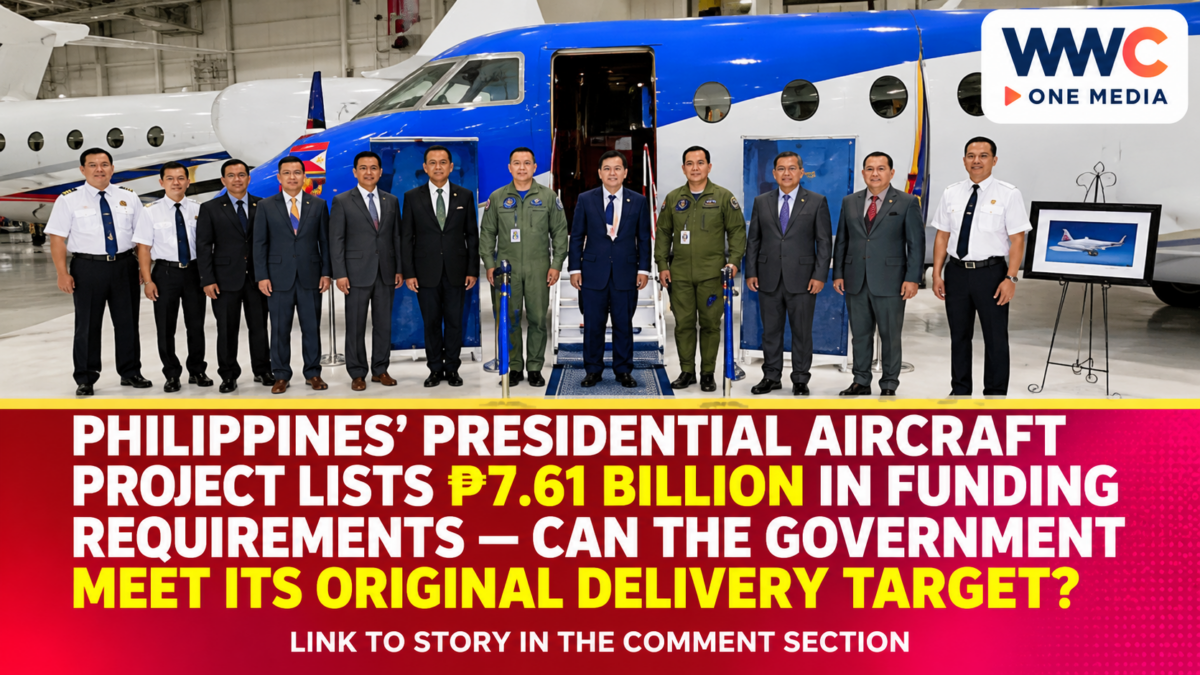
MANILA, PHILIPPINES — The Philippine government’s Presidential Aircraft Acquisition Project faces an important implementation test as its original procurement timetable calls for aircraft purchase and initial delivery in 2026, with more than ₱7.61 billion in funding requirements scheduled between 2026 and 2029.
The acquisition falls under the Revised Armed Forces of the Philippines Modernization Program and is intended for the Philippine Air Force (PAF).
A multiyear contractual authority issued on October 17, 2025, establishes an implementation period extending through 2029, covering aircraft acquisition, configuration, personnel training and maintenance support.
With 2026 approaching its conclusion, the project’s progress raises questions about whether its original delivery milestones remain achievable.
Presidential aircraft project originally targeted 2026 delivery
The government’s implementation timetable initially designated 2025 for contract execution and advance payment.
The following year was allocated for purchasing the aircraft, reviewing its design, arranging spare parts and supporting equipment, initial delivery and training.
Additional work scheduled for 2027 involves aircraft configuration, delivery of supporting equipment and logistics services.
Maintenance assistance and recurrent training are scheduled to continue through 2029.
The timetable illustrates that acquiring the aircraft and establishing its operational capability are separate milestones.
However, the published budget schedule does not independently establish that the planned contract signing, aircraft purchase or delivery has already occurred.
A current procurement update would be necessary to determine whether implementation remains aligned with the original targets.
More than ₱7.61 billion in scheduled funding requirements
The government’s multiyear funding schedule identifies substantial financial requirements for the presidential aircraft acquisition.
| Year | Scheduled funding requirement |
|---|---|
| 2026 | ₱5.763 billion |
| 2027 | ₱1.498 billion |
| 2028 | ₱176.275 million |
| 2029 | ₱176.275 million |
The combined amount listed for these four financial years is approximately ₱7.614 billion.
The 2026 requirement represents roughly 75.7% of the combined funding scheduled between 2026 and 2029.
This makes the current financial year particularly significant within the published implementation programme.
However, the combined amount should not be interpreted as the project’s complete lifetime cost because the table does not include a separate numerical breakdown of the 2025 requirement.
Likewise, scheduled funding does not necessarily mean that the government has already released or spent the corresponding amounts.
The distinction between budget authority, contractual commitments and actual expenditure is also examined in WWC ONE MEDIA’s coverage of Philippine defence acquisition approvals and their actual financial implications.
Why acquiring a presidential aircraft involves more than purchasing a plane
The planned procurement includes several stages beyond obtaining the aircraft itself.
Additional requirements involve configuration, technical equipment, personnel preparation and continuing support.
An aircraft delivered in its initial configuration may still require further modification before it can perform its intended government functions.
For this reason, the date on which an aircraft arrives does not necessarily establish when it becomes fully operational.
The project’s published schedule separates initial aircraft delivery in 2026 from subsequent configuration and supporting activities in 2027.
This distinction is important when assessing whether procurement milestones have been achieved.
An aircraft acquisition should ultimately be evaluated against its intended operational requirements, acceptance conditions and long-term sustainability, rather than the purchase announcement alone.
Government procurement must distinguish approval from completion
The existence of a multiyear contractual authority demonstrates that the project has been included in the government’s financial planning framework.
However, budgetary documentation serves a different purpose from a signed procurement contract or formal aircraft acceptance record.
The Philippine Government Electronic Procurement System, commonly known as PhilGEPS, serves as a central information platform for government procurement.
For major acquisitions, relevant documentation may establish the selected supplier, contract value, implementation schedule and other contractual conditions, subject to applicable disclosure rules.
Until updated project-specific documentation becomes available, the original budget timetable should not be treated as proof that every milestone has been completed.
Similar considerations apply to other aviation acquisitions across Southeast Asia.
WWC ONE MEDIA’s report on Thailand’s Gripen aircraft procurement programme examines why proposed purchases, signed contracts and completed deliveries must be assessed separately.
Maintenance and training remain part of the presidential aircraft programme
The acquisition’s implementation schedule includes continuing support requirements extending beyond the anticipated aircraft delivery.
Funding requirements of ₱176.275 million are listed for each of 2028 and 2029, when maintenance assistance and recurrent training are scheduled.
These provisions illustrate why aircraft procurement involves continuing financial and institutional commitments.
The acquisition price is only one component of an aviation programme. Operational sustainability also depends on maintenance arrangements, appropriately trained personnel and access to supporting equipment.
The importance of sustaining newly acquired aviation assets has also been highlighted in WWC ONE MEDIA’s coverage of the Philippine Air Force’s completed 32-unit Black Hawk acquisition programme.
Although the helicopter programme and presidential aircraft acquisition serve different purposes, both involve requirements extending beyond initial delivery.
What happens next for the presidential aircraft acquisition?
The next significant development would be an updated government procurement disclosure establishing the project’s current implementation status.
Such documentation could clarify whether a supplier has been formally selected, whether contractual arrangements have been completed and whether the original delivery timetable remains applicable.
If the schedule has changed, a revised implementation plan would help establish the implications for subsequent configuration, training and maintenance activities.
The reviewed budget record does not identify a confirmed aircraft manufacturer or model. It also does not establish that the acquisition has been cancelled or formally postponed.
For taxpayers, the central accountability question is whether the government can demonstrate measurable progress against the project’s approved objectives and scheduled funding requirements.
Frequently asked questions
What is the Philippine Presidential Aircraft Acquisition Project?
It is an aircraft acquisition programme for the Philippine Air Force under the Revised Armed Forces of the Philippines Modernization Program.
How much funding is scheduled for the presidential aircraft project?
The official budget table lists approximately ₱7.614 billion in funding requirements between 2026 and 2029, excluding any separate 2025 requirement.
When was the aircraft originally scheduled for delivery?
The original implementation timetable targeted initial aircraft acquisition and delivery in 2026, followed by further configuration and supporting activities in 2027.
Has the presidential aircraft project been officially delayed?
The original budget timetable has been verified, but an updated primary procurement record confirming a formal delay or revised delivery date has not been independently established.
Has the government selected Airbus or Boeing?
The reviewed official budget record does not identify a selected aircraft manufacturer or model. Any assertion that a particular aircraft has been purchased requires additional procurement documentation.