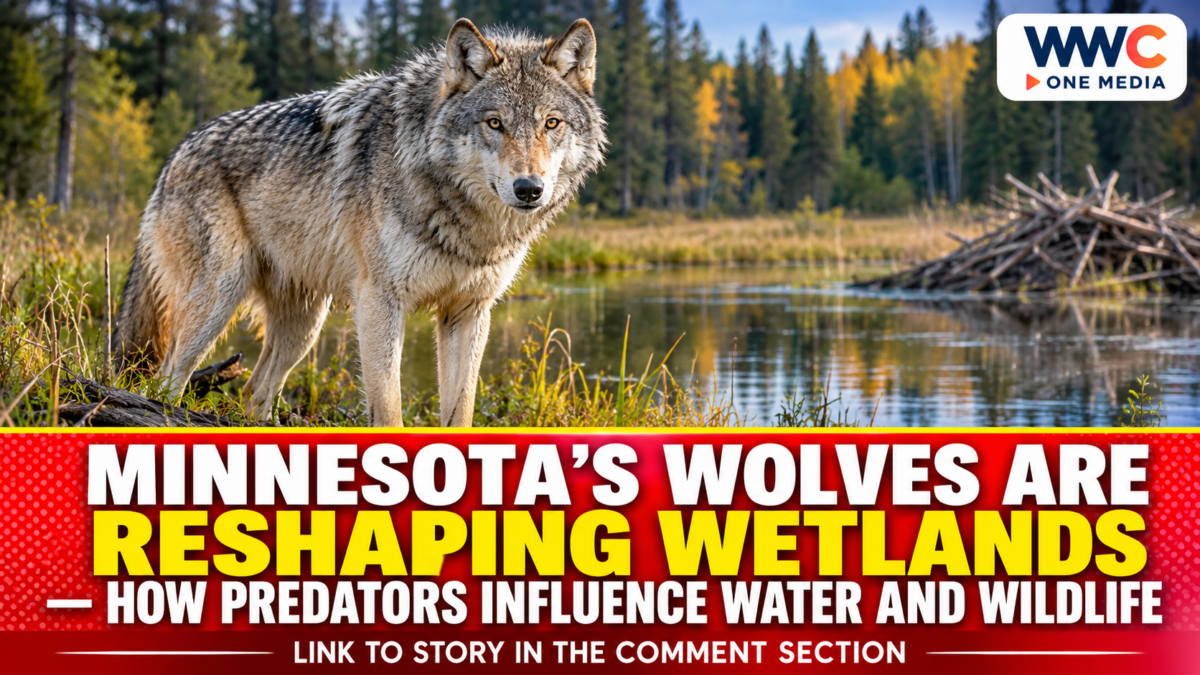
MINNESOTA, UNITED STATES — Gray wolves are influencing the development of wetlands in Minnesota through their interactions with beavers, according to ecological research examining wildlife activity in the Greater Voyageurs Ecosystem.
A study published in Science Advances on November 13, 2020, estimated that wolf predation affects the establishment of approximately 88 beaver ponds annually, with consequences for an estimated 194,000 cubic metres of water storage each year.
The findings offer a different perspective on predator-prey relationships. Wolves are not simply hunting another animal for food. Their interactions with dispersing beavers can also influence whether newly constructed ponds remain part of the landscape, potentially affecting the habitats and ecological processes associated with those wetlands. PubMed Central (PMC)+1
How wolves influence the formation of wetlands
The research focuses on the Greater Voyageurs Ecosystem in northern Minnesota, an area where forests, waterways, beaver colonies and wolf territories overlap.
The American beaver (Castor canadensis) is widely recognised for its ability to modify its surroundings. By building dams across streams, beavers create ponds that change how water moves through forested landscapes.
These structures can also create habitats for other organisms. Water birds, aquatic species and larger mammals benefit from the environmental conditions associated with beaver ponds.
The National Park Service describes beavers as important landscape modifiers in Voyageurs National Park, where their dams and lodges contribute to the area’s distinctive aquatic habitats.
Gray wolves (Canis lupus), meanwhile, are among the region’s principal predators. Their diet includes deer, moose and beavers.
The interaction becomes particularly significant when young or dispersing beavers leave established colonies and attempt to create new ponds or restore previously drained ones.
If a dispersing beaver is killed before completing that process, the developing wetland can lose the animal responsible for maintaining its dam. National Park Service+2
What researchers discovered in Minnesota
The scientists examined wolf movements and beaver activity over several years, combining GPS tracking information with observations of pond establishment and recolonisation.
Between 2015 and 2019, researchers examined 11,817 clusters of GPS locations visited by 32 wolves in the Greater Voyageurs Ecosystem.
Their analysis documented 58 dispersing beavers killed by wolves.
Of those animals, 11 had either started constructing rudimentary dams or begun repairing previously nonfunctional dams.
That represented 19% of the documented wolf-killed dispersing beavers, with a reported 95% confidence interval of 9% to 29%.
The researchers also compared ponds affected by wolf predation with reference ponds established or recolonised by dispersing beavers.
Their observations showed that 84% of the reference ponds remained occupied until the fall. By contrast, none of the monitored ponds in which the dispersing beaver was killed remained active after the predation event during the reported observation period.
This comparison helped the research team estimate how predator activity could influence the establishment and persistence of wetlands across the ecosystem. PubMed Central (PMC)+1
Why the 88-pond estimate matters
One of the study’s most notable findings was its estimate that wolves influence the establishment of approximately 88 beaver ponds annually.
The researchers also calculated that these ponds represent approximately 194,000 cubic metres of water storage.
That figure is equivalent to roughly 51.3 million US gallons.
However, the number needs careful interpretation. It represents an estimated ecological effect on pond establishment and water storage, not a measurement of water permanently lost from Minnesota or a direct calculation of regional water supply.
The researchers reported a 95% confidence interval of 36 to 162 ponds annually and an estimated water-storage range of 79,100 to 355,900 cubic metres.
These ranges illustrate the uncertainty surrounding ecological estimates. Actual effects can vary depending on wolf activity, beaver dispersal and the conditions of individual ponds. PubMed Central (PMC)+1
Why beaver ponds matter beyond their builders
Beaver dams change more than the appearance of a stream.
When water accumulates behind a dam, nearby areas can become flooded, creating wetlands that support different forms of plant and animal life.
These environments can influence nutrient cycling, aquatic food communities and forest succession.
The National Park Service notes that beaver ponds in Voyageurs provide habitat for moose, water birds and numerous aquatic species.
This means that the disappearance or delayed establishment of an individual pond can have consequences beyond the beaver colony itself.
For wider environmental context, WWC has also examined the challenges facing endangered wildlife through its coverage of the Mexican axolotl and conservation efforts in its native wetlands.
Other examples of the relationship between wildlife and habitat appear in the return of rescued endangered animals to the wild in Zamboanga del Norte and research into unusual species living in the deep ocean.
Together, these subjects demonstrate why conservation research increasingly considers relationships between species rather than examining animals in isolation.
Wolves do not necessarily reduce the overall beaver population
An important distinction in the research is that influencing pond establishment does not automatically mean wolves are reducing the overall beaver population.
The researchers discussed evidence suggesting that wolf predation in the Greater Voyageurs Ecosystem may be compensatory at the landscape scale.
In practical terms, other beavers dispersing from neighbouring colonies can help maintain population numbers even when individual animals are killed.
The study therefore highlights a different ecological mechanism: predators may influence where wetlands develop without necessarily causing a corresponding decline in the abundance of their prey.
This distinction matters because it prevents an oversimplified interpretation of predator-prey relationships.
The ecological importance of wolves in this case is not limited to how many beavers they consume. It also involves the consequences of those encounters for the landscape.
What this could mean for ecosystem research
The findings contribute to a broader scientific discussion about how large predators influence ecosystems.
Predators are often studied through their effects on prey populations. However, this research demonstrates that the consequences of predation can also depend on the ecological role of the animal being hunted.
Beavers are particularly important because their construction activities physically transform landscapes. A single animal can influence water movement, vegetation and the availability of aquatic habitats.
When a predator kills a beaver that has started building or restoring a pond, the consequences can extend to other organisms that depend on that wetland.
This does not mean wolves are universally beneficial to every ecosystem or that their presence always increases biodiversity. The results concern a particular ecological relationship in northern Minnesota.
They do, however, reinforce the importance of studying wildlife interactions over extended periods rather than relying exclusively on population counts.
What happens next
Long-term monitoring will be important in determining how wolf predation, beaver dispersal and changing environmental conditions interact over time.
Researchers will also need to examine whether similar patterns occur in other boreal ecosystems where wolves and beavers coexist.
The 2020 findings provide a research framework, but they should not be interpreted as a universal estimate for every wolf population or wetland environment.
For conservation planners, the broader lesson is that protecting an ecosystem requires understanding the relationships between its species, including interactions that may initially appear unrelated to habitat management.
Frequently asked questions
1. How do wolves affect beaver ponds?
Wolves can kill dispersing beavers that are constructing new dams or repairing abandoned ones. Without the beaver maintaining the structure, the dam can fail and the developing pond may drain.
2. How many ponds do wolves influence annually?
The research estimated that wolves influence the establishment of approximately 88 beaver ponds annually in the Greater Voyageurs Ecosystem. The estimate has a 95% confidence interval of 36 to 162 ponds.
3. How much water storage is associated with the research?
The researchers estimated approximately 194,000 cubic metres of water storage annually, equivalent to around 51.3 million US gallons.
4. Does wolf predation cause beaver populations to decline?
Not necessarily. The researchers discussed evidence that dispersal from neighbouring colonies can compensate for predation, meaning effects on pond establishment do not automatically translate into an overall population decline.
5. Where was the research conducted?
The research was conducted in the Greater Voyageurs Ecosystem in northern Minnesota, United States, which includes Voyageurs National Park and surrounding landscapes.