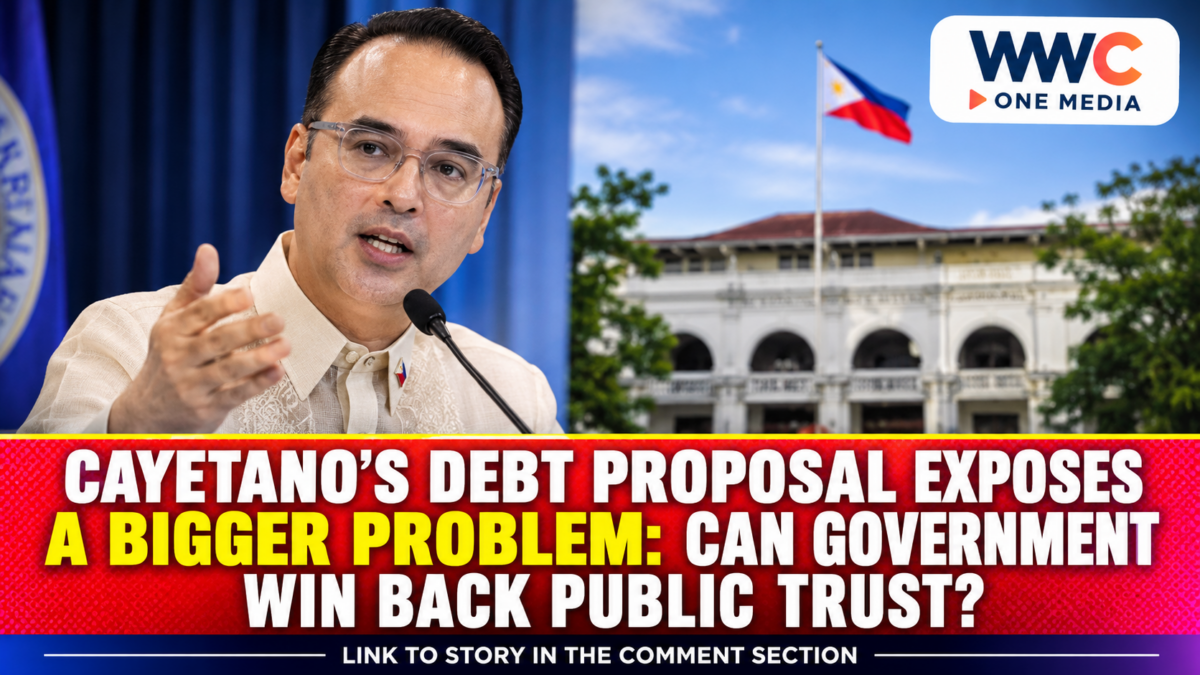
MANILA, Philippines — November 26, 2026 — Senate Minority Leader Alan Peter Cayetano has argued that rebuilding public trust must come before any effort to encourage Filipinos to voluntarily contribute money toward reducing the country’s national debt. His remarks followed a public exchange with Senator Panfilo “Ping” Lacson, who said honest public servants should not be included in broad statements about corruption in government.
The discussion grew out of the Senate’s deliberations on the proposed 2027 national budget, where Cayetano raised the possibility of creating a mechanism for voluntary contributions to help reduce government debt. The debate has since moved beyond the mechanics of accepting donations to a larger question: how can the government persuade citizens to trust the handling of money they voluntarily give?
The financial backdrop is substantial. Bureau of the Treasury figures put outstanding national government debt at ₱19.660294 trillion at the end of September 2026. That figure makes accountability, spending discipline and public confidence important parts of any serious discussion about the country’s finances.
Public trust became the central issue in Cayetano’s proposal
In his November 24 statement, Cayetano explained that some Filipinos might be willing and able to contribute to national causes, but that public doubts about the use of government money could discourage participation.
He said there was no existing mechanism for voluntary contributions to reduce outstanding government obligations and argued that any such arrangement would need safeguards against misuse.
His November 25 statement developed that point. Rather than presenting the collection of money as the main lesson from South Korea’s 1997 gold collection campaign, he said the more important consideration was why citizens had been willing to participate.
“Trust cannot be demanded from the people. It has to be earned by those of us in public office,” Cayetano said in the statement.
He also called on government leaders to demonstrate accountability in spending, borrowing, explaining and reporting public finances.
The distinction matters because the proposal is not simply a question of whether citizens can afford to donate. A voluntary payment system would depend on whether contributors could understand where the money goes, how it is recorded and whether it is actually used to reduce government obligations.
The ₱19.66-trillion debt figure behind the debate
The Bureau of the Treasury’s September 2026 debt table recorded total national government outstanding debt at ₱19,660,294 million.
Domestic debt accounted for ₱13,248,308 million, while external debt stood at ₱6,411,986 million.
These figures represent outstanding obligations at a particular date. They should not be confused with the amount of debt the government repays during a year, the interest expense alone or the total amount of debt that may mature in the immediate future.
The distinction is important when discussing possible public contributions. A donation toward debt reduction would need to be accounted for separately from ordinary tax collections and government borrowing. It would also need a clear process for recording receipts and showing how the money affects outstanding obligations.
WWC has previously examined the rise in Philippine national government debt and its financing implications. The September figures show that the issue remains relevant as lawmakers examine the next national spending plan.
Why Lacson objected to the broad interpretation
Senator Panfilo Lacson responded on November 25 to a circulating interpretation of Cayetano’s remarks. He said public servants who do not steal public funds or accept bribes should not be included in a sweeping generalisation.
The disagreement highlights a difference between describing public sentiment and making a factual accusation against every person working in government.
Cayetano’s November 24 and November 25 statements explain that he was discussing distrust toward government institutions and the difficulty of persuading citizens to contribute money when they question how public funds are handled.
That context is important. A statement about public perception is not proof that every public official is corrupt. Equally, the existence of honest public servants does not remove the need for transparent systems, independent audits and consequences when wrongdoing is established.
For a public debate to remain useful, the distinction between institutional distrust and individual culpability must be maintained.
The government already has tools for spending transparency
The Department of Budget and Management announced the launch of its Centralized Open Monitoring Platform for Appropriations and Spending Statistics, known as DBM COMPASS, on June 26, 2026.
The platform is designed to bring information on the National Expenditure Program, the General Appropriations Act, allotments, obligations and disbursements into a searchable system. It is intended to help citizens follow how public money moves through government.
That matters to Cayetano’s proposal because a voluntary debt contribution system would need more than a bank account or payment channel. It would require a transparent accounting framework that shows how much was received, how the money was applied and how the contribution affected government liabilities.
The wider 2027 budget debate is already testing demands for greater disclosure. WWC has examined the Senate’s scrutiny of proposed assistance allocations and multipurpose buildings, including the importance of distinguishing budget allocations from money actually released or spent.
A separate WWC report has also looked at the proposed 2027 budget’s exposure to transparency and accountability risks. These are related policy questions, but they do not establish that any particular allocation is unlawful.
Why voluntary contributions need safeguards
A voluntary debt contribution scheme would raise practical questions before it could be implemented.
First, the government would need to identify the office authorised to receive contributions and the legal basis for accepting them. Second, it would need to establish whether payments would go directly toward principal repayment, debt servicing or another designated purpose.
Third, contributors would need reliable receipts and public reporting. A system that accepts money without clearly identifying its destination could deepen the very doubts it is intended to address.
There is also a broader fiscal question. Voluntary contributions cannot replace the government’s responsibility to raise revenue, manage expenditure and borrow responsibly. They should not be presented as a substitute for sound fiscal policy or as an obligation imposed on ordinary taxpayers.
Cayetano’s own statement stresses the need to borrow less and borrow better, while ensuring that loans support projects with lasting value.
That argument is relevant beyond the proposed donation mechanism. Public confidence is affected by the quality of government decisions, the visibility of spending and the ability of institutions to explain whether public resources achieved their intended results.
What happens next
The Senate’s published budget schedule places the proposed 2027 national budget under plenary interpellation and review during the final week of November. The debate over voluntary debt contributions is therefore unfolding alongside lawmakers’ examination of spending priorities and government financing.
Cayetano’s office said it had directed staff to study legislation that could strengthen congressional oversight of government loans. That is a separate policy track from creating a mechanism to accept voluntary donations.
The next steps to watch are whether a formal proposal is filed, whether the government identifies a legally authorised receiving mechanism and whether safeguards are developed for public reporting and independent scrutiny.
For now, the donation idea remains a proposal rather than an established government programme. The more immediate test is whether public institutions can demonstrate that taxes, borrowings and appropriations are being managed transparently.
The debate has exposed a basic challenge: citizens cannot be expected to place additional money in public hands simply because a government asks them to. Confidence must come from verifiable systems and accountable decisions.
Frequently asked questions
1. What did Alan Peter Cayetano propose?
Cayetano raised the possibility of allowing Filipinos to make voluntary contributions toward reducing the country’s national debt, subject to a government mechanism and safeguards.
2. Why did Cayetano say public trust matters?
He argued that citizens may hesitate to contribute if they are not confident that government will use their money properly.
3. How much was Philippine national government debt in September 2026?
The Bureau of the Treasury recorded outstanding national government debt of ₱19.660294 trillion at the end of September 2026.
4. Did Cayetano accuse every government official of corruption?
His November 24 and 25 statements describe public distrust toward government. The context is important: describing a public perception is not the same as establishing that every public official is corrupt.
5. Has the government established a voluntary debt donation programme?
No such programme was established in the official records reviewed for this report. Cayetano said a mechanism would be needed and that his staff had been directed to study stronger oversight of government borrowing.