
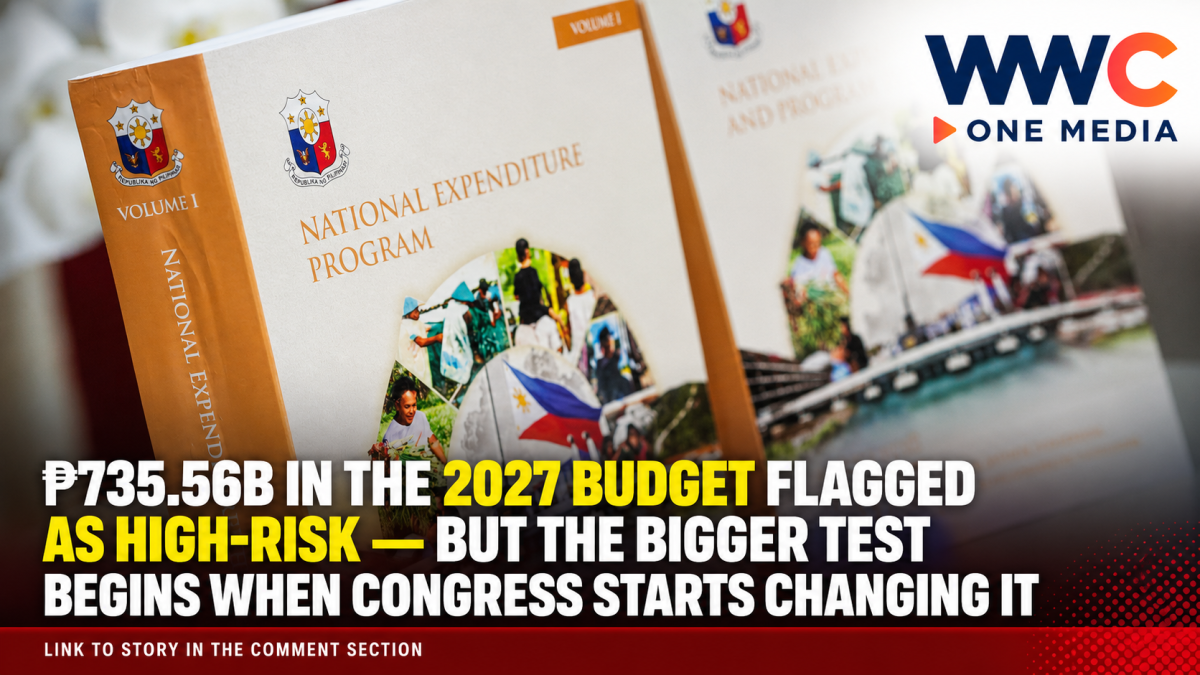
MANILA, Philippines — Nearly ₱736 billion in President Ferdinand Marcos Jr.’s proposed ₱7.2-trillion national budget for 2027 has been placed under heightened scrutiny by a coalition of civil society organizations, which says the allocations could be vulnerable to political intervention, congressional insertions and patronage as the country moves closer to the 2028 elections.
But the headline number needs an important qualification: the ₱735.56 billion has not been officially declared anomalous, corrupt or illegal. It represents programs and appropriations classified by the People’s Budget Coalition (PBC) as carrying elevated risks because of how money may be allocated, amended or distributed.
The PBC divides the amount into three categories: ₱140.07 billion in what it calls “soft pork,” ₱483.51 billion in “hard pork,” and ₱111.98 billion in “shadow pork.” The labels are the coalition’s terminology, not official classifications used by the Department of Budget and Management.
The controversy is emerging just as Congress begins examining a spending plan that the administration describes as disciplined, people-centered and focused on measurable results.
A ₱7.2-Trillion Budget Under the Microscope
The DBM submitted the proposed ₱7.2-trillion 2027 National Expenditure Program, or NEP, to Congress on August 11. The spending proposal is around ₱407 billion, or six percent, larger than the 2026 budget and equivalent to about 21.7 percent of gross domestic product.
Budget officials say much of that increase is driven by mandatory obligations, including a higher National Tax Allotment for local governments, salary adjustments for government workers and other existing commitments.
Acting Budget Secretary Kim Robert de Leon has argued that the spending plan was pared down from more than ₱11 trillion in proposals submitted by agencies, with the government prioritizing projects it considers necessary, implementation-ready and capable of producing measurable benefits.
Civil society groups, however, say the real danger may not simply lie in how large the budget is—but in how certain funds are structured and what could happen to them as lawmakers amend the proposal.
‘Soft Pork’: Assistance Programs That Help Millions — But Can Carry Political Risk
More than ₱71 billion of the coalition’s so-called soft-pork category involves government assistance programs.
Among the major programs identified are the Department of Social Welfare and Development’s Assistance to Individuals in Crisis Situation, or AICS; the Department of Labor and Employment’s TUPAD emergency employment program; and the Department of Health’s Medical Assistance to Indigent and Financially Incapacitated Patients, or MAIFIP.
Under the proposed 2027 budget, AICS would receive ₱33.28 billion, down from ₱63.9 billion in 2026. TUPAD would receive ₱14.25 billion, compared with ₱22.44 billion this year, while MAIFIP would fall to ₱24.24 billion from ₱51.65 billion.
These are legitimate social-protection programs serving people facing unemployment, medical emergencies and financial distress.
The PBC’s concern is not that assistance itself is improper. Rather, the coalition argues that programs involving individual or localized payouts can become politically vulnerable if access depends on politicians, endorsements or discretionary intervention instead of transparent eligibility rules.
Public finance analyst Zy-Za Suzara has similarly questioned whether the allocation pattern could favor politically visible assistance and infrastructure programs as the 2028 election cycle approaches. Her characterization of the proposal as election-oriented remains an analysis and allegation, not an established finding of misuse.
₱58.53-Billion Local Government Fund Faces Questions
Another fund attracting attention is the Local Government Support Fund, or LGSF.
The proposed allocation stands at approximately ₱58.53 billion, slightly above the ₱57.87 billion provided in 2026. The fund is designed to support infrastructure, social development and other priority requirements of provinces, cities, municipalities and barangays.
Senate President and finance committee chair Sherwin Gatchalian has called for closer scrutiny of the fund and evidence showing whether its rapid expansion is actually delivering measurable improvements in local development and poverty reduction.
DBM, for its part, says the larger LGSF is intended to support priorities including rice assistance and local infrastructure development. The government has also projected a separate ₱1.4-trillion National Tax Allotment for LGUs in 2027, an 11-percent increase from current levels.
That distinction is important: a large local-government allocation is not automatically evidence of pork. The accountability question is whether projects have clear beneficiaries, documented criteria, specific locations and measurable results.
The Biggest Red Flag: ₱483.51 Billion in Infrastructure
The largest part of the PBC’s calculation is the ₱483.51 billion it categorizes as “hard pork,” covering infrastructure expenditures it believes require particularly close monitoring against insertions, politically influenced project selection and ghost projects.
The proposed DPWH budget is close to ₱650 billion, while other infrastructure-related allocations cited by the coalition include approximately ₱16 billion for farm-to-market roads, ₱46.36 billion for the National Irrigation Administration and ₱14.54 billion for the Health Facilities Enhancement Program.
Infrastructure spending itself is central to economic growth, disaster resilience and connectivity. The controversy is over how projects are selected and documented.
PBC representatives have called for detailed project descriptions and geotagging so taxpayers can determine exactly where infrastructure is supposed to be built and whether it actually exists.
That issue carries added weight after years of congressional and public scrutiny involving flood-control projects and other public works allocations.
The Evacuation-Center Mystery: ₱3.06B or ₱3.24B?
Senator Panfilo Lacson has separately questioned uniform ₱180-million regional allocations for evacuation centers, saying some items lacked specific proposed locations despite the administration describing the budget as “execution-ready.”
There is, however, a numerical discrepancy in published reports that deserves clarification.
Lacson-linked Senate material and subsequent Palace coverage described 17 regional allocations totaling ₱3.06 billion. Malacañang defended the projects and said safeguards would prevent them from becoming ghost projects.
The August 29 OneNews/Philstar report, however, used 18 regions, producing a total of ₱3.24 billion.
Because the figures conflict, it would be premature to state either total as definitively established without clarification from the final NEP breakdown or the agencies concerned.
The more significant issue raised by Lacson is the same either way: why were identical amounts proposed before all final project sites were specified?
DBM has responded that implementing agencies would still be required to submit final details and that the Office of Civil Defense had not yet completed the list of locations.
‘Shadow Pork’ — But DBM Says the Number Is Historically Low
The PBC also classifies ₱111.98 billion in unprogrammed appropriations as “shadow pork,” arguing that standby funds require heightened safeguards because of controversies surrounding unprogrammed allocations in previous budgets.
This is also where the government has one of its strongest counterarguments.
DBM says the proposed ₱111.984 billion in unprogrammed appropriations represents only around 1.6 percent of total spending and is the lowest proposed amount at the NEP stage in nominal terms since 2019. According to De Leon, its share of the total expenditure program is the lowest since 1991.
The largest planned uses include roughly ₱57 billion associated with restoring the Philippine Deposit Insurance Corp. fund balance and ₱42.55 billion to support foreign-assisted projects.
DBM stresses that unprogrammed appropriations are not automatically available for spending. Release is subject to conditions prescribed by law and the availability of qualifying funding sources.
That does not eliminate transparency concerns, but it means the entire ₱111.98 billion should not simply be described as hidden or freely spendable money.
Another ₱10.7B Under Scrutiny: Confidential and Intelligence Funds
Separate from the ₱735.56-billion PBC calculation, senators are also examining approximately ₱10.7 billion in proposed confidential and intelligence funds.
The proposal contains around ₱4.3 billion in confidential funds and ₱6.4 billion in intelligence funds, about 8.8 percent lower than the ₱11.8 billion provided in the 2026 General Appropriations Act.
Gatchalian has said confidential funds should be confined to agencies with legitimate enforcement or surveillance functions.
DBM says it rejected some requests from agencies whose mandates did not justify confidential spending and redirected expenses that could be funded through ordinary budget items.
Why the Next Stage Could Be More Important Than the ₱735.56-Billion Headline
The proposed budget is still an NEP—not yet the final General Appropriations Act.
Congress can examine, reduce, increase and amend allocations before the spending bill reaches the President.
That is why the PBC says its ₱735.56-billion calculation should be viewed as an early warning rather than a final tally. The coalition argues that previous budget cycles have shown that controversial or discretionary allocations can expand during legislative deliberations.
DBM, meanwhile, says it supports greater transparency and has urged journalists, lawmakers and civil society to scrutinize the numbers and hold institutions accountable. The department maintains that the proposed budget prioritizes education, health, infrastructure, food security, social protection and other high-impact investments.
That leaves the central question unanswered for now.
The real test of the 2027 budget will not be whether every peso labeled a “red flag” eventually proves problematic.
It will be whether Congress can demonstrate—project by project and peso by peso—that allocations are based on documented public need rather than political convenience.
With ₱7.2 trillion on the table and the 2028 elections getting closer, the most consequential numbers may not be the ones already printed in the NEP.
They may be the numbers that appear—or disappear—before the budget becomes law.



Leave a Reply