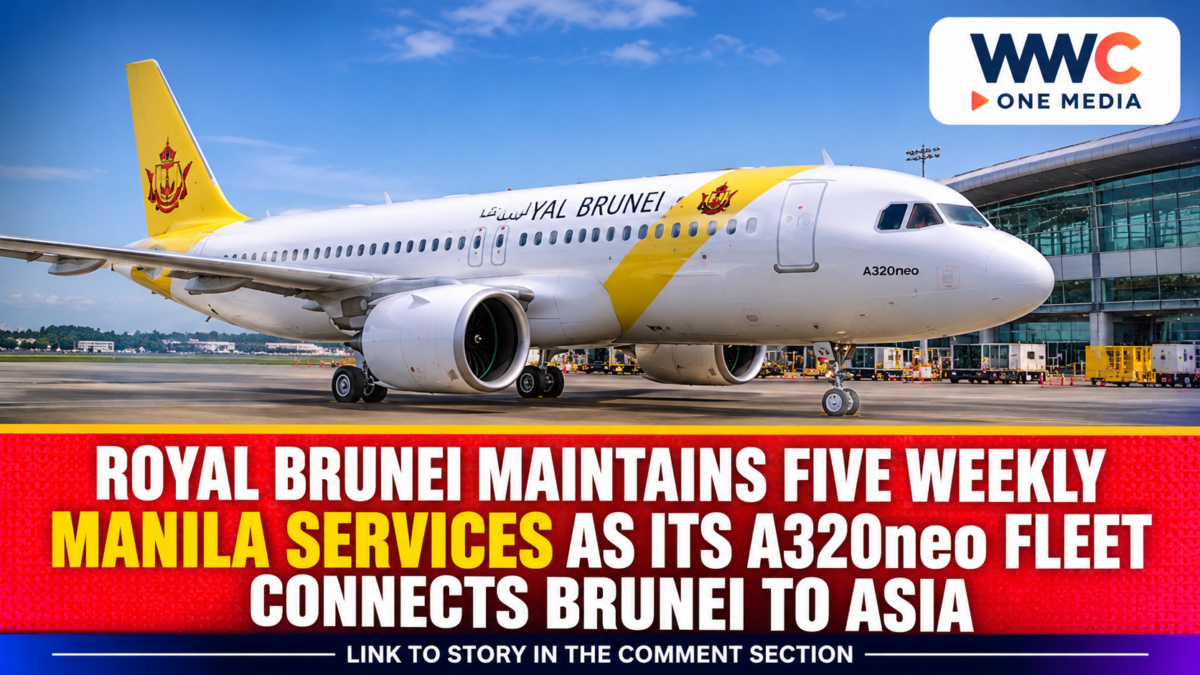
MANILA, Philippines — November 26, 2026 — Royal Brunei Airlines is maintaining five scheduled services each week between Manila and Bandar Seri Begawan in both directions under its November operating timetable, keeping the Brunei–Philippines connection active for business, tourism and connecting passengers.
The airline’s published schedule lists two flight numbers in each direction, with services spread across five operating days. The timetable comes as the carrier continues to position its Airbus A320neo aircraft as the main aircraft type for shorter-haul operations across its regional network.
The aircraft registration V8-RBA has drawn attention through flight-tracking records identifying it as an Airbus A320-251N operated by Royal Brunei Airlines. But an aircraft’s tracking history should not be confused with the airline’s official route schedule: the published timetable does not assign individual aircraft registrations to specific Manila services.
For travelers, the more useful development is the schedule itself. For the airline, the route illustrates how a relatively compact regional fleet supports connections between Brunei and nearby Asian markets.
Royal Brunei flights: Five weekly services connect Manila and Brunei
Royal Brunei’s November 10, 2026 operating schedule lists five weekly departures from Brunei to Manila and five weekly return services.
The published timetable identifies the following flights:
| Route | Flight | Departure | Arrival | Operating days |
|---|---|---|---|---|
| Brunei–Manila | BI685 | 18:30 | 20:55 | Monday, Thursday, Friday |
| Brunei–Manila | BI683 | 11:45 | 14:10 | Wednesday, Saturday |
| Manila–Brunei | BI686 | 21:45 | 00:00 next day | Monday, Thursday, Friday |
| Manila–Brunei | BI684 | 15:00 | 17:15 | Wednesday, Saturday |
All times are local to the relevant airports, as indicated by the airline’s timetable.
The schedule provides weekday and weekend options, although it does not mean that flights operate every day. Passengers should also account for the overnight arrival shown for BI686, which departs Manila late in the evening.
Royal Brunei separately promotes the return of Sunday services on its Philippine-facing website. Travelers should check the latest operating timetable and booking confirmation because published schedules may change.
What the A320neo contributes to the airline’s network
Royal Brunei identifies the Airbus A320neo as the primary aircraft for its shorter-haul fleet. Its published cabin information lists 12 Business Class seats, 18 Preferred Seats and 120 Economy Class seats.
That configuration gives the airline a narrow-body aircraft suited to regional routes where a wide-body aircraft may not be necessary. The carrier also operates Boeing 787-8 Dreamliners for its longer-haul network.
The difference matters operationally. A narrow-body aircraft can serve shorter regional sectors while the airline reserves larger aircraft for routes that require their range or capacity. It also allows a carrier to organise its fleet around different journey lengths and passenger markets.
However, the airline’s fleet page does not say that V8-RBA is assigned to the Manila route. Nor does the November schedule name the registration operating BI683, BI684, BI685 or BI686. Aircraft assignments can change, so passengers should not assume that a particular registration will operate their booked flight.
Why V8-RBA is not the same as a flight number
Aircraft registrations identify individual airframes. Flight numbers identify scheduled airline services.
V8-RBA is an aircraft registration associated with an Airbus A320-251N operated by Royal Brunei Airlines. BI683 and BI684, by contrast, are flight numbers appearing in the airline’s Manila timetable.
This distinction is important when reading public flight-tracking information. A tracker can show a registration’s reported movements, but that information does not replace an airline’s official schedule, nor does it establish why an aircraft was assigned to a particular service.
The registration itself also does not demonstrate that a route is new, that a flight has been diverted or that an operational incident has occurred. Those conclusions require separate evidence.
For readers following the wider regional aviation market, WWC has also covered AirAsia Philippines’ increase in Manila–Kaohsiung frequency, showing how airlines use additional weekly services to broaden travel options.
Brunei’s regional connectivity extends beyond Manila
Royal Brunei’s operating schedule includes destinations across Southeast and East Asia, as well as longer-haul services. Its listed network includes Singapore, Kuala Lumpur, Bangkok, Jakarta, Surabaya, Hong Kong, Seoul, Tokyo and other destinations.
The Manila connection therefore forms part of a wider network rather than a standalone service. Brunei can function as a destination in its own right and as a connecting point for eligible itineraries, subject to the airline’s routing and ticketing arrangements.
The airline’s Philippine website is also promoting travel to Brunei for journeys in 2027. One offer lists a selling period through December 7, 2026, with a travel period from January 1 to October 31, 2027. Promotional fares remain subject to availability and applicable conditions.
The importance of regional connectivity can also be seen in other airline developments covered by WWC, including Philippine Airlines’ launch of nonstop Manila–Chicago services and new direct Vietnam routes from Cebu. Each reflects a different approach to connecting passengers with regional and international destinations.
What the schedule means for Filipino travelers
Five weekly services in each direction give passengers several options when planning trips between Manila and Brunei. The timetable includes both daytime and evening departures, which may help travelers coordinate work schedules, holidays and onward arrangements.
But frequency alone does not establish whether a route is profitable or whether demand is increasing. Those conclusions would require passenger numbers, load factors, revenue data or a company statement addressing the route’s commercial performance.
Travelers should verify flight times before departure, particularly where arrival falls after midnight. They should also confirm baggage allowances, check-in requirements, travel documents and any applicable entry rules directly with the airline and relevant authorities.
What happens next
Royal Brunei’s November 10 timetable is the latest operating schedule reviewed for this report. The airline states that schedules are subject to change, so the published times should be treated as a snapshot rather than a guarantee for every future departure.
The next indicators to watch are any official changes to Manila service frequency, adjustments to departure times, new route announcements or updated fleet information.
For now, the available records establish a continuing five-times-weekly Manila–Brunei connection and the role of the A320neo in Royal Brunei’s shorter-haul fleet. They do not establish that V8-RBA has been permanently assigned to the route or that its tracked movements signal a new operational development.
Frequently asked questions
1. What aircraft is V8-RBA?
V8-RBA is identified in aircraft-tracking records as an Airbus A320-251N operated by Royal Brunei Airlines.
2. How many times a week does Royal Brunei fly between Manila and Brunei?
The airline’s November 10, 2026 timetable lists five weekly services in each direction.
3. Which Royal Brunei flights operate between Manila and Brunei?
The timetable lists BI685 and BI683 from Brunei to Manila, and BI686 and BI684 from Manila to Brunei.
4. Does V8-RBA always operate the Manila route?
The published timetable does not identify individual aircraft registrations for the Manila services. It therefore does not establish that V8-RBA always operates the route.
5. What aircraft does Royal Brunei use for shorter regional routes?
Royal Brunei identifies the Airbus A320neo as the primary aircraft for its shorter-haul fleet. Its published fleet information separately lists the Boeing 787-8 Dreamliner.