Indonesia’s lawmakers are examining changes to the country’s copyright framework that could strengthen protections for journalistic works as artificial intelligence becomes more deeply integrated into digital publishing. The debate reached a significant stage on November 25, when the House of Representatives’ Legislation Body was reported to be reviewing 1,117 government-submitted issue points in the Copyright Bill.
The proposed changes could influence how news organisations protect their reporting, negotiate licensing arrangements and seek compensation when their material is used commercially, including in AI-related services.
But publishers should not mistake political support for a completed legal change. Indonesia’s existing Copyright Law remains in force, while the proposed amendments and the practical arrangements for any new royalty system are still being discussed.
Why journalism copyright has become an economic issue
News reporting requires more than writing an article. Media organisations invest in reporters, editors, photographers, research, verification, equipment, technology and distribution.
That investment produces material that can remain commercially useful long after its original publication. Articles, photographs, investigative reports and archives can become valuable information resources for digital services and AI developers.
The concern raised by Indonesian media organisations is that their work may be collected, processed or used commercially without clear permission, attribution or compensation.
The Press Council has argued that journalistic works should be expressly recognised as protected intellectual property in the revised Copyright Law. In its April 23, 2026 submission to the government, the council also called for a proportionate approach to fair use, taking into account the purpose of use, the amount of material taken and the effect on the market for the original work.
This is an important distinction. Protecting journalism does not necessarily mean preventing all quotation, research or public-interest use. The challenge is establishing where legitimate access ends and commercial exploitation begins.
The same debate is developing internationally. WWC previously examined how Meta’s AI-related content rules raised concerns among publishers in Europe and the United Kingdom. Indonesia’s debate adds another national legislative perspective to the wider question of how technology companies use material produced by news organisations.
The Copyright Bill is still under legislative discussion
Indonesia’s current copyright framework is based on Law No. 28 of 2014 on Copyright. The legislation establishes exclusive rights for creators and provides a framework for economic rights, licensing and royalty arrangements.
The proposed revision is intended to respond to changes in the digital economy, including new questions about how journalistic works are recognised and used.
The House of Representatives approved the proposed amendment as a legislative initiative in March 2026. The bill subsequently entered the legislative discussion process with the government.
A November 25 update from the House’s Legislation Body described the scale of the current work: 1,117 Daftar Inventarisasi Masalah, or government-submitted issue points, were being examined by the working committee.
The stated target was to complete the discussion in December. If that timetable is not achieved, the process could continue under the 2027 priority legislative programme.
The number of issue points illustrates the complexity of the bill. Lawmakers must consider the rights of creators, publishers, technology companies and members of the public who rely on access to information.
For news organisations, the outcome will matter more than political statements supporting stronger protection. The final wording will determine what rights are recognised, how those rights can be exercised and what remedies are available when they are violated.
AI training and commercial licensing are central questions
One of the most difficult questions is how copyright rules should apply when AI developers use journalistic content to build or improve their systems.
A news article may be accessed by an ordinary reader, quoted in another publication or used in research. Those activities are not necessarily equivalent to collecting large quantities of material for a commercial technology product.
The distinction becomes important when a system processes content at scale, potentially using articles and archives as part of its training or retrieval infrastructure.
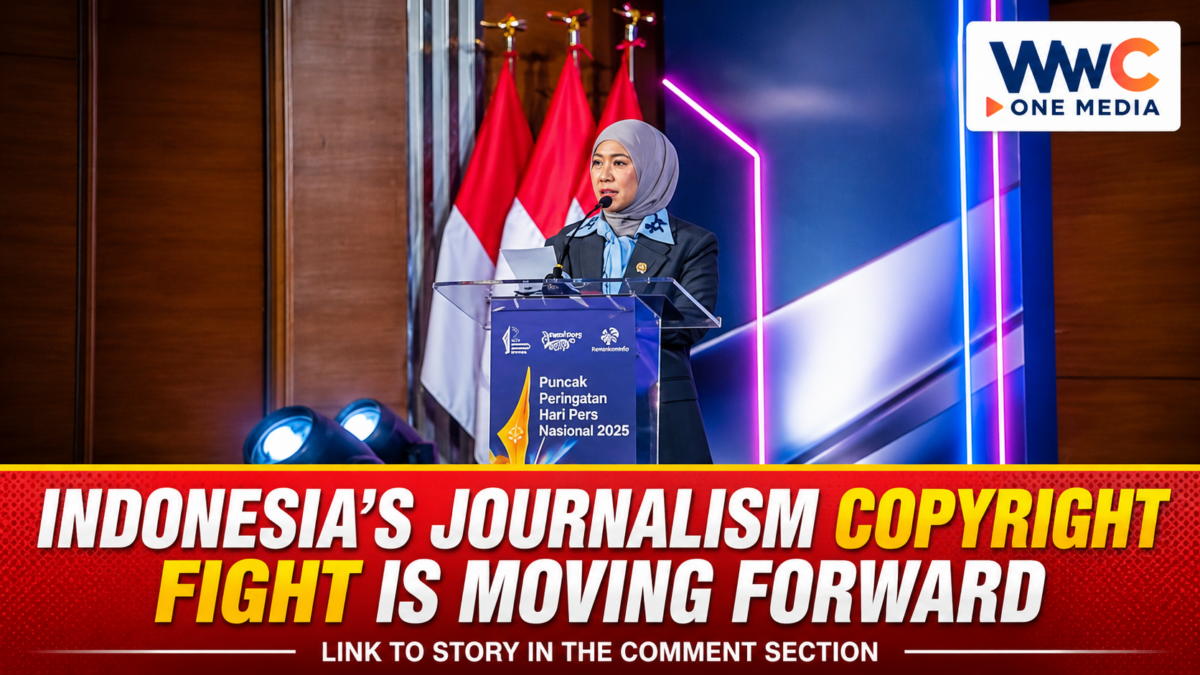
Indonesia’s Ministry of Communication and Digital Affairs has already held discussions with industry participants about copyright governance in the AI era. In a July 29, 2026 ministry statement, Deputy Minister Nezar Patria said the government was gathering views on journalistic protection, AI use and possible cooperation models between digital platforms and media companies.
The ministry described the discussion as unresolved and said no conclusion had been reached at that stage. It identified several competing interests: copyright protection, the sustainability of the media industry and legal certainty for digital platforms.
That position suggests the government is considering more than one possible approach. Licensing agreements between individual companies, collective rights-management arrangements and other compensation structures may all require consideration.
WWC has also reported on the proposed Philippine copyright framework for AI-created material. Although the Philippine proposal concerns a different legal question, it illustrates why AI-related copyright rules increasingly need to distinguish between human-created work, AI-assisted production and the material used by AI systems.
Indonesia already has rules for AI-assisted journalism
Copyright protection is only one part of the issue. Indonesia’s Press Council adopted Regulation No. 1/Peraturan-DP/I/2025, establishing guidelines for the use of artificial intelligence in journalistic work.
The regulation took effect on January 22, 2025. It allows news organisations to use AI applications but requires human control throughout the journalistic process.
It also places responsibility on the media company for journalism produced using AI. News organisations must check and verify information, images, audio, video and other material obtained through AI tools.
The rules also address transparency. Significant AI involvement in a journalistic work must be clearly disclosed, while AI-generated images or human representations may require specific labelling and consent.
These provisions concern how journalism is produced and published. They do not, by themselves, establish a complete system for charging AI companies that use existing news archives.
That separation is important. A newsroom can comply with rules governing its own use of AI while still facing questions about whether outside platforms may commercially reuse its published content.
What the debate could mean for media businesses
A clearer copyright framework could give publishers a stronger basis for negotiating content licences and protecting commercially valuable archives.
For smaller media organisations, this could be particularly significant. They may not have the resources to negotiate individually with large technology companies or monitor every use of their material across digital platforms.
A collective licensing system could potentially reduce those barriers, but it would require clear rules on representation, ownership, distribution and accountability. Individual business-to-business agreements could offer another option, although their effectiveness would depend on the bargaining position of each publisher.
There is also a public-interest consideration. Excessively broad restrictions could make it harder for researchers, educators and the public to quote or discuss reporting. A workable law must protect original journalism without turning ordinary access to information into an unnecessary legal obstacle.
The commercial pressures facing news organisations are not limited to copyright. WWC’s coverage of Ayala’s long-running support for Philippine business journalism explored the importance of sustaining professional reporting as audience habits and digital distribution continue to change.
The wider media environment also depends on reliable publishing infrastructure. A recent cyberattack that disrupted Allied Media’s newspaper production showed how operational disruptions can affect the delivery of journalism itself.
Copyright protection may help preserve the economic value of reporting, but it cannot replace sustainable advertising, subscriptions, investment and responsible distribution.
What happens next
The immediate focus is the Copyright Bill’s legislative discussion. Lawmakers and the government must determine whether the proposed changes can be completed in December or whether the work will continue into the 2027 legislative programme.
For media companies, the most important details to watch are the final definition of protected journalistic works, the treatment of commercial AI use, licensing requirements and any framework for collecting and distributing compensation.
Until the revised law is approved and its implementing rules are established, publishers should not assume that a new universal AI royalty mechanism is already operational.
Indonesia’s policy direction is becoming clearer: journalistic content has economic value and deserves meaningful protection. The difficult part is translating that principle into rules that can be enforced, applied fairly and understood by both publishers and technology companies.
Frequently asked questions
1. Has Indonesia passed a new law requiring AI companies to pay royalties for news content?
No. The Copyright Bill remains under legislative discussion. The proposed changes have not yet become a new enacted law.
2. What is Indonesia’s current copyright law?
The existing framework is Law No. 28 of 2014 on Copyright. It establishes rights for creators and provides rules covering economic rights, licensing and royalties.
3. Does Indonesia already regulate AI use in journalism?
Yes. Press Council Regulation No. 1/Peraturan-DP/I/2025 sets requirements for human oversight, verification, responsibility and transparency when AI is used in journalistic work.
4. What is the main concern for news publishers?
Publishers want clearer protection and compensation arrangements when their reporting, photographs and archives are used commercially, including in AI systems.
5. When could Indonesia’s Copyright Bill be completed?
The House’s Legislation Body identified December 2026 as a target for completing discussions, with the possibility that the bill could continue into the 2027 priority legislative programme.