
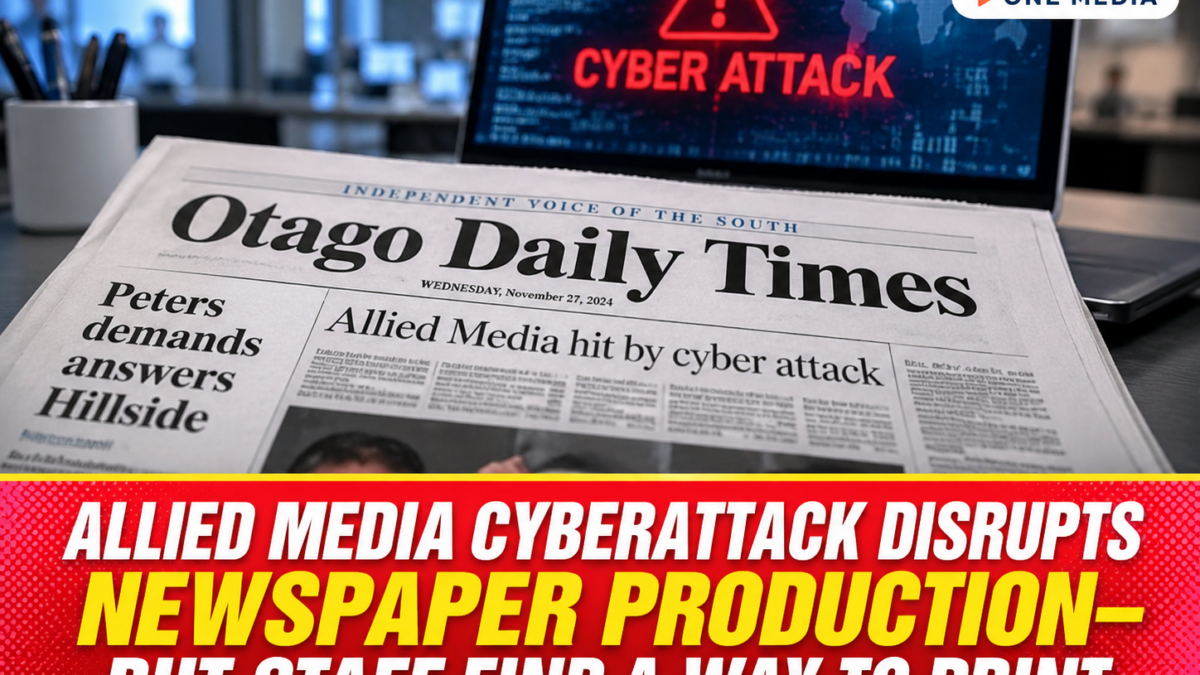
A cyberattack on New Zealand media company Allied Media disrupted production-critical systems on November 24, 2026, forcing the publisher to change how its newspapers were prepared. By the following day, staff had managed to get the Otago Daily Times into print by laying out every page manually, while three community titles faced a one-day delivery delay.
The incident highlights a business risk that extends beyond lost access to computers: when a publisher’s production infrastructure stops working, the disruption can reach the printing schedule, advertisers, subscribers and communities that rely on local reporting. Allied Media says there is currently no evidence that customer or staff information was accessed, but restoration work remains underway.
Allied Media cyberattack hits the systems behind print production
Allied Media disclosed that the attack occurred early on Tuesday, November 24, and disrupted several production systems. In a follow-up notice published November 25, the company said the attack had taken out its production-critical servers.
The immediate effects were visible in the publication schedule. The company said the Blenheim Sun, Southern Rural Life and The Ensign, which had been due on Wednesday, November 25, would instead be delivered on Thursday, November 26.
The Otago Daily Times faced a different outcome. Rather than abandon the scheduled edition, staff used a manual workaround to prepare its pages for printing. The company said every page was laid out by hand.
That response shows how a publishing operation can depend on systems that readers rarely see. Editorial content must pass through production processes before it becomes a finished newspaper. If those systems become unavailable, staff may need alternative methods to complete the work.
The company has not publicly identified the technical entry point, the type of malicious software involved or the identity of whoever carried out the attack.
A manual workaround kept the daily newspaper in print
The manual production effort was more than a technical workaround. It was a continuity measure that helped preserve the newspaper’s publication schedule despite the loss of critical systems.
Allied Media said the Otago Daily Times had missed only two publishing days in its 165-year history. The company was founded in 1861, according to its corporate history.
The November 25 update also included a statement from chief executive Grant McKenzie thanking staff who helped produce the edition. He said employees across the business stayed late to make the publication possible.
For a newspaper company, continuity is not simply a question of keeping its website online. Print production involves editorial preparation, page design, pre-press processes, printing and distribution. A disruption at one stage can affect the entire chain.
The incident does not establish that manual production is a sustainable substitute for normal systems. It demonstrates that employees were able to use an alternative process to get one edition out while technical recovery continued.
What the company has—and has not—confirmed about data
The data question remains separate from the production disruption.
In its November 24 notice, Allied Media said it had no evidence at that stage that customer information had been accessed. Its November 25 update broadened the statement to say there was no evidence, based on what the company knew at that point, that customer or staff data had been accessed.
That wording is important. It describes the company’s current findings, not a final forensic conclusion that no information was accessed.
The company said it was working with IT specialists to assess the impact and restore its systems. It did not publish a confirmed account of the attack method, the number of affected servers, whether data was copied or the full technical scope of the incident.
There is also no public evidence in the notices reviewed that the incident involved ransomware, a ransom demand or a confirmed data leak. Those descriptions should not be treated as facts without further disclosure.
Other organisations have faced similar questions about the difference between system access and information exposure. WWC’s report on Bell Financial’s disclosed cyber incident and possible client-data access explains why an organisation’s operational status and the security of customer information are separate issues.
Why a media company’s technology is a business-critical asset
Allied Media describes itself as an independent media company with 24 newspapers, five magazines and two events. Its operations extend beyond reporting and editing to include print, digital services, distribution, events and commercial work.
That breadth helps explain why a production-system outage can affect more than one publication. Shared technology and production infrastructure can support multiple titles and business functions. A problem in a central system may therefore have consequences across a wider publishing operation.
The incident also raises a broader question for media businesses: how much of the publishing process depends on systems that may become unavailable at the same time?
Cybersecurity is often discussed in terms of personal information, account credentials and financial loss. For publishers, operational availability is another critical concern. A company may have no confirmed evidence of data exposure and still face missed deadlines, disrupted advertising schedules, delayed distribution and additional recovery costs.
A separate WWC report on Japan’s Fugaku supercomputer cyberattack examines how unauthorised access can affect the availability of important digital infrastructure. The systems are different, but both cases illustrate why recovery planning must account for the services an organisation needs to keep operating.
New Zealand’s cyber-risk figures provide wider context
The attack comes as New Zealand’s National Cyber Security Centre reports a rise in cybersecurity incidents handled during the third quarter of 2026.
The centre recorded 1,694 incident reports between July and September, compared with 1,129 in the previous quarter. Of those reports, 179 were assessed as potentially nationally significant and required specialist technical support. The remaining 1,515 did not require that level of support.
The figures provide context for the country’s wider cyber-risk environment. They do not establish that Allied Media’s incident is connected to any other attack, nor do they identify the method or perpetrator in this case.
For media organisations, the lesson is that cyber resilience must include more than perimeter security. Recovery arrangements, backups, alternative production workflows, access controls and clear communication plans can all influence how quickly a publisher restores its services.
WWC has also examined the distinction between alleged intrusions and confirmed data breaches in its coverage of cybersecurity investigations involving Philippine government agencies. The same reporting discipline applies here: an attack on systems does not automatically prove that personal information was taken.
What happens next
Allied Media says its priority is restoring production-critical systems while limiting further disruption to its daily publishing schedule. It cautioned that recovery must be handled carefully and may take time.
The next important disclosures would clarify which systems have been restored, whether normal production has resumed and whether the company’s investigation changes its current assessment of possible data access.
The company has not announced a final recovery date or provided a detailed technical account of the attack. Its public notices also do not establish whether the disruption will create lasting financial or operational effects.
For readers and advertisers, the immediate issue is publication continuity. For the wider media industry, the incident is a reminder that journalism depends not only on reporters and editors, but also on the systems that turn their work into a product communities can receive.
Frequently Asked Questions
What happened to Allied Media on November 24, 2026?
The company said a cyberattack disrupted several production systems and took out production-critical servers.
Which newspapers were affected?
Allied Media said the Blenheim Sun, Southern Rural Life and The Ensign would be delivered one day late. The Otago Daily Times still went to print after staff manually laid out its pages.
Was customer or staff information stolen?
Allied Media said it had no evidence, based on what it knew as of November 25, that customer or staff data had been accessed. Its investigation was continuing.
Has Allied Media identified the attackers?
The company’s public updates reviewed for this report do not identify an attacker or explain the technical method used.
When will Allied Media return to normal operations?
The company has not announced a firm recovery date. It said restoration work was continuing and would be carried out carefully.










