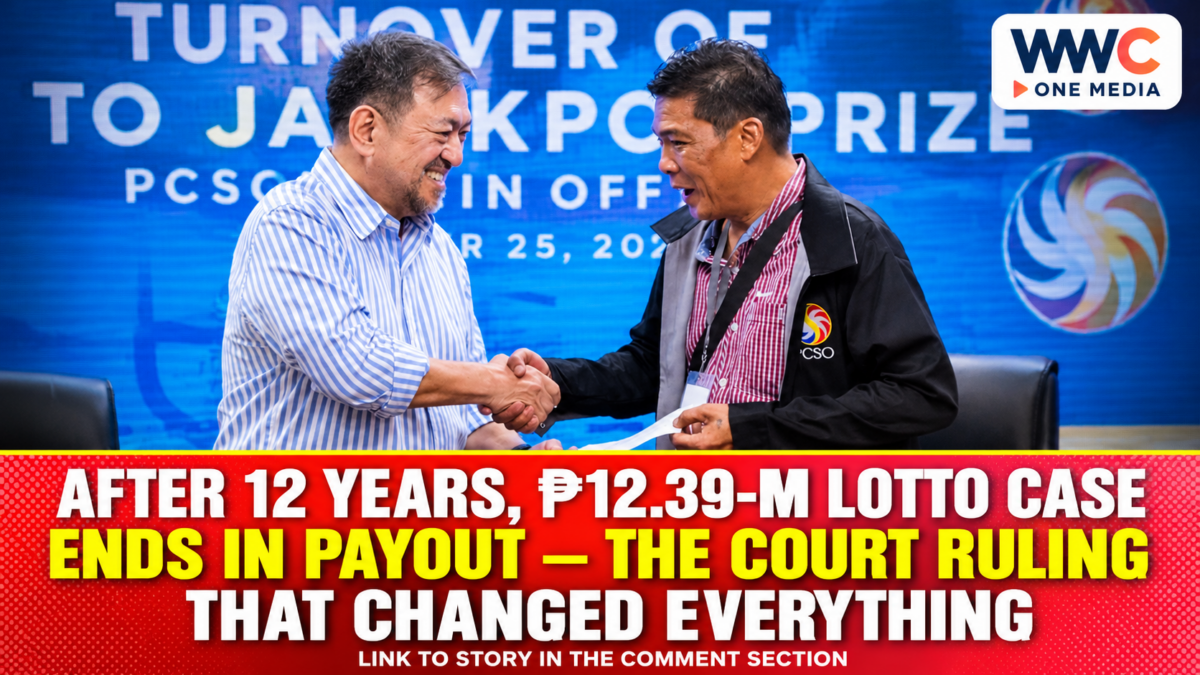
MANDALUYONG CITY, Philippines — November 26, 2026 — Antonio F. Mendoza has reportedly received a ₱12,391,600 check from the Philippine Charity Sweepstakes Office (PCSO), closing a dispute over a Lotto 6/42 jackpot drawn on October 2, 2014. The payment follows a Supreme Court ruling that found he had established his right to the prize despite his winning ticket being partially blackened.
The case is significant beyond the amount involved. It tested whether a damaged physical ticket automatically defeats a prize claim when other evidence can establish that the bettor selected the winning combination. The Supreme Court’s answer was that the circumstances and supporting records could be considered, and that PCSO remained obligated to pay the winner.
The reported handover came more than a decade after the draw and more than three years after the Supreme Court issued its decision. The ruling provides a useful explanation of the difference between a ticket as proof of a bet and the actual selection of the winning numbers.
Lotto jackpot payout followed a Supreme Court order
The Supreme Court’s March 13, 2023 decision in Philippine Charity Sweepstakes Office v. Antonio F. Mendoza, G.R. No. 257849, denied PCSO’s petition challenging the lower courts’ rulings in Mendoza’s favour.
The Court ordered PCSO to pay him ₱12,391,600 as the Lotto 6/42 jackpot prize for the October 2, 2014 draw. It also ruled that the amount would earn legal interest of 6% per year from the finality of the decision until full payment.
A later public information release from the Supreme Court summarized the ruling and the circumstances behind the claim. The November 25, 2026 check turnover has been reported by the Philippine News Agency, but the specific PCSO payment announcement and COA authorization were not available in the primary records reviewed for this article.
The distinction matters: the court order establishes the legal obligation to pay. A separate payment record is what would independently document the actual release and receipt of the money.
How the winning ticket became partially unreadable
The court decision records that Mendoza placed three Lotto 6/42 bets through the “lucky pick” option at an outlet in Barangay Dacanlao, Calaca, Batangas, on October 2, 2014.
The next morning, he learned that one of his combinations had won. His granddaughter had crumpled the ticket. When his daughter tried to straighten it using an iron with a piece of cloth covering it, the ticket became blackened.
Only portions of the printed information remained visible, including the first two digits of each of the three combinations, the outlet information, the draw date, the purchase date and part of the purchase time.
Mendoza brought the damaged ticket to PCSO on October 5, 2014, and later submitted an affidavit explaining what happened. PCSO informed him in an October 20 letter that the prize could not be awarded because the damaged ticket could not be validated.
The dispute then moved through hearings, administrative discussions and court proceedings. The case eventually became a legal question about what evidence could establish ownership of a winning combination when the original ticket could no longer be fully read.
Why the Supreme Court rejected a strict ticket-only approach
PCSO argued that its rules required presentation and surrender of the winning ticket. The agency maintained that paying a jackpot without a fully valid ticket could undermine the integrity of lottery operations.
The Supreme Court considered the wording of the PCSO rules and found ambiguity in whether payment depended absolutely on presentation of a complete physical ticket or on proof that the bettor had selected the winning combination.
The Court treated the ticket as evidence of the numbers selected, rather than the only possible way to prove that selection. It also considered the circumstances surrounding the damaged ticket and supporting evidence, including PCSO records discussed in the decision.
Those records included certifications concerning the October 2, 2014 draw and the transaction at the outlet where Mendoza placed his bets. The Court concluded that the evidence sufficiently established that he had selected the winning six-number combination.
The ruling does not mean that every damaged or missing ticket will qualify for payment. It turned on the evidence presented in this particular case and the Court’s interpretation of the applicable Lotto 6/42 rules.
What the case means for ordinary lotto players
PCSO’s 2025 Citizen’s Charter sets out a formal process for jackpot claims, including ticket validation, preparation of a disbursement voucher and transmission of the approved documents to the Treasury Department for check preparation.
The charter also lists the normal requirements and steps for a jackpot prize claim. These procedures underline why players should protect their tickets and follow the agency’s instructions. Mendoza’s case was resolved through litigation and a final court ruling; it should not be understood as a routine alternative to the standard claim process.
The decision is also a reminder that records matter. In Mendoza’s case, the Court considered the available evidence as a whole rather than relying only on the legibility of the physical ticket.
WWC has previously examined the role of lottery operators and public-benefit funding in its coverage of PCSO’s international recognition and its charitable mandate. The present case concerns an individual prize claim, but both subjects involve public confidence in the integrity and administration of lottery operations.
A reminder about protecting tickets and keeping proof
The practical lesson for players is straightforward: keep a winning ticket in a safe, dry place, avoid exposing it to heat or liquids, and follow PCSO’s published claim requirements. The warning printed on tickets and the agency’s validation process are designed to protect both legitimate winners and the integrity of the lottery.
Players should also avoid posting photographs of tickets online before claiming a prize. A ticket can contain information that should be kept private, and public disclosure may create unnecessary risks.
Other lottery stories have shown how disputes can arise even when a ticket is intact. WWC previously reported on a Hong Kong Mark Six jackpot dispute involving colleagues who allegedly pooled money for a ticket. That case is separate from Mendoza’s and involves different facts, but it illustrates why clear records of ticket ownership and group contributions can matter.
For players outside the Philippines, WWC has also covered two Singapore TOTO players sharing a multimillion-dollar jackpot, another example of how official draw and prize records establish the basis for a payout.
What happens next
The Supreme Court’s decision resolved the legal dispute over Mendoza’s entitlement to the 2014 jackpot. The reported November 25 handover indicates that the payment has now been carried out, although the PCSO payment record and COA authorization should be obtained to complete the primary-document trail.
The remaining public-interest question is whether PCSO will publish a formal statement explaining the payment and confirming the amount released, including how the legal interest ordered by the Court was handled.
For lottery players, the broader lesson is that a damaged ticket can create a difficult claim, but the legal outcome depends on the specific evidence and applicable rules. Mendoza’s victory came through a court process, not an automatic exception to ticket-validation requirements.
Frequently asked questions
How much did Antonio Mendoza win?
The Supreme Court ordered PCSO to pay him ₱12,391,600 as the Lotto 6/42 jackpot prize for the October 2, 2014 draw.
Why was Mendoza’s lotto ticket damaged?
The Supreme Court decision records that the ticket was crumpled by his granddaughter and later became blackened when his daughter tried to straighten it using an iron with a piece of cloth covering it.
Did the Supreme Court order PCSO to pay him?
Yes. In its March 13, 2023 decision in G.R. No. 257849, the Court ordered PCSO to pay the ₱12,391,600 jackpot, with 6% annual legal interest from the decision’s finality until full payment.
Does a damaged lotto ticket always qualify for a jackpot claim?
No. Mendoza’s case depended on the specific evidence and the Court’s interpretation of the PCSO rules. It does not create an automatic guarantee for every damaged-ticket claim.
What should lotto winners do with their tickets?
Winners should protect their tickets from heat, water, oil and damage, keep them secure, and follow PCSO’s official validation and prize-claim procedures.