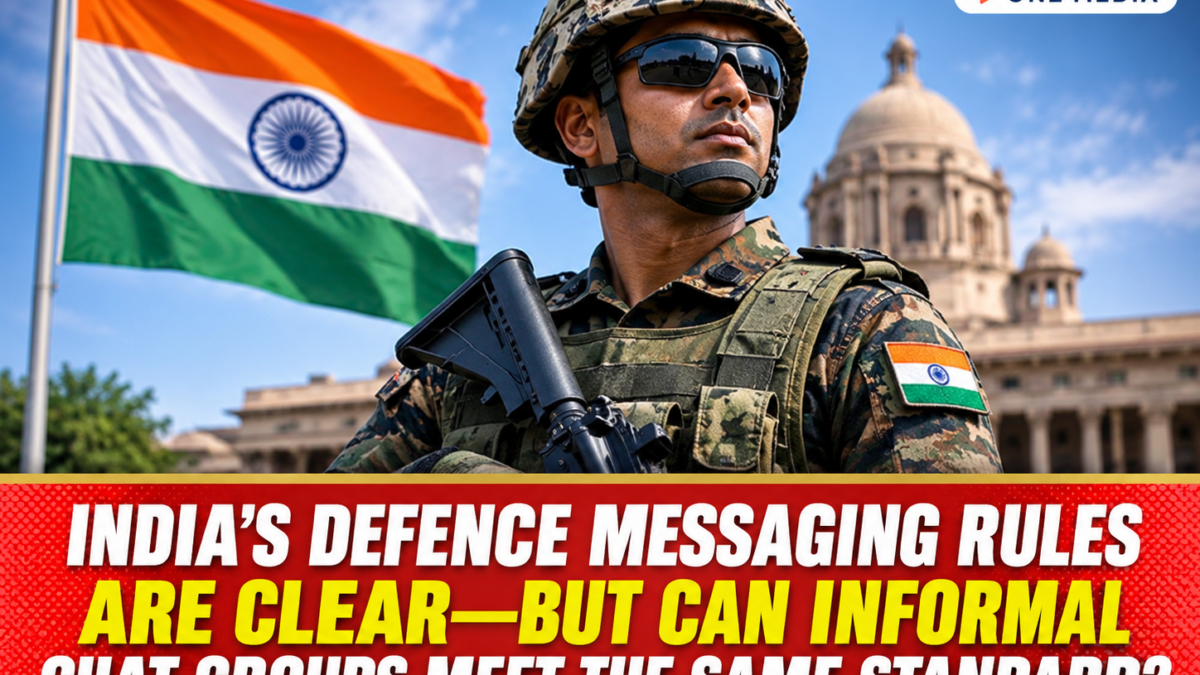
India’s government has maintained formal restrictions on how officials handle classified information through public messaging services, with a February 2022 security memorandum warning against using platforms such as WhatsApp and Telegram for sensitive official communications. Separate Ministry of Defence announcements show that the Indian Army has developed dedicated messaging systems intended for communication within its own networks.
Those records provide an important context for renewed questions about the security of messaging groups used by defence and government personnel. They also highlight a distinction that matters in any cybersecurity report: a warning about insecure communications is not proof that a data breach has occurred.
The issue is larger than one application. Secure messaging in government depends on who is permitted to communicate, what information is being shared, how devices and accounts are controlled, and whether a communication channel is approved for the sensitivity of the material.
Secure messaging begins with information classification
A Government of India office memorandum dated February 24, 2022, issued by the Ministry of Skill Development and Entrepreneurship, addressed the use of public-domain messaging platforms by government officers and officials.
The memorandum specifically named WhatsApp and Telegram and warned that officials were using such services to communicate classified information, including by sending photographs or scanned copies of documents.
It described that practice as a violation of information-security instructions under the Manual of Departmental Security Instructions and the National Information Security Policy Guidelines.
The document also distinguished between four information classifications: Top Secret, Secret, Confidential and Restricted.
Its instructions state that Top Secret and Secret information must not be shared over the internet. Such information is to be shared only through a closed network with leased-line connectivity and the specified encryption mechanism.
For Confidential and Restricted information, the memorandum identifies conditions under which internet-based communication may be used, including commercial AES 256-bit encryption. It also recommends government email or government instant-messaging platforms for communication involving those classifications.
The underlying principle is straightforward: the convenience of a messaging application does not determine whether it is suitable for official information. The classification of the information and the security of the channel must determine how it is handled.
Why the Indian Army developed its own messaging systems
The Ministry of Defence has publicly documented efforts to establish communication tools designed for military use.
In October 2020, the Indian Army announced the Secure Application for Internet, or SAI. The official announcement described it as an Android application supporting secure voice, text and video calls over the internet.
The Ministry said the application used an end-to-end encrypted messaging protocol and local in-house servers. It also stated that SAI had been vetted by a CERT-In-empanelled auditor and the Army Cyber Group.
A separate announcement in December 2021 introduced ASIGMA, or Army Secure IndiGeneous Messaging Application. The Army described it as a web-based application developed in-house by officers of the Corps of Signals.
The announcement said ASIGMA was being deployed on the Army’s internal network as a replacement for the Army Wide Area Network messaging application, which had been in service for 15 years.
It also identified features including multi-level security, message prioritisation and tracking, and a dynamic global address book.
These announcements demonstrate that secure communication has been treated as an institutional requirement, not simply a matter of asking personnel to choose a preferred commercial application.
They do not, however, establish that every communication by every member of the armed forces takes place through one system, or that the existence of a dedicated application eliminates all cybersecurity risks.
The weak point can be access, not just encryption
Encryption protects information while it is transmitted or stored under particular technical arrangements. But it does not, by itself, establish that every person inside a group should have access to the conversation.
A messaging group can include legitimate participants and still create risks if its membership is not regularly reviewed. A number may be unfamiliar, a device may be shared, an account may be compromised, or a participant may no longer be authorised to receive the information being discussed.
This is why identity verification, account security and membership management matter alongside encryption.
For an organisation, the practical questions include whether administrators know who each participant is, whether membership is tied to an official role, how quickly access can be withdrawn and whether group conversations are permitted to contain operational or classified material.
These are general security considerations, not claims that a particular Indian defence group was compromised.
The same distinction applies to wider government cybersecurity incidents. WWC has examined how authorities distinguish hacking claims from confirmed incidents in its report on alleged attacks involving Philippine government agencies. A claim that information has appeared online must be investigated before it can be treated as proof of a new breach.
Messaging risks extend beyond military organisations
The security of messaging platforms is also a concern for companies, public agencies and ordinary users.
A compromised account can be used to impersonate a trusted contact, distribute malicious files or persuade another person to disclose information. Even without access to classified material, a fraudulent message can create financial, privacy or operational consequences.
India’s Ministry of Home Affairs has separately warned businesses and finance professionals about WhatsApp account-takeover attempts involving malicious files disguised as account statements and regulatory communications. The official advisory urged recipients not to open files from unknown or unverified sources and recommended reviewing linked devices.
This is a different threat from unauthorised access to a government messaging group, but it illustrates why account protection cannot depend on the apparent identity of the sender alone.
For readers in the Philippines, the broader lesson is also relevant to government and workplace communication. WWC’s coverage of reported data-breach notifications involving Philippine government agencies explains why institutions must establish what information was exposed before making claims about the scale or impact of an incident.
The risks are not confined to government networks. WWC has also examined a separate European Commission cybersecurity incident involving personal information on an online learning platform, showing why organisations need clear access controls and incident-response procedures even when the affected service is not a classified system.
What happens next
The official records reviewed for this article establish India’s long-standing communication-security guidance and the Army’s development of dedicated messaging systems. They do not independently confirm the details of the specific November 2026 allegations about unauthorised participants in defence-related messaging groups, nor do they establish whether a defence data breach occurred.
Those questions require a direct statement or document from the responsible security agency, the Ministry of Defence or another competent authority. Any reported audit, removal of group members or investigation should be described only when the underlying official record is available.
For institutions, the broader policy challenge remains clear: communication security requires more than an encrypted application. It requires appropriate classification, authorised users, secure devices, verified identities and consistent enforcement of rules governing what personnel may share.
For the public, the distinction between a suspected intrusion, a precautionary advisory and a confirmed data breach is essential. Treating those as interchangeable can create unnecessary alarm and obscure what authorities have actually established.
Frequently asked questions
Does India allow government officials to use WhatsApp for classified information?
The February 24, 2022 government memorandum warns against using public-domain messaging platforms such as WhatsApp and Telegram for classified official communications. It sets out different handling requirements based on the information’s classification.
What is the Indian Army’s SAI application?
SAI stands for Secure Application for Internet. The Indian Army announced it in October 2020 as an Android application supporting encrypted voice, text and video communication.
What is ASIGMA?
ASIGMA stands for Army Secure IndiGeneous Messaging Application. The Army announced it in December 2021 as an in-house web-based messaging system deployed on its internal network.
Does encryption guarantee that a messaging group is secure?
No. Encryption is one protection, but organisations must also manage group membership, account access, device security and the classification of information shared.
Has a defence data breach in India been officially confirmed in the records reviewed here?
No. The official documents reviewed establish communication-security rules and dedicated military messaging initiatives. They do not confirm the specific November 2026 breach allegations.