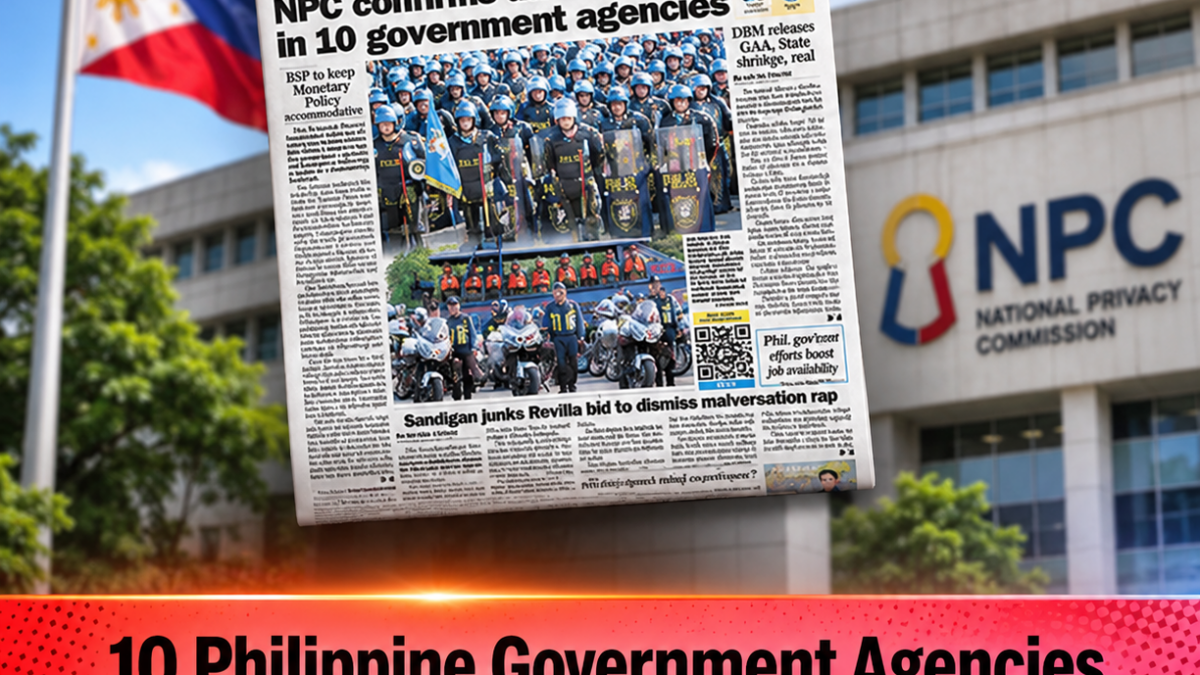
MANILA, Philippines — November 12, 2026 — The National Privacy Commission (NPC) is investigating personal data breach notifications involving 10 Philippine government agencies, raising concerns about the security of sensitive information held by institutions responsible for taxes, public services, business regulation and national security.
The privacy watchdog confirmed on November 10 that it had received breach notifications from 10 government agencies and institutions following a series of reported cybersecurity incidents.
The disclosures include the Department of Information and Communications Technology (DICT), Bureau of Internal Revenue (BIR), Securities and Exchange Commission (SEC), Philippine Coast Guard (PCG), and Department of Trade and Industry (DTI).
Other agencies on the list include the Presidential Commission on Good Government (PCGG), Department of Labor and Employment (DOLE), Philippine Amusement and Gaming Corporation (PAGCOR), Department of Justice (DOJ), and Department of Science and Technology’s Philippine Institute of Volcanology and Seismology (DOST-PHIVOLCS).
The development has intensified questions about how government institutions protect the personal information of millions of Filipinos who rely on public services and digital platforms.
However, authorities have not yet announced a consolidated number of affected individuals or confirmed that all 10 incidents involved the same type of unauthorized access.
The NPC is evaluating the notifications to establish what happened, what information may have been exposed and whether additional regulatory action is necessary.
Which 10 Philippine Government Agencies Reported Data Breach Incidents?
According to the NPC’s November 10 announcement, the following government institutions submitted personal data breach notifications:
- Presidential Commission on Good Government (PCGG) – The agency responsible for recovering ill-gotten wealth and investigating assets associated with corruption during the Marcos regime.
- Department of Information and Communications Technology (DICT) – The government department responsible for information and communications technology development, digital infrastructure and cybersecurity coordination.
- Department of Labor and Employment (DOLE) – Specifically, its Bureau of Local Employment, which handles employment-related programs and information.
- Bureau of Internal Revenue (BIR) – The country’s tax collection agency, which maintains sensitive taxpayer information.
- Philippine Amusement and Gaming Corporation (PAGCOR) – The state-owned gaming regulator and operator responsible for gaming-related regulatory and commercial activities.
- Department of Justice (DOJ) – Specifically, its Office for Alternative Dispute Resolution.
- Securities and Exchange Commission (SEC) – The agency responsible for regulating corporations, securities markets and registered business entities.
- Philippine Coast Guard (PCG) – The maritime agency responsible for maritime safety, security and law enforcement functions.
- Department of Trade and Industry (DTI) – The government department responsible for trade, industry development and consumer protection.
- Department of Science and Technology – Philippine Institute of Volcanology and Seismology (DOST-PHIVOLCS) – The scientific institution responsible for monitoring earthquakes, volcanic activity and related geological hazards.
The NPC emphasized that receiving breach notifications is part of the regulatory process established under the Data Privacy Act of 2012.
Each report must be assessed individually, meaning that the involvement of 10 agencies does not automatically establish that every institution experienced the same type or severity of cybersecurity incident.
BIR Admits Some Taxpayer Profile Information May Have Been Exposed
One of the most concerning developments involves the Bureau of Internal Revenue.
In an advisory issued on November 10, the BIR disclosed that certain taxpayer profile information may have been exposed following cybersecurity incidents reported on November 6 and 7.
The agency said it immediately began preserving evidence, preventing further exposure and investigating the possible extent of the incident.
However, the BIR made an important distinction regarding its internal systems.
Its initial findings indicated that taxpayer filing and payment records were not compromised. The agency also said that no taxpayer information had been modified or lost and that the integrity of its internal database infrastructure remained intact.
The bureau is coordinating with the Cybercrime Investigation and Coordinating Center (CICC) and the DICT’s National Computer Emergency Response Team (NCERT) to conduct a forensic investigation.
The investigation is intended to establish the source of the incident and determine which taxpayer information may have been exposed.
For ordinary Filipinos, this development deserves attention because taxpayer profiles can contain personal and identifying information that criminals might attempt to exploit through fraudulent communications.
The BIR has advised taxpayers to update account credentials, activate multi-factor authentication, monitor account activity and use only official BIR channels for transactions.
SEC Confirms Its Digital Platform Users May Have Been Affected
The Securities and Exchange Commission also confirmed a security incident involving accounts associated with its digital platforms.
In its November 9 advisory, the SEC warned that certain user information may have been exposed through malware infection or unauthorized access by a third-party threat actor involving devices used to access its platforms.
The agency identified potentially exposed information that could include:
- Full names
- Usernames
- Email addresses
- Mobile numbers
- Dates of birth
- Gender
- Residential addresses
- Tax Identification Numbers (TINs)
The SEC clarified that its initial assessment found no evidence that passwords stored in its databases had been leaked or that company records had been compromised.
It also said that its internal databases remained intact and that its technical response teams had implemented containment and preventive measures.
The commission advised potentially affected users to change passwords, scan their devices for malware and remain cautious of unexpected messages requesting sensitive information.
This distinction matters because a possible exposure of personal profile information does not necessarily mean that an individual’s SEC account has been taken over or that corporate records have been stolen.
Nevertheless, exposed contact details and identification information can still create opportunities for impersonation and targeted scams.
NPC Warns Government Agencies That Outsourcing Does Not Remove Responsibility
The National Privacy Commission has also emphasized that government agencies cannot avoid accountability simply because their technology infrastructure or data-processing operations involve external service providers.
Under Section 21 of Republic Act No. 10173, or the Data Privacy Act of 2012, personal information controllers remain responsible for personal information under their control or custody, including information transferred to third parties for processing.
This means government agencies must ensure that appropriate security measures are maintained even when outside contractors or technology providers handle their information systems.
NPC Deputy Privacy Commissioner and spokesperson Atty. Jose S. Belarmino II explained that submitting a breach notification is only one part of an agency’s obligations.
Government institutions must also address vulnerabilities, mitigate possible harm and notify affected individuals when the applicable notification requirements are met.
The NPC’s Compliance and Monitoring Division is reviewing the notifications and will prepare findings and recommendations for submission to the Commission En Banc.
The Commission En Banc will then determine the appropriate regulatory action based on the circumstances of each incident.
The process is important because the filing of a notification does not automatically establish legal liability or prove that an agency failed to comply with every requirement of the Data Privacy Act.
Reports of Wider Government Data Leaks Raise Additional Questions
The latest disclosures come after cybersecurity monitoring group Deep Web Konek reported alleged data exposures involving as many as 23 local institutions.
Its monitoring report covering November 5 to 7 described alleged leaks involving government departments, law enforcement and military-related organizations, educational institutions and private-sector companies.
The group cited potentially exposed information including personal identification details, taxpayer and corporate registration records, employee information, payroll data, student files and operational records.
Among the organizations mentioned in the broader report were the National Power Corporation, Mactan Electric Company and LBC Express.
However, these broader allegations should not be confused with the 10 breach notifications officially acknowledged by the NPC.
The authenticity and extent of individual datasets have not been independently established in every case.
The NPC has also not confirmed that all the reported incidents are connected or that the same threat actors were responsible.
This distinction is essential when assessing cybersecurity reports because a claim that information is being offered on an underground forum is not, by itself, proof that the advertised information came from the organization being named.
Why the Data Breach Reports Matter to Ordinary Filipinos
Government agencies hold some of the most sensitive information belonging to citizens.
Tax records, employment information, business registrations, identification details and other personal records are used in everyday transactions involving government services.
If unauthorized individuals obtain such information, the consequences could extend beyond the original cybersecurity incident.
Potential risks include:
Identity theft. Criminals may attempt to use exposed personal information to impersonate individuals or create fraudulent accounts.
Phishing and text scams. Scammers could use accurate personal details to make fraudulent messages appear to come from the BIR, SEC or another government agency.
Social engineering. Attackers may pretend to be government personnel and use information obtained from exposed records to convince victims to reveal additional details.
Fraudulent transactions. Depending on the information involved, criminals could attempt to exploit exposed personal data in financial or commercial transactions.
These are potential risks, not confirmation that such crimes have already occurred as a result of the 10 reported incidents.
The actual level of risk will depend on the type of information involved, the number of affected individuals and whether unauthorized parties obtained or misused the data.
What Filipinos Should Do to Protect Their Personal Information
While government investigations continue, the public should take reasonable precautions against possible phishing attempts and identity-related scams.
The NPC has reminded citizens to be careful when responding to unsolicited messages, clicking unfamiliar links or downloading attachments from unknown senders.
Filipinos should also consider the following precautions:
- Update important account passwords. Prioritize accounts that may contain financial, tax or identifying information. Avoid reusing the same password across multiple services.
- Enable multi-factor authentication. Use additional verification wherever available, particularly for email, financial and government-related accounts.
- Verify government communications. If a message claims to come from the BIR, SEC or another agency, check the official website or contact the institution through its published channels.
- Never disclose passwords or security PINs. Government agencies and legitimate service providers should not ask individuals to reveal their confidential login credentials through unsolicited messages.
- Monitor suspicious account activity. Watch for unexpected password-reset requests, unfamiliar login notifications and suspicious transactions.
- Report suspected scams. Preserve suspicious messages and report incidents through the appropriate government or law-enforcement channels.
People should also remember that changing a password cannot reverse the exposure of information such as a name, address or TIN. Those details require continued caution if they may have been compromised.
Philippine Government Cybersecurity Faces a Bigger Test
The reports involving 10 government institutions highlight a wider challenge facing the Philippines as more public services become dependent on digital infrastructure.
Government digitalization can make transactions faster, improve access to public services and reduce administrative costs.
However, these benefits also increase the importance of protecting the information collected and stored by public institutions.
WWC One Media previously examined the country’s cybersecurity investment challenges in its report, Philippine Organizations Keep Cybersecurity Costs Low Despite Rising Data Breach Risks.
The report explored the financial pressures organizations face when balancing cybersecurity spending against other operational priorities.
The latest government disclosures demonstrate why cybersecurity cannot be treated as an optional technology expense.
It must be part of the planning, maintenance and daily operation of essential digital systems.
The issue also connects with ongoing efforts to modernize local government services. Cebu’s three-year digitalization roadmap, for example, emphasizes system protection, employee awareness and stronger safeguards for public information.
Read WWC One Media’s report: Cebu Launches Three-Year Digitalization Roadmap to Modernize Capitol Services — But Can It Protect Residents’ Data From Cyberattacks?.
The importance of government accountability is also highlighted by an earlier incident involving the Land Transportation Franchising and Regulatory Board.
In LTFRB Data Breach Confirmed — But the Biggest Question Is Still Unanswered, WWC One Media examined how a confirmed security incident can leave major questions unanswered about the information involved and the potential impact on affected individuals.
International developments provide another warning.
Singapore’s healthcare and telecommunications sectors have also faced recent disclosures involving customer information.
WWC One Media covered these developments in Doctor Anywhere Data Breach Exposes Singapore Users’ NRIC and Bank Account Details as M1 Is Also Hit.
These incidents are separate from the Philippine government cases, but they illustrate why data protection has become a regional concern.
The common lesson is that organizations holding sensitive personal information must be prepared to prevent unauthorized access, detect suspicious activity and respond effectively when incidents occur.
What Happens Next in the NPC Investigation?
The immediate priority is determining the circumstances surrounding each of the 10 notifications.
The NPC’s Compliance and Monitoring Division must assess the nature of the reported incidents, the potential impact on individuals and the actions taken by the agencies concerned.
Its findings and recommendations will then be submitted to the Commission En Banc for appropriate action.
Meanwhile, government agencies are expected to strengthen their security measures, address vulnerabilities and comply with applicable requirements for notifying affected individuals.
The public should also watch for further advisories from the BIR, SEC, DICT and other institutions involved.
At this stage, authorities have not announced a single consolidated figure for the number of affected Filipinos, nor have they established that all 10 incidents involved the same method of attack.