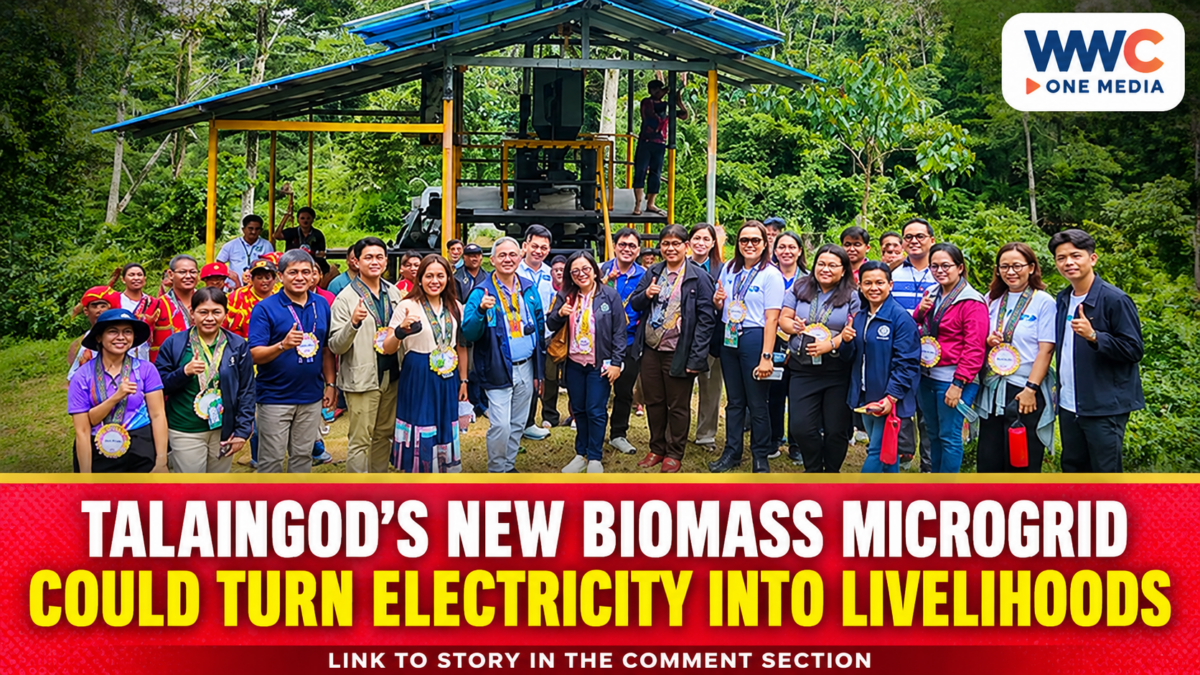
TALAINGOD, Davao del Norte, Philippines — Electricity in a remote Indigenous community is being positioned as more than a source of household lighting. In Sitio Tibucag, Barangay Dagohoy, a renewable-energy project is designed to help residents turn access to power into small businesses and additional sources of income.
The Department of Science and Technology (DOST) Region XI has established a biomass-powered microgrid in the Ata-Manobo community through its MICROGRIDTERPRISES in Geographically Isolated and Disadvantaged Areas (GIDAs) under the Community Empowerment through Science and Technology (CEST) program.
The initiative targets approximately 300 households in Tibucag. Its approach combines solar home kits for households scattered across the community with a community-based biomass gasifier that uses wood waste and agricultural residues to generate electricity.
The goal is to connect energy access with livelihood opportunities, allowing residents to explore small enterprises that would be difficult to operate without dependable power.
From agricultural waste to electricity
The Tibucag system uses a combination of renewable-energy technologies rather than relying on a single power source.
Solar home kits are intended for households spread across the village, while the biomass gasifier uses available organic materials, including wood waste, corn cobs and coconut husks.
The arrangement creates a practical link between local agricultural activity and electricity production. Materials that might otherwise be discarded can become inputs for the community’s energy system.
The Tibucag Farmers Association has an important role in this arrangement. The association helps generate the wood supply required by the gasifier and manages electricity consumption and payments among participating members and users.
This community-based arrangement is significant because a renewable-energy facility needs more than equipment to remain useful. It also requires an organized system for supplying fuel, managing consumption, collecting payments and maintaining the infrastructure.
Why electricity matters for small businesses
For households with regular electricity, a refrigerator or a small food business may seem ordinary. In an off-grid community, however, the ability to operate such equipment can represent a major economic change.
The project has identified opportunities for residents to develop small enterprises using electricity. Refrigeration, for example, could support products such as ice candy and other chilled goods, provided that the system can supply sufficient and dependable power.
Juvy Anlas, president of the Tibucag Farmers Association, has described electricity access as an important support for household welfare and livelihood activities.
The project therefore looks beyond the immediate benefit of lighting homes. Its broader objective is to create conditions in which community members can use technology to produce, process and potentially sell goods.
However, the target of approximately 300 households should not be interpreted as confirmation that every household already has continuous electricity or an established business. The longer-term impact will depend on actual household connections, system reliability, operating costs and the ability of residents to develop viable enterprises.
Talaingod is part of a wider Davao Region initiative
Tibucag is one of several communities identified under the DOST Region XI microgridterprises initiative.
Other project locations include Sitio Mambago in Barangay Gupitan, Kapalong, Davao del Norte; Barangay Mangayon in Compostela, Davao de Oro; and Sitio/Purok 15 in Barangay Awao, Monkayo, Davao de Oro.
The program combines renewable-energy systems with agricultural and agro-based microenterprise development. Its stated objectives include improving access to sustainable electricity, expanding economic opportunities and connecting local enterprises with wider markets.
The University of Southeastern Philippines has also documented its partnership with DOST Region XI and private-sector groups through a memorandum of agreement. Its role includes engineering feasibility assessments for community-based biomass and micro-hydro facilities, as well as support for solar-powered systems in selected geographically isolated communities.
The wider effort reflects a growing recognition that electrification in remote areas must be connected to the economic activities of the people who will use the power.
The bigger challenge: keeping the system sustainable
Building a renewable-energy facility is only the beginning. The long-term success of a community microgrid depends on whether residents can maintain the equipment, secure fuel inputs, manage payments and keep the system operating reliably.
For Tibucag, the involvement of the farmers association provides a community structure for managing key parts of the biomass system. But its long-term performance will still need to be measured through actual electricity availability, maintenance requirements, operating expenses and the income generated by participating households.
The initiative also sits within a broader energy-access challenge across the Philippines. Remote and geographically isolated communities often face infrastructure and logistical barriers that make conventional electricity connections difficult or expensive.
The Department of Energy has identified microgrids as part of the country’s wider effort to reach unserved and underserved communities. These smaller electricity systems can serve areas where extending the main grid is challenging, although their design and operating arrangements must suit local conditions.
WWC ONE MEDIA has previously examined the pressure on Mindanao’s electricity supply and the risks facing Davao consumers, as well as the regional push to expand solar power and battery storage in remote communities.
For Indigenous communities, energy development must also be considered alongside local participation, land rights and sustainable livelihood planning. Indigenous leaders around Mount Apo have raised the importance of protecting ancestral lands while creating sustainable economic opportunities.
Electricity access will be measured by what communities can build
The Talaingod project highlights an important distinction in rural electrification: installing renewable-energy equipment is not the same as achieving lasting economic development.
The real test will be whether the biomass microgrid and solar home kits provide dependable electricity, whether the community can manage the system over time, and whether residents can turn that power into sustainable sources of income.
For the Ata-Manobo households of Sitio Tibucag, the intended outcome is clear: electricity that does more than light homes — it should help create opportunities to earn.