HONG KONG — A rare Harry Winston ruby and diamond ring emerged as one of the most anticipated offerings at Bonhams’ Exceptional Jewels and Jadeite auction scheduled for Nov. 23, 2026, highlighting the enduring appeal of exceptional coloured gemstones in Asia’s luxury jewellery market.
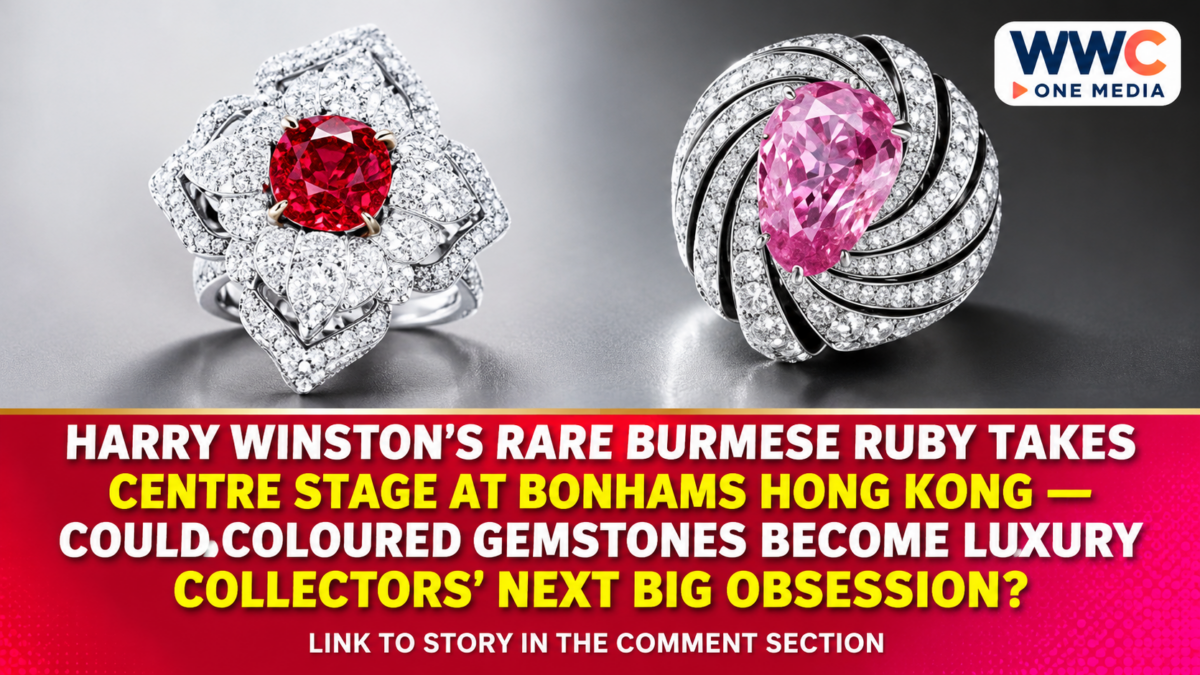
The Harry Winston ruby ring features a 4.12-carat cushion-shaped Burmese ruby described as unheated and possessing the highly prized colour designation known as Pigeon’s Blood.
Bonhams assigned the jewel a pre-sale estimate of HK$2 million to HK$3.8 million, reflecting the combination of gemstone quality and craftsmanship associated with the piece.
The auction comes amid renewed growth in Hong Kong’s luxury retail sector, where sales of jewellery, watches, clocks and valuable gifts increased 20.3% year-on-year in September.
For luxury collectors, the offering raises an interesting question: could exceptional coloured gemstones become increasingly important in a market traditionally associated with diamonds?
Harry Winston ruby ring combines rarity and craftsmanship
The centrepiece of the Harry Winston creation is a cushion-shaped ruby originating from Myanmar, historically known as Burma.
Its diamond setting incorporates pear-shaped and round brilliant-cut stones arranged around the central gemstone in an openwork design.
The combination illustrates how fine jewellery can derive its value from both the characteristics of a central gemstone and the craftsmanship surrounding it.
Unlike jewellery produced primarily for standardised retail distribution, exceptional auction pieces must be evaluated individually.
Two rubies of identical weight can command substantially different valuations depending on their colour, transparency, treatment history and physical condition.
The identity of the jewellery designer may also influence collector interest, particularly when a piece demonstrates distinctive craftsmanship.
Similar considerations were examined in WWC ONE MEDIA’s coverage of the 24-carat Bulgari Pink diamond and its remarkable auction history.
For collectors, the Harry Winston offering represents more than the acquisition of a precious gemstone. Its design and documented characteristics form part of its overall appeal.
What makes a Pigeon’s Blood ruby so valuable?
Colour is among the most important characteristics influencing ruby valuations.
In the international gemstone trade, the expression Pigeon’s Blood has historically been associated with particularly desirable shades of red.
However, the terminology should not be interpreted as a universally standardised guarantee of gemstone quality.
Different laboratories may apply specific criteria when assigning colour descriptions, making the accompanying gemological documentation important.
Clarity also plays a significant role. Inclusions that substantially interfere with transparency, brightness or structural integrity can affect a ruby’s commercial value.
The Harry Winston ring’s auction description highlights the central stone’s colour, clarity and absence of heat treatment.
Together, these characteristics help explain why the jewel was assigned a multimillion-dollar Hong Kong valuation.
The importance of colour, origin and treatment was previously examined in WWC ONE MEDIA’s coverage of the craftsmanship and gemological characteristics behind rare coloured gemstones.
Why unheated rubies attract collectors
Gemstone treatments can alter the appearance of naturally occurring minerals.
Heat treatment is among the established techniques used to improve the appearance of certain gemstones, including rubies.
An unheated designation indicates that the available examination has not identified evidence of the relevant heat treatment.
However, an absence of heat treatment does not independently establish that a gemstone is more attractive or valuable than every treated alternative.
Its overall quality must still be assessed.
Independent gemological laboratories use multiple analytical techniques to investigate gemstone characteristics, geographic origin and detectable treatments.
For high-value jewellery transactions, these assessments can provide important information for buyers evaluating a particular piece.
Collectors should also recognise that geographic origin does not independently guarantee exceptional quality. Gemstones recovered from the same region can exhibit considerably different physical characteristics.
Cartier and other luxury houses broaden the auction’s appeal
Bonhams’ November jewellery sale was designed to showcase a broader selection of coloured gemstones and creations from established luxury houses.
Another featured offering was Cartier’s Solar Landscape ring, which incorporates an unheated Sri Lankan padparadscha sapphire weighing more than 10 carats.
The piece was assigned a pre-sale estimate of HK$2.8 million to HK$3.6 million.
Its design originated from Cartier’s Dépaysement High Jewellery Collection, presented at the 2012 Paris Biennale des Antiquaires.
Padparadscha sapphires are particularly distinctive because of their characteristic pinkish-orange appearance.
Bonhams also included ruby and diamond earrings carrying an estimated valuation of HK$1.5 million to HK$3 million.
The range demonstrates how luxury auction houses can attract attention through different gemstone categories rather than depending exclusively on conventional white diamonds.
Hong Kong luxury retail sales rise 20.3%
The Bonhams event comes at an interesting moment for Hong Kong’s broader luxury market.
Preliminary government statistics released on Nov. 3, 2026, show that sales of jewellery, watches, clocks and valuable gifts increased 20.3% in September compared with the corresponding month in 2025.
Overall retail sales grew by 6.4%, marking the 17th consecutive month of year-on-year expansion.
The figures provide a positive backdrop for businesses operating in Hong Kong’s luxury sector.
WWC ONE MEDIA previously examined this development in its analysis of Hong Kong’s jewellery sales recovery and the changing economics of precious-metal purchases.
Nevertheless, retail sales statistics and rare gemstone auction results measure different commercial activities.
Growth in jewellery retail expenditure does not automatically establish that auction prices for individual rubies or sapphires are increasing at the same rate.
Exceptional auction pieces are influenced by their particular characteristics and the willingness of individual bidders to compete for them.
The hidden costs behind multimillion-dollar jewellery auctions
Understanding an auction valuation requires distinguishing the hammer price from the buyer’s total expenditure.
The hammer price represents the accepted winning bid. A buyer’s premium is an additional charge calculated under the auction house’s applicable terms.
For the November Hong Kong event, Bonhams published a premium of 30% on the first HK$300,000 of the hammer price and 28% on the portion exceeding HK$300,000 up to HK$6 million.
Additional pricing tiers apply to higher-value transactions.
These charges can materially increase the total acquisition cost.
Consequently, collectors evaluating jewellery as a financial asset must consider more than the winning bid. Insurance, storage, future selling expenses and market liquidity can also influence eventual financial outcomes.
Rare gemstones may command extraordinary prices, but they do not guarantee investment returns.
What happens next for Asia’s coloured gemstone market?
Bonhams’ selection of rubies, sapphires, coloured diamonds and signed jewellery illustrates the diversity of the high-end auction market.
However, determining whether coloured gemstones are experiencing sustained appreciation will require more than examining a single auction.
Comparable transactions, final hammer prices, unsold lots and consistent gemstone quality assessments would provide a stronger basis for identifying meaningful market trends.
For luxury houses and auction businesses across Asia-Pacific, the opportunity lies in connecting collectors with exceptional pieces while maintaining confidence in gemstone documentation and transaction transparency.
The Harry Winston ruby ring demonstrates why a gemstone’s commercial significance can extend beyond its physical size.
Its combination of colour, origin, treatment characteristics and craftsmanship makes it a distinctive offering in the international jewellery market.
Whether such pieces become the next major focus of luxury collectors will ultimately depend on sustained demand rather than individual headline-grabbing valuations.
Frequently Asked Questions
What is special about the Harry Winston ruby ring at Bonhams Hong Kong?
The ring features a 4.12-carat cushion-shaped Burmese ruby described as unheated and displaying the highly desirable Pigeon’s Blood colour designation, surrounded by diamonds.
What was the ring’s pre-auction estimate?
Bonhams assigned the Harry Winston ruby and diamond ring a pre-sale estimate of HK$2 million to HK$3.8 million.
What does Pigeon’s Blood ruby mean?
It is a traditional gemstone trade designation associated with particularly desirable red ruby colours. Specific assessment criteria can vary between gemological laboratories.
Are unheated Burmese rubies guaranteed to increase in value?
No. Gemstone valuations depend on quality, documentation, condition and buyer demand. Geographic origin and treatment status do not guarantee investment returns.
Is Hong Kong’s luxury jewellery market growing?
Preliminary government statistics show that sales in the jewellery, watches, clocks and valuable gifts category increased 20.3% year-on-year in September 2026.