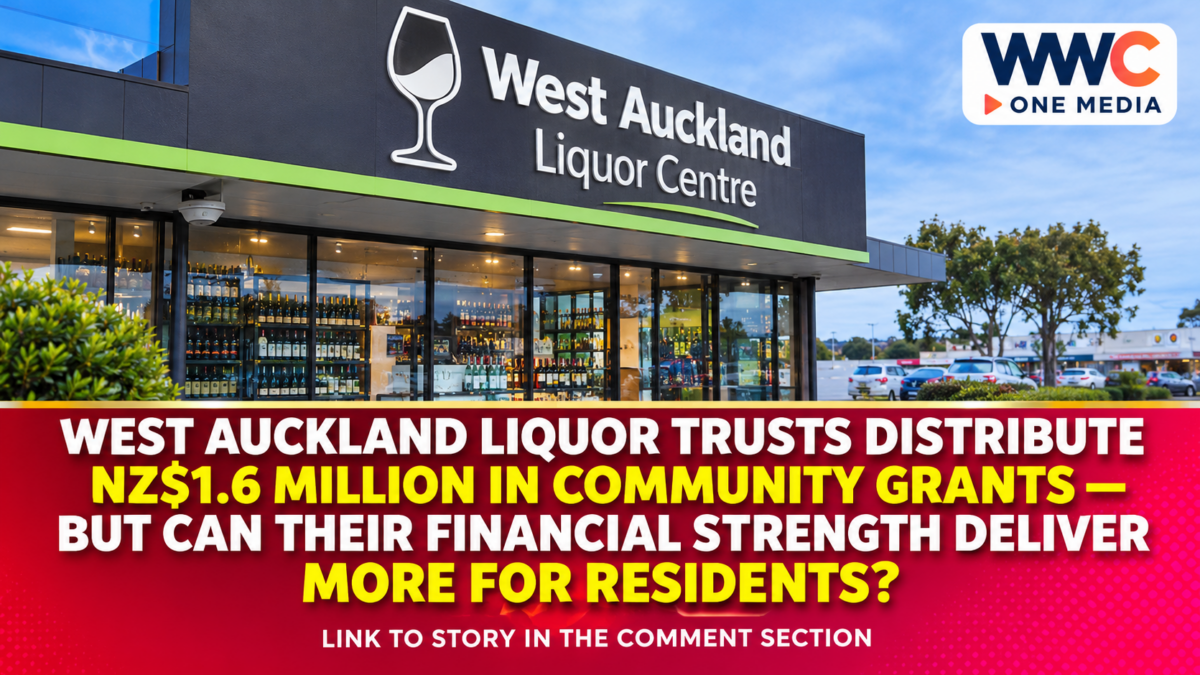
AUCKLAND, NEW ZEALAND — West Auckland’s community-owned liquor businesses are facing an important financial and governance question after the Portage and Waitākere Licensing Trusts announced NZ$1.6 million in community grants for FY2026, despite a decline in their combined operating earnings before depreciation and other expenses.
The West Auckland liquor trusts recorded combined earnings before interest, taxes, depreciation and amortisation (EBITDA) of NZ$5.1 million before community grants, compared with NZ$7.6 million in the previous financial year.
Meanwhile, demand for community assistance exceeded NZ$5 million, with more than 280 funding applications submitted.
The figures highlight a challenge facing community-owned commercial enterprises: how much capital should be retained to protect their long-term financial stability, and how much should be distributed to the communities they serve?
With management reporting a debt-free financial position and the trusts pursuing changes to their property portfolios, the debate extends beyond annual profitability.
It concerns the future purpose and management of community-owned assets.
West Auckland liquor trusts face declining operating earnings
The trusts’ October 2026 financial announcement establishes a significant decline in their combined EBITDA compared with FY2025.
The reduction from NZ$7.6 million to NZ$5.1 million represents a decrease of approximately 32.9%, based on the rounded figures published for the two financial years.
Despite the weaker result, community grant distributions increased from approximately NZ$1.1 million in FY2025 to NZ$1.6 million in FY2026.
Management also reported NZ$180,000 in additional central management cost reductions.
These developments illustrate the competing priorities facing the organisation.
Maintaining commercial viability requires sufficient resources for operating expenses, property maintenance and future investment. Its community ownership structure also creates expectations that financial resources will generate meaningful local benefits.
However, EBITDA should not be interpreted as the amount of money immediately available for distribution.
A comprehensive assessment requires examining net earnings, operating cash flow, capital expenditure and existing financial commitments.
Why community ownership changes the financial equation
The Portage and Waitākere Licensing Trusts were established in 1972 following decisions by West Auckland communities.
Unlike conventional privately owned retail businesses, their governance arrangements involve elected representatives responsible for overseeing the organisations on behalf of local residents.
The two trusts remain separate entities while sharing central management functions through West Auckland Trust Services Limited.
Their operating network includes retail outlets, hospitality venues and hotel operations.
The licensing framework also provides preferential alcohol trading rights, although the restrictions do not prevent every form of independently licensed hospitality business from operating.
This creates a distinctive governance challenge.
Commercial performance remains important, but profitability alone cannot fully establish whether the organisations are fulfilling their community responsibilities.
Residents must also consider the public benefits delivered, the effectiveness of elected governance and the consequences of the existing retail framework.
The importance of connecting investment decisions with measurable community outcomes has previously featured in WWC ONE MEDIA’s coverage of Auckland’s economic growth and international investment strategy.
Lincoln Green property strategy could reshape future returns
Property investment represents another important dimension of the trusts’ financial strategy.
In May 2025, Waitākere Licensing Trust announced its intention to market the Lincoln Green commercial property in Henderson.
The freehold development occupies 1.67 hectares and incorporates a 70-room hotel alongside other commercial operations.
Its mixed-use zoning provides opportunities for alternative development configurations.
Commercial property firm JLL was appointed to manage the proposed sale process.
The trust stated that proceeds from a sale would be reinvested into projects and assets intended to generate stronger and more sustainable community benefits.
However, an intention to sell should not be confused with a completed transaction.
The property’s eventual financial contribution will depend on the transaction price, associated expenses and subsequent investment decisions.
The broader challenge of combining hospitality, retail and community-oriented property development has also been examined in WWC ONE MEDIA’s reporting on Robinsons Land’s Bridgetowne destination estate strategy.
For the Waitākere Licensing Trust, the relevant question is whether alternative investments could generate greater long-term community value than retaining existing commercial assets.
Where community grant funding is going
The trusts’ published community funding programme identifies beneficiaries across several areas of social and economic development.
Making Good received NZ$18,500 for an initiative providing winter clothing to West Auckland children.
Sport Waitakere Trust received NZ$20,000 to support equitable access to sporting and recreational opportunities for Māori communities.
Drowning Prevention Auckland received NZ$99,313 for a programme addressing coastal safety risks.
Other beneficiaries include organisations supporting environmental restoration, cultural activities, healthcare education and youth development.
In September 2026, the trusts also announced the renewal of their sponsorship of Netball Waitākere’s 2027 Premier Competition.
These commitments demonstrate that community benefits extend across different activities rather than a single charitable programme.
However, the financial sustainability of such support remains important.
Organisations receiving grants may need predictable funding to maintain programmes, retain personnel and plan future activities.
A dependable distribution strategy could therefore offer advantages beyond occasional increases in individual grant allocations.
Critics question whether preferential trading rights deliver enough
The West Auckland Licensing Trusts Action Group has challenged the economic effectiveness of the existing licensing model.
In June 2025, the group released its own analysis comparing four licensing trusts with eleven community trusts operating without equivalent retail protections.
Its research examined financial performance over a decade and questioned whether alternative investment arrangements could generate stronger community returns.
These findings represent the conclusions of an advocacy organisation supporting changes to the existing system. They should not be treated as independently audited proof that an alternative structure would necessarily produce better outcomes.
The trusts, meanwhile, argue that their community mandate helps manage alcohol availability while supporting local organisations through commercial earnings.
Both perspectives raise legitimate policy questions.
An assessment of the existing model should consider financial returns alongside public health objectives, employment, consumer choice and the consequences of introducing additional competition.
Why financial reserves require careful examination
A strong financial position can help businesses manage unexpected disruptions and fund necessary investments.
However, retaining capital also carries an opportunity cost when those resources could potentially support other productive activities.
For community-owned enterprises, that consideration becomes particularly important because the potential beneficiaries include residents and local organisations.
Management has reported that the West Auckland trusts have no debt.
Nevertheless, a debt-free position does not establish how much cash can safely be distributed without compromising future operations.
Businesses operating property and retail portfolios may require capital for refurbishment, asset replacement, working capital and other obligations.
The importance of understanding financial commitments before assessing a retailer’s apparent financial strength has previously featured in WWC ONE MEDIA’s coverage of David Jones’ restructuring and the financial exposures faced by commercial landlords and creditors.
For West Auckland residents, the most useful disclosures would distinguish unrestricted cash from committed funds and explain the expected returns on retained investments.
What happens next for West Auckland’s liquor trusts?
The next test for the trusts will involve demonstrating how their commercial operations, property strategy and community funding arrangements work together.
Important measures include net profitability, investment returns, cash flow, future capital expenditure and the outcomes achieved through community grants.
Elected trustees must balance the organisation’s long-term financial requirements against the immediate needs of West Auckland communities.
For other Asia-Pacific economies examining community-owned business structures, the debate illustrates the importance of defining financial success alongside social objectives.
The trusts have demonstrated their ability to support dozens of community organisations.
The bigger question is whether their available resources can generate even greater public value without undermining the financial foundation needed to sustain that support.
Frequently Asked Questions
What are the West Auckland liquor trusts?
The Portage and Waitākere Licensing Trusts are community-owned organisations operating retail, hospitality and related commercial businesses in West Auckland, New Zealand.
How much community funding did the trusts distribute in FY2026?
The trusts announced approximately NZ$1.6 million in grants distributed to 78 local organisations.
How profitable were the West Auckland liquor trusts in FY2026?
Their published combined EBITDA before community grants was NZ$5.1 million, compared with NZ$7.6 million in FY2025. EBITDA is not equivalent to net profit.
What is the Lincoln Green property?
Lincoln Green is a 1.67-hectare commercial property in Henderson incorporating a hotel and other business premises. Waitākere Licensing Trust announced its intention to sell the property in May 2025.
Why are the trusts’ financial reserves important?
Financial reserves can support future investments and operating stability. However, community-owned organisations must also assess whether retained capital is generating appropriate benefits for their communities.