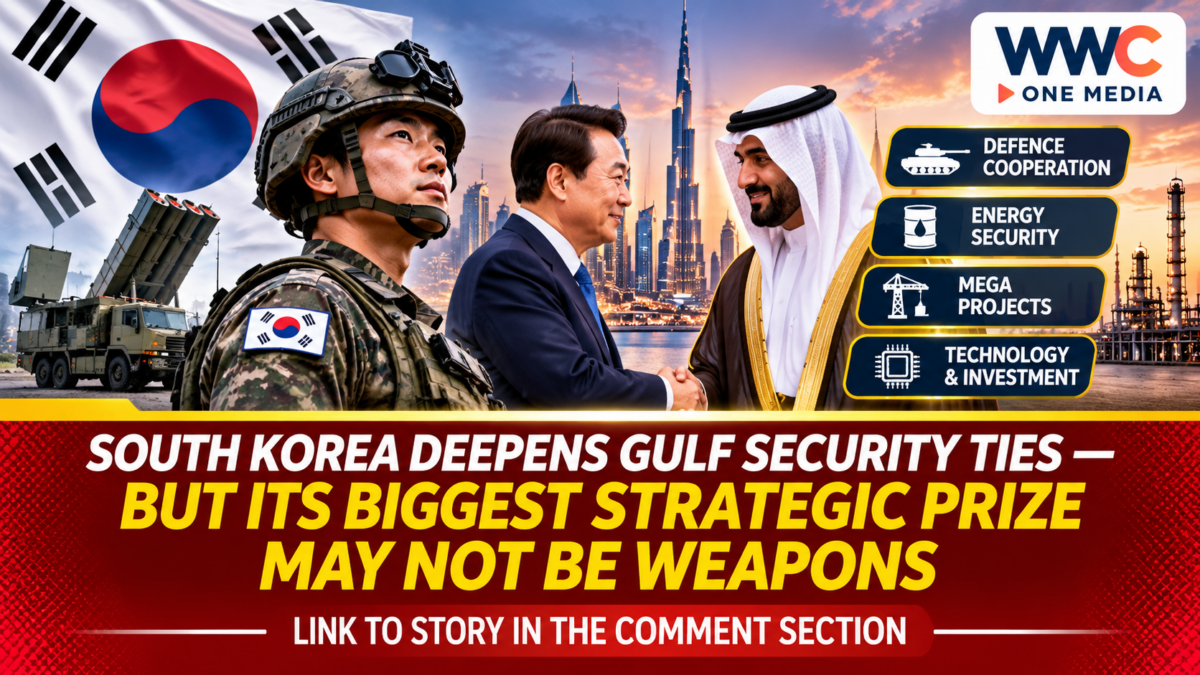
SEOUL — South Korea is pursuing a deeper strategic relationship with the Middle East, expanding its cooperation with the United Arab Emirates (UAE) and Saudi Arabia beyond conventional defence exports into industrial development, energy security and advanced technologies.
The South Korea Gulf security partnership is increasingly becoming an economic priority as Seoul seeks to protect critical energy supplies while creating long-term opportunities for its manufacturers.
Government agreements concluded during 2025 and 2026 establish a framework for stronger industrial collaboration, joint defence development and more resilient resource supply chains.
But the implications extend beyond the international arms market.
For South Korea, maintaining dependable access to Gulf energy could prove just as strategically important as expanding its defence industry.
South Korea Gulf Security Partnership Moves Beyond Arms Sales
The transformation of Seoul’s relationship with the UAE was formally articulated during President Lee Jae Myung’s state visit on Nov. 18, 2025.
The two governments committed to expanding defence cooperation through technology partnerships, collaborative development and local manufacturing.
This approach represents a broader industrial relationship than conventional transactions involving the purchase and delivery of military equipment.
Long-term partnerships could involve workforce development, knowledge exchange, maintenance services and sustained cooperation between manufacturers.
For Gulf countries, such arrangements offer opportunities to strengthen domestic industrial capabilities.
For Korean companies, they could create additional sources of revenue beyond initial equipment sales.
However, the economic benefits will depend on the terms of future contracts, intellectual property arrangements, regulatory approvals and the ability of participating businesses to fulfil their commitments.
A strategic declaration establishes an intended direction, but it does not guarantee that every proposed project will materialise.
Energy Security Is Becoming a Central Strategic Priority
South Korea’s relationship with the Middle East cannot be understood exclusively through its defence industry.
Energy supplies remain fundamental to its economic interests.
On July 8, 2026, South Korea’s Ministry of Trade, Industry and Resources and the Abu Dhabi National Oil Company concluded a strategic crude oil supply-chain cooperation agreement.
The arrangement covers supply stability, coordinated emergency responses and joint stockpiling.
The discussions also addressed energy storage and transport infrastructure designed to reduce exposure to disruptions around the Strait of Hormuz.
For an industrial economy dependent on imported energy, uncertainty surrounding international shipping can translate into higher manufacturing expenses and additional pressure on consumer prices.
The risks surrounding Asia’s oil supply and the security of shipping through the Strait of Hormuz demonstrate why stable relationships with energy-producing countries remain important.
Even so, bilateral agreements cannot independently eliminate every risk associated with regional conflicts, shipping disruptions or international commodity prices.
Saudi Arabia Offers Another Major Industrial Opportunity
Seoul is pursuing a parallel relationship with Saudi Arabia, identified by the South Korean government as its largest crude oil supplier.
During a visit from June 13 to 14, 2026, South Korean Trade, Industry and Resources Minister Jung-Kwan Kim held discussions with Saudi Energy Minister Prince Abdulaziz bin Salman.
The two governments reviewed existing petroleum supply arrangements and agreed to maintain planned supplies through the end of 2026.
They also signed a memorandum of understanding covering longer-term cooperation in the oil and gas industries.
The relationship extends into manufacturing.
Hyundai Motor and Saudi Arabia’s Public Investment Fund are developing a vehicle manufacturing project expected to begin full-scale production in 2027.
Industrial cooperation also includes shipbuilding and potential partnerships involving minerals and advanced technologies.
These initiatives demonstrate that Saudi Arabia’s relationship with South Korea encompasses multiple commercial interests rather than a single industry.
For Korean manufacturers, successful local partnerships could provide access to new customers and production opportunities while supporting Saudi Arabia’s economic diversification objectives.
The Strait of Hormuz Presents a Difficult Security Choice
Economic cooperation alone cannot guarantee the safe movement of international energy shipments.
South Korea must also consider how maritime instability could affect its commercial interests and international relationships.
The policy debate surrounding Seoul’s potential involvement in maritime security operations near the Strait of Hormuz illustrates the competing responsibilities facing the government.
Greater security cooperation could help protect commercial interests and strengthen international partnerships.
However, additional overseas military commitments would also require consideration of personnel safety, financial costs, diplomatic consequences and South Korea’s domestic defence priorities.
There are meaningful differences between supporting commercial shipping, participating in international security coordination and becoming directly involved in a regional conflict.
These alternatives should not be treated as interchangeable.
Seoul’s strategic challenge is determining how to protect its economic interests without accepting commitments that exceed its resources or undermine other national priorities.
Can Gulf Cooperation Reduce South Korea’s Energy Vulnerability?
South Korea’s growing relationships with Saudi Arabia and the UAE could help improve the reliability of its energy procurement.
Nevertheless, closer partnerships with existing suppliers and diversification into alternative energy sources serve different purposes.
Long-term supply arrangements can improve predictability, while geographical diversification could reduce exposure to disruptions concentrated in a particular region.
The commercial debate over South Korea’s potential participation in the Alaska LNG project highlights another dimension of this challenge.
Alternative suppliers may offer greater geographical flexibility, but their commercial viability depends on production costs, infrastructure requirements and contractual terms.
Energy security therefore involves more than identifying countries willing to supply petroleum or natural gas.
It also requires evaluating affordability, transportation reliability, infrastructure and the consequences of unexpected supply interruptions.
Why the Gulf Partnership Matters to Asia-Pacific Businesses
The South Korea–UAE strategic framework also identifies artificial intelligence, semiconductors and civil nuclear energy as areas for expanded cooperation.
Potential projects include joint technology investment, research and commercial development.
These ambitions could create opportunities for companies involved in advanced manufacturing, digital infrastructure and energy-related services.
For investors across the Asia-Pacific, the developing relationship highlights the increasing connection between international security, industrial competitiveness and resource availability.
Nevertheless, projected opportunities should not be confused with realised revenue.
Companies will still need commercially viable projects, dependable financing and appropriate government approvals.
What Happens Next for South Korea’s Gulf Strategy?
The next significant developments will involve the implementation of existing agreements rather than the announcement of additional strategic ambitions alone.
Joint industrial ventures, formal commercial contracts, resource procurement arrangements and maritime policy decisions will provide clearer evidence of how far the relationship is progressing.
South Korea does not necessarily need to choose between remaining a commercial supplier and becoming a closer strategic partner.
The two roles can complement each other, provided the associated commitments remain economically sustainable and consistent with national security priorities.
The country’s growing Gulf relationships offer substantial opportunities. But their ultimate value may lie less in the quantity of equipment sold than in the durability of the economic and diplomatic partnerships created.
Frequently Asked Questions
What is South Korea’s Gulf security strategy?
South Korea is expanding cooperation with Gulf countries through defence-industrial partnerships, energy security agreements, technology development and broader economic collaboration.
Which Gulf countries are South Korea’s key partners?
The United Arab Emirates and Saudi Arabia are important partners in defence, energy and industrial development.
Why is the Strait of Hormuz important to South Korea?
The waterway is strategically significant for transporting Middle Eastern energy supplies. Disruptions can affect South Korean procurement costs, shipping reliability and industrial production.
What defence cooperation has South Korea agreed with the UAE?
The November 2025 joint declaration establishes ambitions for collaborative development, technology cooperation, local manufacturing and capacity building beyond conventional arms sales.
Does South Korea’s Gulf partnership establish a new military alliance?
No. The verified agreements establish broader strategic cooperation and industrial partnerships. They do not establish a new mutual-defence treaty or an automatic obligation to participate in military conflicts.