
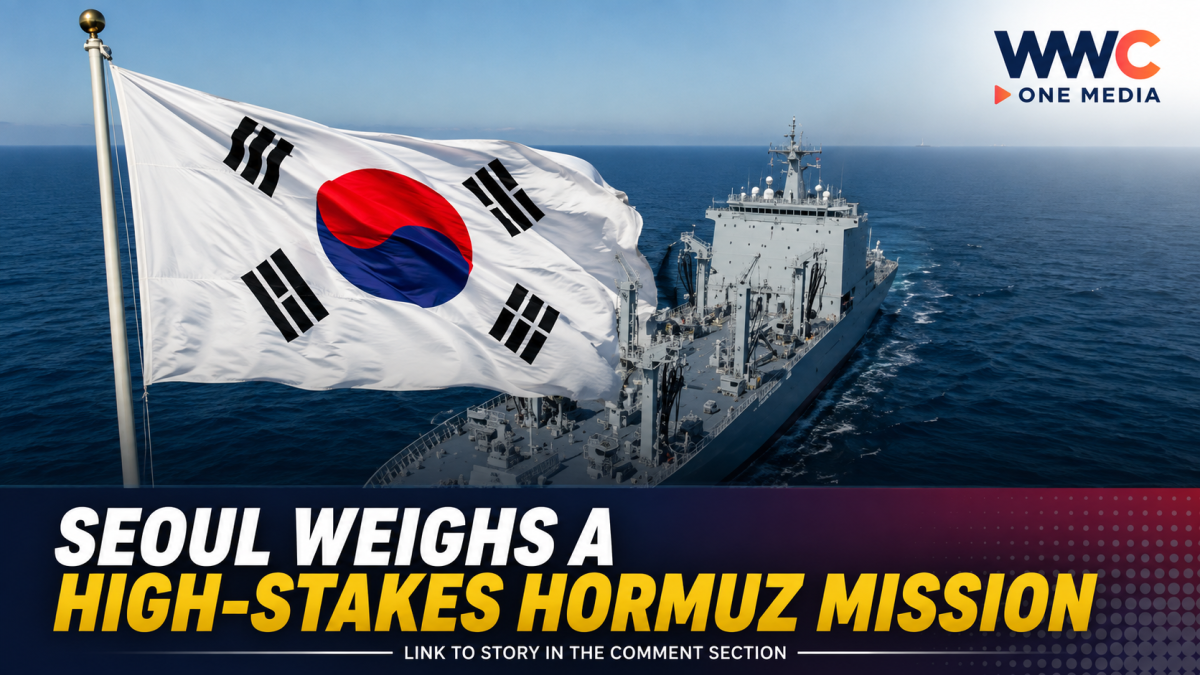
SEOUL — South Korea is considering sending military assets to support freedom of navigation in the strategically vital Strait of Hormuz, with a maritime patrol aircraft, logistics support ship and mine-clearance capabilities among the options under discussion.
The potential mission comes as maritime security in the Gulf remains severely strained and as Washington continues pressing allies and partners to contribute to efforts aimed at keeping commercial shipping moving through the waterway.
But there is a crucial distinction: Seoul has not officially approved a deployment.
South Korea’s presidential office said Friday that the government is reviewing practical options, including military measures, but denied reports that a final decision had already been made. The Ministry of National Defense likewise said no specific deployment had been finalized.
That leaves Seoul balancing two competing pressures: protecting its economic interests and supporting its security relationships while avoiding direct involvement in combat with Iran.
P-8 Poseidon emerges as a key option
Among the assets reportedly being considered is the South Korean Navy’s P-8A Poseidon, a long-range maritime patrol aircraft designed primarily for anti-submarine warfare but equipped with sophisticated radar and electro-optical and infrared sensors.
South Korea operates six P-8As, which entered service in July 2025, according to The Korea Times.
Unlike a warship sailing directly into the narrow waterway, a maritime patrol aircraft could provide surveillance over a much wider area while keeping Korean personnel farther from potential confrontation.
Experts cited by The Korea Times said the aircraft could monitor suspicious activity around commercial shipping routes and share information with other forces operating in the region.
The mission would therefore be less about attacking Iranian forces and more about surveillance, maritime awareness and support for navigation security.
A support ship could accompany the mission
Another option is the South Korean Navy’s 11,000-ton fast combat support ship ROKS Soyang.
The vessel is designed to provide fuel, ammunition and other supplies to naval forces, allowing them to remain deployed for longer periods.
That could make Soyang particularly useful if Seoul chooses a support-oriented mission rather than sending a conventional combat force.
But there is an obvious complication.
A logistics vessel operating in a high-threat environment would itself require protection.
That could force Seoul to deploy an escort warship, potentially expanding what begins as a noncombat support mission into a larger naval commitment. The Korea Times quoted defense experts warning about precisely that dilemma.
Mine clearance may be the least provocative option
Mine-countermeasure operations are also being discussed as a possible role for South Korean forces.
This could offer Seoul a way to contribute to maritime security without directly participating in offensive operations against Iran.
Defense experts told The Korea Times that clearing naval mines could have a broader justification because it would directly protect commercial shipping and other vessels using the waterway.
Modern mine-clearance operations can also employ unmanned underwater vehicles to locate and neutralize underwater threats, potentially reducing the exposure of personnel.
Such a mission could become particularly important if fighting subsides but underwater hazards remain in shipping lanes.
SBS reports preparations are already advancing
While Seoul’s presidential office insists that no final decision has been made, South Korean broadcaster SBS reported that the military has begun more concrete preparations.
According to SBS, a potential package could include P-8 Poseidon aircraft, a Navy logistics support ship and an explosive ordnance disposal team.
SBS reported that officials were discussing possible foreign ports of call and operational bases that would be needed to support the mission.
The broadcaster also reported that any actual deployment would require a National Security Council decision, Cabinet approval and consent from the National Assembly, with a parliamentary motion potentially coming as early as September.
Those reports, however, should be distinguished from an approved deployment. The presidential office continues to characterize the matter as being under review.
Why the Strait of Hormuz matters to South Korea
The stakes extend far beyond the Middle East.
The Strait of Hormuz is one of the world’s most important energy chokepoints, linking the Persian Gulf with the Gulf of Oman and Arabian Sea.
The U.S. Energy Information Administration estimates that oil flows through the strait averaged 20 million barrels per day in 2024, equivalent to roughly one-fifth of global petroleum liquids consumption at the time.
The disruption caused by the current conflict has dramatically reduced traffic.
EIA estimates that crude oil and petroleum liquids moving through Hormuz averaged only 4.9 million barrels per day in the second quarter of 2026, compared with 21.6 million barrels per day in the final quarter of 2025 before the conflict intensified.
Reuters reported Friday that only four commodity vessels crossed the waterway on Thursday, far below the recent 10-day average of 15 vessels. The figure excludes vessels whose tracking transponders were switched off.
For energy-dependent Asian economies, that disruption can quickly become an economic problem.
South Korea is particularly exposed because of its reliance on Middle Eastern energy supplies. Reuters reported that more than 60% of South Korea’s crude oil imports have historically come through the region and that Hormuz is therefore strategically important to Seoul’s energy security.
Seoul faces a difficult military calculation
Sending forces to Hormuz would not simply be a question of military capability.
South Korea must also consider the readiness of its armed forces on the Korean Peninsula.
The presidential office has emphasized that any contribution would have to take into account Seoul’s ability to maintain an adequate defense posture at home.
Experts also caution that even a supposedly limited deployment carries diplomatic risks.
A Korean combat ship operating alongside U.S., British or French forces could be interpreted very differently from a Korean aircraft conducting surveillance or a team performing humanitarian or mine-clearance work.
That is why defense specialists have generally favored surveillance, logistics, mine clearance and potentially evacuation support over direct combat.
U.S. pressure adds another layer
The issue is also unfolding against a complicated backdrop in South Korea-U.S. relations.
Reuters reported that Seoul’s discussions involve coordination with the United States, Britain and France, while other reporting has highlighted repeated pressure from U.S. President Donald Trump for South Korea to contribute more to the regional effort.
That puts President Lee Jae Myung’s government in a delicate position.
A contribution could demonstrate solidarity with Washington and other partners while protecting South Korea’s own shipping and energy interests.
But a direct military role could increase the possibility of confrontation with Iran and create political opposition at home.
A recent Gallup Korea poll cited by Reuters found that 55% of South Koreans opposed sending a warship to the region.
The next decision could determine the mission’s true scale
For now, Seoul appears to be keeping several doors open.
A surveillance-focused P-8A deployment would represent a relatively limited military contribution.
A logistics ship would provide more substantial operational support but could require an escort.
Mine-clearance capabilities would offer another route for Seoul to contribute without directly joining offensive operations.
And an evacuation role could become important if the security situation deteriorates and Korean nationals need assistance leaving the region.
The question is therefore no longer simply whether South Korea can contribute to Hormuz security.
It is how far Seoul is willing to go—and where it draws the line between protecting navigation and becoming directly involved in the conflict.
For now, officials insist that no final deployment decision has been made.
But with military preparations reportedly advancing and diplomatic pressure mounting, the next step could reveal just how significant South Korea’s role in the Strait of Hormuz will become.
WWC ONE MEDIA G.A




Leave a Reply