
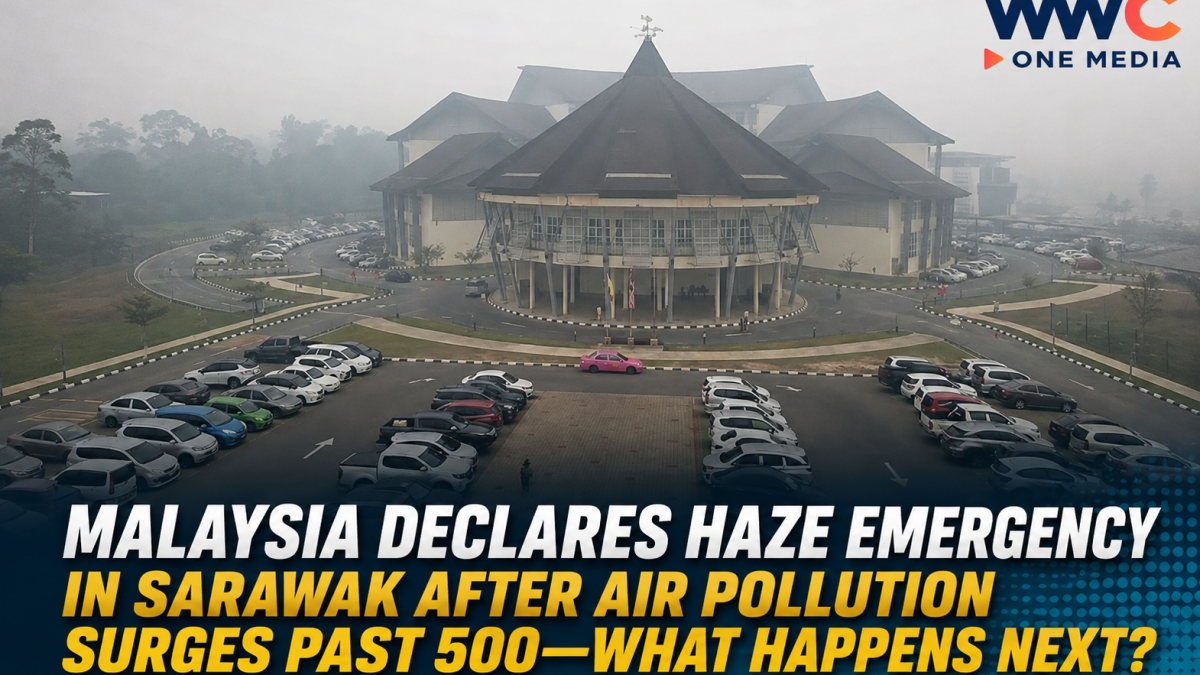
SERIAN, SARAWAK — September 4, 2026 — Malaysia has declared an emergency in Sarawak’s Serian Division after dangerously high levels of haze pushed the Air Pollutant Index (API) beyond the country’s emergency threshold, triggering extraordinary measures to protect residents.
The emergency declaration was consented to by Malaysia’s King, Sultan Ibrahim Sultan Iskandar, following advice from Prime Minister Anwar Ibrahim, Sarawak Premier Abang Johari Openg and relevant government agencies.
The decision came after air pollution in Serian climbed above 500, a level regarded by Malaysian authorities as requiring emergency action. Reuters reported an API reading of 519, while other measurements during the day reached as high as 521.
The development marks a dramatic escalation of a haze crisis that has already disrupted schools, affected daily activities and blanketed parts of Sarawak in thick smoke.
Serian Becomes the Epicenter of Sarawak’s Haze Crisis
Serian, located about 60 kilometres southeast of Sarawak’s capital Kuching and close to the Indonesian border, has been among the areas hardest hit by the worsening haze.
Malaysia classifies API readings above 300 as hazardous, while the level above 500 has been used as the trigger for an emergency declaration under the country’s haze response framework.
For perspective, Malaysia’s normal API scale classifies readings of 0–50 as good, 51–100 as moderate, 101–200 as unhealthy, 201–300 as very unhealthy and readings above 300 as hazardous.
Sarawak’s official haze monitoring data had already shown severe conditions before the emergency was declared. On September 3, the Serian monitoring station recorded an API of 408, while Lubok Antu reached 470 and Lundu recorded 322.
By Friday, conditions deteriorated further.
Emergency Does Not Mean a COVID-Style Lockdown
Sarawak Deputy Premier Douglas Uggah Embas stressed that the emergency should not be confused with the movement restrictions imposed during the COVID-19 pandemic.
Instead, authorities will implement specific operating procedures designed to reduce public exposure to dangerous air pollution.
According to Bernama and The Star, government and private-sector activities in the affected area are expected to be restricted, while essential services—including supermarkets, petrol stations, banks and security services—will continue operating.
Residents have been urged to remain indoors as much as possible, minimize outdoor activities and follow official instructions.
Those who must go outside have been advised to wear suitable protective masks, particularly N95 masks or equivalent, to reduce exposure to airborne pollutants.
Schools Already Hit as Haze Spreads Across Sarawak
The emergency comes as haze continues to disrupt education across the state.
The Sarawak Education Department said schools in 12 districts would remain closed from September 7 to 11 because of the hazardous conditions.
The closure affects 563 primary schools with 108,477 students and 84 secondary schools with 90,082 students—a combined 647 schools and more than 198,000 students.
Home-based teaching and learning will be implemented during the closure.
The disruption highlights how the haze crisis has moved beyond an air-quality concern and into a wider public-safety and economic issue.
Kuching Also Records Hazardous Air
Serian is not the only part of Sarawak facing dangerous conditions.
CNA reported that Kuching recorded an API reading of 306, while other areas including Samarahan and Sri Aman also experienced very unhealthy air quality.
Bernama later reported Kuching at 313, Samarahan at 288 and Sri Aman at 239 as of 4 p.m. Friday, illustrating how rapidly conditions have been changing throughout the day.
Sarawak’s Natural Resources and Environment Board has likewise recorded widespread unhealthy, very unhealthy and hazardous readings across the state.
Indonesian Fires Blamed for the Thick Smoke
The latest haze episode is linked to fires on the Indonesian side of Borneo, particularly in Kalimantan, with smoke carried across the border into Sarawak.
Sarawak shares a long border with Indonesian Kalimantan, making the Malaysian state particularly vulnerable when dry weather and widespread land and forest fires generate large amounts of smoke.
Reuters, AP and other international reports have linked the current conditions to fires in neighbouring Indonesia.
The crisis is therefore part of a much larger regional problem that has repeatedly affected Southeast Asia during periods of dry weather.
Malaysia Turns to Cloud Seeding
Authorities have already begun cloud-seeding operations in an attempt to improve conditions.
A three-day cloud-seeding operation was launched in Sarawak on Thursday, targeting water resources including three hydroelectric dams and 13 water catchment areas.
Officials said the operation has two objectives: encourage rainfall that could help reduce airborne pollutants and replenish water supplies ahead of potentially hotter and drier conditions.
However, cloud seeding is not a guaranteed solution. Its effectiveness depends on the presence of suitable atmospheric conditions.
Residents Report Breathing Difficulties
The worsening haze has already affected residents’ daily lives.
CNA reported residents describing the current episode as the worst they had experienced in years, with complaints including breathing difficulties, eye irritation and extreme discomfort when spending time outdoors.
Demand for protective masks has also surged. CNA reported that one pharmacy in Serian had sold out of N95 masks amid what staff described as panic buying.
The reports underscore the immediate health concerns created by prolonged exposure to heavily polluted air.
Sarawak Has Seen Severe Haze Before
The current crisis is serious, but Sarawak has experienced extreme haze episodes before.
CNA reported that the state’s worst recent air-quality episode occurred in 2019, when the API reached 405.
The last haze emergency in Sarawak was declared in September 1997, when the API reportedly reached a staggering 860.
The historical record shows why authorities are treating the latest surge above 500 as a major public-health warning.
What Happens Now?
The emergency will remain focused on protecting residents while authorities monitor whether pollution levels improve.
Sarawak officials have emphasized that residents should not panic and should rely on official information rather than unverified reports circulating online.
The key question now is whether rainfall and changing weather conditions will bring the API back below the emergency threshold—or whether the haze will continue worsening.
For residents of Serian and surrounding areas, the next few days could determine whether this remains a short-lived emergency or develops into a broader regional crisis.
For now, authorities are urging residents to stay indoors, reduce outdoor exposure and take the hazardous air seriously.



Leave a Reply