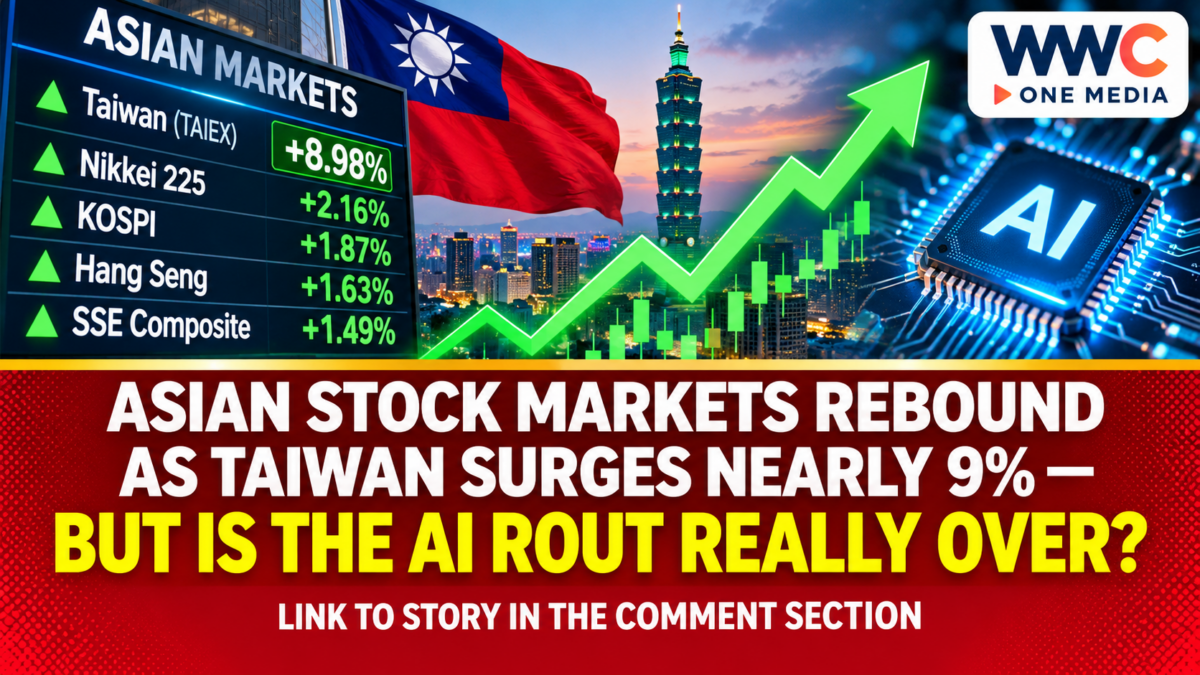
TAIPEI — Asian stock markets are facing a dramatic shift in momentum after Taiwan’s benchmark index reversed its early losses on Nov. 23, 2026, and surged nearly 9% the following day, following a bruising period of financial-market volatility.
The Taiwan Stock Exchange Capitalization Weighted Stock Index (TAIEX) closed at 40,122.35 on Nov. 24, gaining 3,310.46 points from Monday’s closing level.
The recovery follows mounting concerns about technology-sector valuations, artificial intelligence investment and potential changes in US monetary policy.
Meanwhile, South Korea has introduced temporary regulatory measures intended to give listed companies greater flexibility in repurchasing their own shares.
The developments raise an important question for investors across the Asia-Pacific: does the sharp rebound represent the beginning of a sustainable recovery, or merely a temporary reversal following substantial losses?
Asian Stock Markets: Taiwan Stages a Dramatic Reversal
Taiwan’s stock market experienced considerable volatility during Monday’s trading session.
The TAIEX opened at 35,899.48, below Friday’s closing level of 36,033.29. Selling pressure subsequently pushed the index to an intraday low of 35,442.41.
However, the benchmark recovered to finish Monday at 36,811.89, recording a gain of 778.60 points, or approximately 2.16%.
That improvement accelerated on Tuesday, when the benchmark reached an intraday high of 40,180.38 before closing at 40,122.35.
Despite the impressive recovery, Taiwan’s benchmark remained approximately 8.13% below its Nov. 13 closing level of 43,675.12.
The rebound must therefore be viewed in the context of Taiwan’s recent 17.5% weekly stock market decline.
The substantial losses recorded during the preceding week demonstrate why even unusually strong daily gains do not necessarily establish that a market has fully recovered.
South Korea Introduces Emergency Market Measures
South Korea’s government has responded to increased stock market volatility by implementing temporary regulatory changes.
Following an emergency market assessment on Nov. 22, the Financial Services Commission announced on Nov. 23 that it would relax daily purchase-order limits applicable to listed companies conducting share buybacks.
The measure takes effect on Nov. 24, 2026, and remains in force until Feb. 23, 2027.
The regulator identified uncertainty surrounding the global AI and semiconductor industries, together with the possibility of further US interest-rate increases, as factors affecting market conditions.
These developments build upon earlier concerns surrounding Asian stock markets and AI investment uncertainty.
The regulatory adjustment is intended to provide companies with greater flexibility during volatile market conditions.
However, it does not require companies to repurchase shares, nor does it guarantee that stock prices will increase.
How Corporate Share Buybacks Could Influence Market Confidence
A corporate share buyback occurs when a listed company purchases its own outstanding shares.
Depending on how the transaction is structured, repurchases can reduce the number of shares available to investors and influence measures such as earnings per share.
During periods of declining stock prices, companies with adequate financial resources may consider repurchases an attractive use of capital.
Nevertheless, the effectiveness of buybacks depends on several factors, including a company’s financial health, valuation, investment requirements and available cash.
South Korea’s temporary regulatory adjustment provides companies with additional flexibility but does not eliminate these financial considerations.
Investors should distinguish between regulatory permission to purchase shares and actual corporate commitments to undertake repurchases.
Subsequent stock exchange disclosures will be important in establishing whether companies make substantial use of the temporary rules.
AI Investment Remains Central to Regional Market Risks
The latest market movements highlight the distinction between developments in the technology industry and the prices investors are prepared to pay for technology shares.
A company can continue expanding its operations while experiencing a decline in its stock valuation.
Similarly, a sharp stock market recovery does not automatically establish that underlying corporate earnings have improved.
Taiwan’s experience illustrates why investors must assess export demand, corporate profitability and international investment flows separately.
Previous developments surrounding Taiwan’s AI-driven export expansion and currency pressures provide additional context for understanding these different economic forces.
For businesses connected to advanced computing, semiconductor production and digital infrastructure, the sustainability of AI investment remains an important consideration.
The critical issue is whether future revenues and profits can justify the capital being committed to these industries.
Stock market gains can reflect changing expectations, but those expectations must eventually be supported by commercial performance.
Japan’s Market Holiday Complicates Regional Comparisons
Japanese financial markets were closed on Nov. 23 for Labour Thanksgiving Day.
Japan Exchange Group also suspended holiday derivatives trading because of scheduled disaster-recovery testing conducted from Nov. 21 to 23.
The closure is an important consideration when comparing market movements across Asia.
While Taiwanese and South Korean investors were responding to developments on Monday, Japan’s regular equity market was not conducting a new trading session.
An unchanged Japanese benchmark on that date therefore should not be interpreted as evidence of stronger investor confidence or immunity from regional financial pressures.
Comparisons between different stock markets must account for trading calendars, local market conditions and the timing of international developments.
Is the Asian Stock Market Recovery Sustainable?
Taiwan’s two-session rebound provides evidence of renewed buying activity, but it does not establish that the broader correction has ended.
From Nov. 20 to Nov. 24, the TAIEX recovered approximately 11.35%.
Nevertheless, the benchmark had previously fallen substantially, leaving it below its earlier November levels.
The arithmetic of market losses is particularly important during periods of exceptional volatility.
When an index falls sharply, the percentage gain required to restore its original value is larger than the percentage decline it initially experienced.
Investors should therefore assess the full sequence of market movements rather than focusing exclusively on the latest daily percentage increase.
For Asia-Pacific economies, sustained financial-market stability will depend on multiple factors, including corporate profitability, financing conditions, international investment flows and confidence in economic policy.
What Happens Next?
South Korea’s temporary share repurchase rules are now in effect, while Taiwan’s latest closing figures demonstrate a substantial improvement from last week’s market lows.
The next indicators to watch include corporate buyback disclosures, technology-sector financial results and whether subsequent trading sessions sustain the recovery.
International interest-rate expectations and the commercial outlook for AI infrastructure could also influence investment decisions.
For now, the recovery offers a significant improvement from the preceding market turmoil.
But the most important question remains unanswered: whether stronger share prices will be supported by stronger corporate fundamentals over the coming months.
Frequently Asked Questions
Why did Asian stock markets experience increased volatility?
South Korea’s financial regulator identified uncertainty surrounding the global AI and semiconductor industries and possible US interest-rate increases as factors contributing to financial-market volatility.
How much did Taiwan’s stock market rise on November 24, 2026?
The TAIEX increased approximately 8.99%, gaining 3,310.46 points to close at 40,122.35.
Has Taiwan recovered all its recent stock market losses?
No. Its Nov. 24 closing level remained approximately 8.13% below its Nov. 13 closing level of 43,675.12.
What emergency market measure has South Korea introduced?
South Korea temporarily relaxed daily share repurchase order limits for listed companies from Nov. 24, 2026, until Feb. 23, 2027.
Why was Japan’s stock market closed on November 23?
Japan observed Labour Thanksgiving Day. Its derivatives markets were also closed because of scheduled disaster-recovery testing.