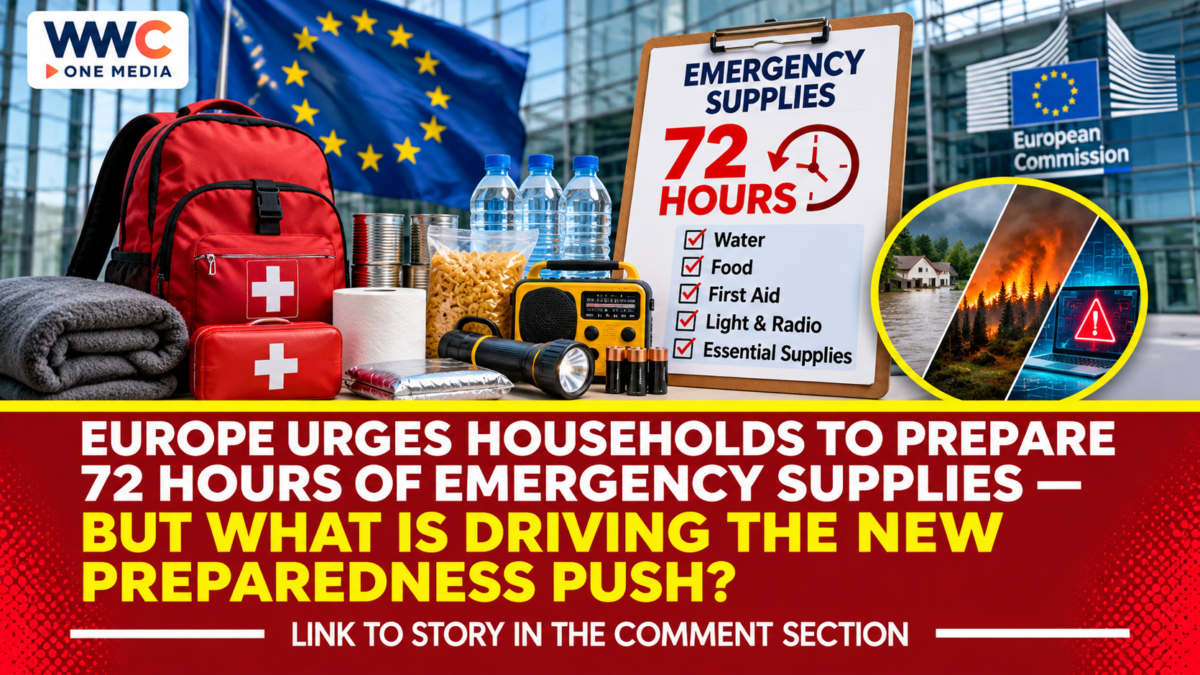
EUROPE— The European Commission introduced new emergency preparedness guidelines on Nov. 3, 2026, encouraging households to maintain sufficient essential supplies to manage the first 72 hours of a crisis while public assistance is mobilised.
The initiative follows the United Kingdom’s Oct. 22 launch of its Be Ready campaign, which encourages residents to prepare for temporary interruptions to electricity, water and communications services.
The economic effects of these initiatives are beginning to appear in official retail statistics, with British supermarkets reporting increased demand for long-life food products following the campaign’s introduction.
However, the government recommendations should not be interpreted as confirmation of an impending war or widespread food shortage. Their stated purpose is to strengthen household resilience against multiple potential emergencies.
Emergency Preparedness Becomes a European Policy Priority
The European Commission’s latest guidelines form part of the Preparedness Union Strategy adopted in March 2025.
The strategy addresses a range of risks, including natural disasters, geopolitical instability, cybersecurity threats and interruptions to critical infrastructure.
Rather than developing separate household preparedness systems for every possible emergency, the initiative encourages practical measures that could remain useful under different circumstances.
The November guidelines also place emphasis on accessible public warnings, preparedness education and the participation of people with disabilities in emergency planning.
These provisions recognise that household resilience involves more than purchasing additional groceries.
People may also need dependable communications arrangements, access to medication and assistance when normal transportation or utility services become unavailable.
The European guidelines are non-binding. They do not impose a universal legal obligation requiring households to purchase emergency supplies.
British Retail Statistics Reveal Changes in Consumer Spending
The United Kingdom’s preparedness campaign has already coincided with measurable changes in retail activity.
The Office for National Statistics reported on Nov. 20 that British retail sales volumes increased by 0.7% in October, following a revised decline of 0.6% in September.
Supermarkets reported stronger demand for products such as canned food and ultra-high-temperature-treated milk following the Be Ready campaign.
However, the overall retail increase cannot be attributed exclusively to emergency preparedness purchases. Other retail categories also contributed to the monthly improvement.
From a commercial perspective, government preparedness campaigns could influence inventory planning and purchasing patterns across grocery retailers and household goods suppliers.
The longer-term effect remains uncertain. Consumers who establish emergency reserves may subsequently replace those products periodically rather than continually expanding their purchases.
Retailers should therefore distinguish temporary increases in demand from sustained changes in household consumption.
What Governments Actually Recommend Households Prepare
Britain’s official preparedness checklist encourages families to maintain three days of drinking water and food that can be stored without refrigeration.
Its drinking water recommendation is three litres per person daily, with additional supplies needed for other household activities.
The guidance also identifies practical equipment, including battery-operated lighting, spare batteries, warm clothing, essential medication and copies of important documents.
For a household of four, the British drinking water recommendation would translate into 36 litres for three days, excluding additional requirements for cooking and hygiene.
Importantly, the government encourages families to build their reserves gradually according to their financial circumstances.
Households can review existing supplies before purchasing additional items and replenish their emergency provisions during ordinary shopping trips.
This approach differs from indiscriminate stockpiling, which could place unnecessary pressure on household budgets and local retail inventories.
WWC’s recent coverage of Thailand’s food stockpiling debate illustrates why governments must clearly distinguish routine emergency planning from warnings about actual supply shortages.
Why Household Preparedness Cannot Replace Government Assistance
Emergency supplies may help households manage temporary service interruptions, but individual preparation cannot address every vulnerability.
People with limited incomes, insecure housing arrangements or specialised medical needs may require additional support.
Britain’s campaign encourages eligible residents to register for additional assistance through its Priority Services Register, which helps utility providers identify customers requiring greater support during disruptions.
The initiative also encourages communication among neighbours and community organisations.
These measures highlight the importance of combining household preparation with accessible public services.
WWC’s reporting on Philippine disaster-readiness volunteer programmes provides a relevant comparison involving community participation in preparing emergency relief supplies.
From a policy perspective, household resilience and government preparedness should reinforce each other rather than transfer responsibility entirely to individuals.
What Filipino Families Can Learn From Europe’s Strategy
The European approach is particularly relevant to Philippine communities exposed to weather-related hazards and interruptions to essential services.
Quezon City’s official emergency go-bag guidance recommends preparing essential provisions for evacuation, including drinking water, food, medication, clothing, portable charging equipment and identification documents.
The city also recommends checking supplies regularly and replacing expired food and medication.
For Filipino households, emergency preparation can begin with identifying existing resources rather than purchasing expensive survival equipment.
Families should also consider local evacuation arrangements and the individual needs of children, older relatives and people requiring medical assistance.
WWC’s earlier examination of emergency food distribution to flood-affected communities in Zambales highlights the logistical difficulties that may arise when transportation infrastructure becomes disrupted.
Keeping appropriate household supplies could provide temporary support during such interruptions, but residents should always follow evacuation instructions and official emergency warnings.
What Happens Next?
The European Commission has proposed establishing an annual EU Preparedness Day on Oct. 23, beginning in 2027.
The proposal would create a recurring opportunity to strengthen public awareness and encourage community participation in disaster preparedness.
Britain’s Be Ready initiative is also designed as a three-year campaign rather than a short-term emergency warning.
For businesses, future retail statistics may provide further insight into whether preparedness campaigns produce lasting changes in consumer spending.
For households, the more important objective is maintaining practical supplies without excessive purchasing or unnecessary financial pressure.
The European initiatives demonstrate that emergency preparedness can become part of everyday planning without requiring people to assume that a major disaster is imminent.
Frequently Asked Questions
Why is Europe recommending 72 hours of emergency supplies?
The guidelines aim to help households meet essential needs during the initial stages of an emergency while authorities organise assistance.
Does the recommendation mean Europe is preparing for an imminent war?
The guidance covers multiple potential hazards and does not, by itself, establish that war or another catastrophe is imminent.
How much drinking water does Britain recommend storing?
Its checklist recommends three litres per person daily for three days, with additional water required for other household activities.
Are Europeans legally required to stockpile food?
The European Commission’s November preparedness guidelines are non-binding.
Should Filipino families prepare emergency supplies?
Philippine local government guidance already encourages households to maintain emergency go bags suited to their individual needs and local disaster risks.