
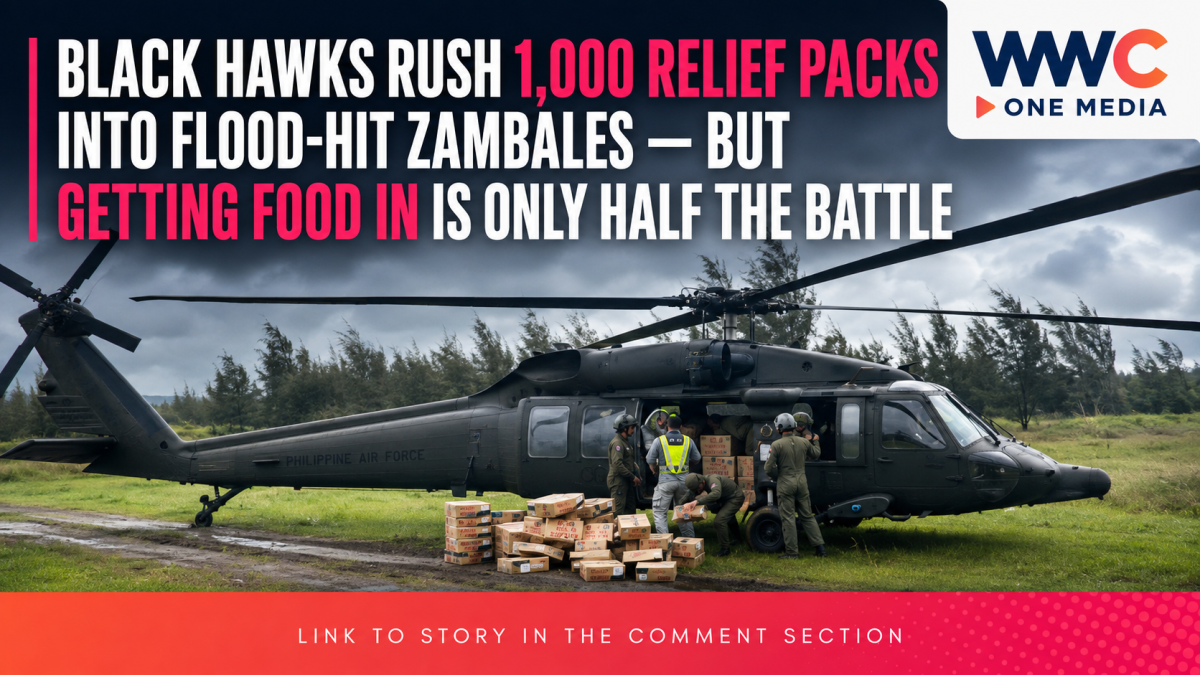
MANILA, Philippines — Philippine Air Force Black Hawk helicopters have airlifted 1,000 family food packs to flood-stricken communities in Zambales, underscoring the growing logistical challenge facing authorities as weeks of heavy monsoon rains leave roads damaged, bridges impassable and thousands of residents displaced.
The Philippine Air Force said its S-70i Black Hawk helicopters transported the Department of Social Welfare and Development relief supplies from Clark Air Base in Pampanga on September 1 for delivery to Barangay Santa Fe in San Marcelino, Zambales.
The mission was conducted through the PAF’s Tactical Operations Wing Northern Luzon and Air Logistics Support Command, in coordination with the Philippine Army and other government agencies.
Air Force spokesperson Col. Ma. Christina Basco said the deployment was part of continuing humanitarian assistance and disaster response operations aimed at getting essential supplies to communities hit by recent weather disturbances.
But the 1,000-pack airlift tells only part of a much larger disaster story unfolding across Central Luzon.
Zambales Faces Repeated Flooding and Damaged Access Routes
San Marcelino has been among the Zambales communities repeatedly battered by heavy rainfall associated with the southwest monsoon, or Habagat.
GMA News reported that floodwaters became powerful enough in San Marcelino to undermine a house, forcing residents to evacuate before the structure eventually collapsed. Relief operations in the municipality were also temporarily suspended at one point after floodwaters overwhelmed a road.
The damage has made reaching some communities increasingly difficult.
Another report said a bridge serving Barangay Santa Fe was rendered unusable after strong currents and swollen rivers battered the area, cutting an important access route to residents.
That helps explain why military aircraft are becoming an increasingly important part of the government’s relief operation.
When conventional roads cannot safely carry trucks loaded with food and emergency supplies, helicopters can become one of the quickest ways to reach stranded or geographically isolated communities.
More Than 10,000 Evacuated in Zambales
The humanitarian situation extends well beyond San Marcelino.
Zambales Governor Hermogenes Ebdane Jr. said around 3,800 families, or 10,442 people, had been evacuated as of late August as severe flooding affected several communities, including San Marcelino, San Antonio and Cabangan.
Ebdane also appealed for urgent national government assistance in repairing infrastructure damaged by the Habagat, warning that broken roads and bridges could complicate both relief delivery and the province’s recovery.
Olongapo City, meanwhile, declared a state of calamity on September 1 after extraordinary rainfall caused flooding, landslides, property damage and displacement.
According to the Philippine Daily Inquirer, Olongapo recorded about 2,900.5 millimeters of rainfall during August—roughly 3.47 times its normal August rainfall. At least 13 of the city’s 17 barangays experienced flooding during one particularly severe period.
The scale of the rainfall highlights why emergency response teams have struggled with repeated flooding even after waters temporarily recede.
DSWD Expands Ground and Air Relief Operations
The Department of Social Welfare and Development has also been carrying out direct relief distributions in Zambales.
Radyo Pilipinas reported that DSWD teams were able to bring 1,037 boxes of family food packs to affected residents in San Marcelino despite an impassable bridge and severe flood damage. Social Welfare Secretary Rex Gatchalian also visited communities in Zambales and Pampanga as authorities assessed the needs of displaced families, including members of Aeta communities.
The 1,000 food packs transported by the Air Force on September 1 were part of the continuing effort to maintain the flow of supplies to places where conventional transportation has become unreliable.
The government has increasingly relied on a combination of military aircraft, emergency vehicles and other logistical support when floods and landslides isolate communities.
Disaster Impact Has Reached Millions Nationwide
Zambales is only one part of a much wider emergency.
The Office of Civil Defense said on September 2 that approximately 9.4 million people nationwide had been affected by the combined effects of tropical cyclones and the continuing southwest monsoon.
Infrastructure damage was estimated at roughly ₱6.27 billion, while agricultural losses had reached around ₱2.84 billion, according to figures reported by the Philippine News Agency.
Thousands of homes were also reported damaged or destroyed.
Central Luzon has emerged as one of the hardest-hit regions.
Separate government figures reported hundreds of flooded areas across Bataan, Bulacan, Nueva Ecija, Pampanga, Tarlac and Zambales as repeated rainfall overwhelmed rivers, drainage systems and transportation infrastructure.
The Bigger Challenge Comes After the Airlift
The Black Hawk operation shows how military air power can provide a crucial lifeline when communities become inaccessible.
But delivering emergency food is only the first phase.
For Zambales, the larger challenge will be restoring damaged bridges and roads, helping displaced families return home safely, repairing public infrastructure and supporting communities whose livelihoods have been disrupted by weeks of flooding.
Until those access routes are restored—and until weather conditions stabilize—helicopters, emergency crews and government relief convoys may remain critical to keeping isolated communities supplied.
For residents of San Marcelino and other flood-hit towns, the question is therefore no longer simply whether relief can reach them today.
It is how long communities will have to depend on emergency lifelines before normal access—and normal life—can finally return.
WWC ONE MEDIA MJE



Leave a Reply