
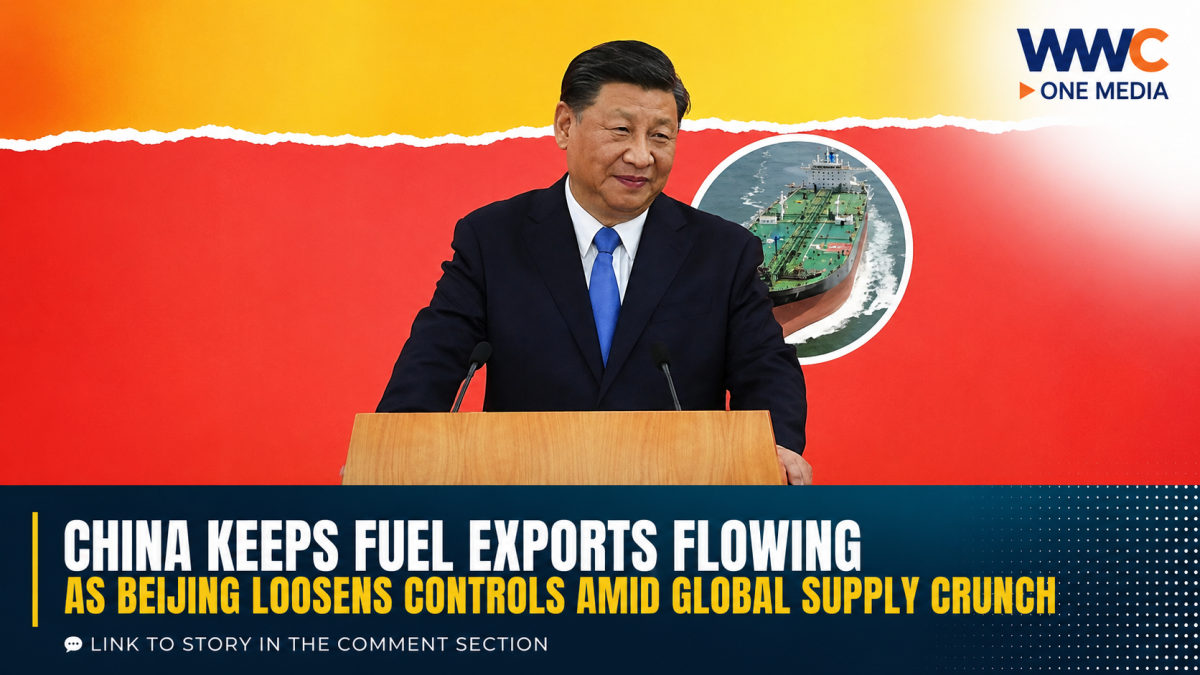
China is preparing to keep its refined-fuel exports roughly steady in September, signaling that Beijing is becoming more willing to let refiners take advantage of lucrative overseas markets even as global fuel supplies remain tight.
Five trade sources told Reuters that Chinese refiners are expected to export slightly more than 4 million metric tons of gasoline, diesel and jet fuel in September. That would be above China’s average monthly exports of about 3 million tons for those products last year.
The development is significant because Beijing had sharply restricted fuel exports earlier this year to protect domestic supplies after the conflict involving the United States and Iran disrupted crude flows from the Middle East.
Now, with international refining margins elevated, China appears increasingly willing to reopen the export tap.
China Is Releasing More Fuel Into the Global Market
The expected September shipments include:
- Up to 2.4 million tons of jet fuel
- More than 1 million tons of diesel
- Up to 600,000 tons of gasoline
The figures are based on estimates from trade sources and Chinese consultancies that track the sector. Official August trade data is not expected until later in September.
August exports were estimated at similar levels, with roughly 700,000–800,000 tons of gasoline, 1.1–1.2 million tons of diesel and 2.2 million tons of jet fuel.
Some September cargoes were also rolled over from August because of tight shipping schedules.
That means the headline figure should be treated as an industry estimate rather than confirmed customs data.
Why Beijing Changed Course
China began restricting refined-fuel exports in March as the Middle East conflict disrupted crude supplies.
The goal was straightforward: protect China’s domestic fuel market while uncertainty over international oil supplies remained high.
But conditions have changed.
Global crude supplies have partially recovered, while refined products remain relatively scarce.
Russia—once a major exporter of refined fuel—has suffered refinery disruptions and domestic shortages, while fuel exports from the Middle East remain constrained. Russia has now extended its diesel export ban through Sept. 30, adding another layer of pressure to the international market.
That has created an opportunity for Chinese refiners.
With overseas fuel prices and refining margins significantly higher, exporting additional barrels can be considerably more profitable.
Diesel Margins Have Exploded
Diesel is particularly attractive.
Some Chinese refiners are reportedly achieving export margins of more than 1,500 yuan per metric ton, according to trade sources.
Asian diesel refining margins are around US$70 per barrel, more than three times their level before the Iran conflict began.
That creates a powerful incentive for refiners to produce and sell more fuel internationally.
And China’s move could have consequences well beyond its borders.
More Chinese diesel, gasoline and jet fuel entering Asian markets could increase regional supply and potentially limit further price increases, particularly while supplies from Russia and the Middle East remain constrained.
China’s Export Policy Has Been Easing for Months
September’s expected shipments are not an isolated decision.
Beijing began loosening its restrictions in July.
In June, China had set a July export allowance of around 800,000 tons for state-owned refiners, according to trade sources. The government subsequently lifted destination restrictions for July and allowed Zhejiang Petrochemical Corp to resume exports after a four-month suspension.
By August, refiners received approval to export 2.7 million tons of gasoline, diesel and jet fuel to destinations excluding Hong Kong and Macau, with some unused allowances allowed to roll into September.
The September outlook therefore represents another step in China’s gradual return toward more normal refined-fuel exports.
July Data Shows Just How Quickly Exports Rebounded
China’s customs data already showed a significant recovery in July.
Refined oil product exports rose 6.7% from June to 4.65 million tons, although they remained 12.9% below July 2025.
Diesel exports climbed 88% month on month to about 810,000 tons, while aviation-fuel exports increased 42% to approximately 1.32 million tons. Gasoline exports also rebounded sharply from June.
The figures show that China is not simply announcing higher export allowances—the physical flow of fuel has already begun recovering.
Southeast Asia Could Be One of the Biggest Beneficiaries
China’s returning fuel exports are particularly important for Asia.
July trade data showed Southeast Asian countries receiving the majority of China’s diesel shipments outside Hong Kong and Macau.
Singapore, Malaysia and Myanmar were among the main destinations for Chinese gasoline, while Southeast Asia also received a substantial share of China’s additional jet-fuel shipments.
That could become increasingly important if other traditional suppliers remain constrained.
For fuel-importing economies across Asia, additional Chinese cargoes could provide another source of supply at a time when global refining capacity remains under pressure.
But China Isn’t Turning the Taps Fully Open
There is an important caveat.
Beijing still controls refined-fuel exports through a quota system, meaning the government can adjust shipments depending on domestic supply and market conditions.
China’s first 2026 quota batch allocated 19 million tons for gasoline, diesel and jet fuel, broadly in line with the previous year. A second batch allocated another 18 million tons across refined and marine fuels.
More than 60% of the latest September export allowances were reportedly granted to state-owned PetroChina and Sinopec, with Zhejiang Petrochemical receiving a substantial allocation as well.
So this is better described as controlled liberalisation, not a complete abandonment of China’s export restrictions.
China’s Fuel Strategy Is Also Being Shaped by Its Oil Supply
Another major development is happening inside China’s crude-oil market.
Reuters reported on Sept. 2 that Sinopec is increasing purchases of Russian crude, particularly the ESPO blend, as Middle Eastern supplies remain constrained.
The company is reportedly seeking as many as 20 October shipments, equivalent to more than 400,000 barrels per day, according to trading sources.
Cheaper Russian crude can help Chinese refiners capture higher margins while supporting the production of refined fuels for both domestic and international markets.
That creates an important link between China’s crude procurement strategy and its renewed fuel exports.
Why This Matters for Global Fuel Prices
The global energy market is currently experiencing a strange imbalance.
Crude supplies have improved from the worst point of the Middle East crisis, but refined fuel remains much tighter.
Russia’s refinery problems, reduced Middle Eastern exports and other disruptions have created shortages particularly in diesel and other middle distillates.
Reuters recently reported that diesel exports from Russia, the Middle East and major Asian suppliers were 1.3 million barrels per day lower in July than a year earlier, highlighting how severely the refined-fuel market has been affected.
China’s decision to increase exports therefore arrives at a critical moment.
More Chinese fuel could help fill part of that gap—but whether it is enough to significantly lower prices will depend on how long Beijing maintains the more relaxed policy and whether other major suppliers recover.
The Bigger Question: How Far Will China Go?
The September numbers suggest Beijing is becoming more comfortable allowing refiners to sell abroad when international margins are attractive.
But China’s government still has to balance export profits against domestic energy security.
If global fuel prices remain high and domestic inventories remain comfortable, refiners could have an incentive to push more cargoes overseas.
If another supply shock hits crude imports or domestic demand rises sharply, Beijing could tighten the controls again.
For now, however, China’s message to the fuel market is becoming clearer:
The world’s biggest oil importer is once again becoming a more important source of refined fuel for Asia.
And with Russia extending its diesel export restrictions and Middle Eastern supplies still constrained, China’s next quota decision could have an outsized impact on regional fuel prices.
Accuracy Note
The slightly more than 4 million-ton September export figure is an estimate from five trade sources and two Chinese consultancies, not confirmed official customs data. China’s National Development and Reform Commission had not immediately responded to Reuters’ request for comment, and official August trade data was still pending.
The broader trend—China gradually easing restrictions after sharply reducing exports earlier in 2026—is supported by previous Reuters reporting and July customs data.
WWC ONE MEDIA J.M.D




Leave a Reply