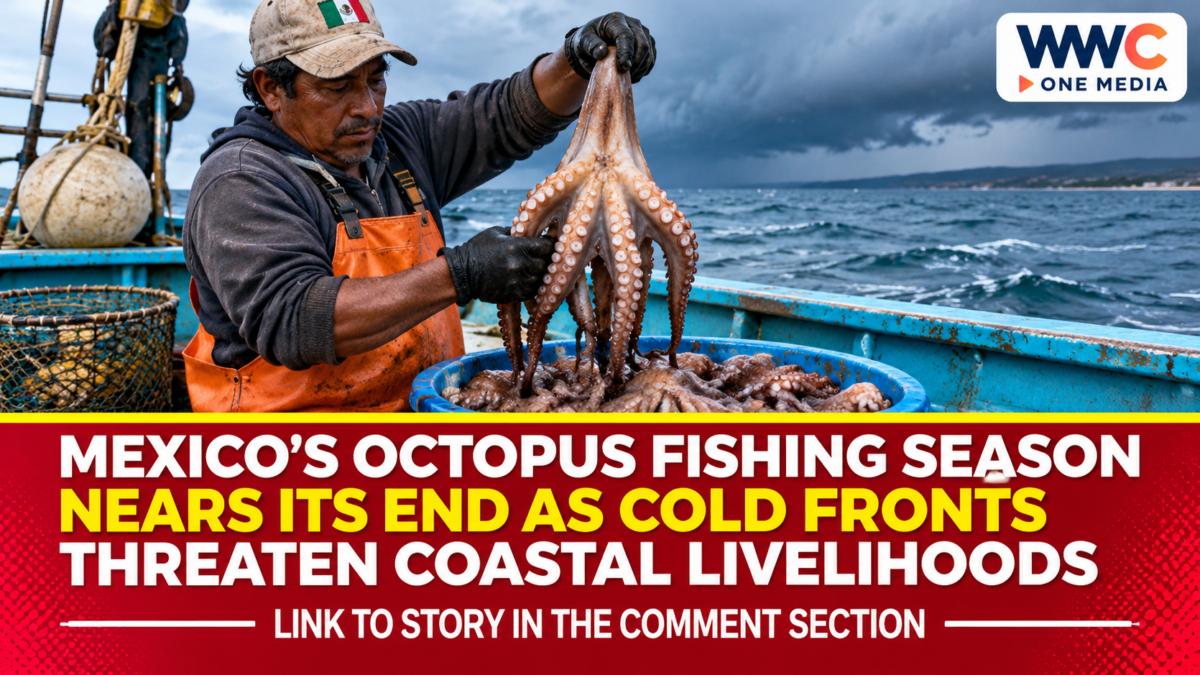
MANILA, Philippines — Mexico’s coastal fishing communities face renewed weather risks as the country’s National Meteorological Service issued a Nov. 23, 2026, forecast warning of heavy rainfall across parts of Quintana Roo.
The adverse weather comes as the annual octopus fishing season approaches its Dec. 15 deadline, leaving fishing enterprises with a limited period to complete their remaining seasonal operations.
For communities such as Chiquilá and Holbox, the combination of weather exposure and seasonal fishing restrictions highlights a broader economic vulnerability.
When unsafe maritime conditions interrupt fishing activities, households and seafood businesses may have fewer opportunities to recover lost income before mandatory conservation periods begin.
Mexico’s Octopus Fishing Season Approaches Its December Deadline
Mexico’s federal fisheries regulations establish an annual red octopus fishing season from Aug. 1 to Dec. 15 across Campeche, Yucatán and northern Quintana Roo.
The corresponding closed season runs from Dec. 16 to July 31.
These restrictions are intended to protect marine resources during their reproductive period and support the long-term sustainability of commercial fisheries.
The country’s federal fisheries authorities recognise two principal species supporting octopus production in the Gulf of Mexico and Caribbean region: the red octopus, scientifically known as Octopus maya, and Octopus americanus.
Red octopus has historically represented approximately 75% of the region’s combined octopus catches since 1998.
The economic implications of the seasonal restrictions are particularly important when adverse weather occurs shortly before the closing date.
Unlike businesses that can postpone production indefinitely, seasonal fisheries operate within legally defined periods. Fishing opportunities lost near the end of a season may therefore be difficult to recover.
Cold Front No. 8 Brings Additional Weather Concerns
Mexico’s National Meteorological Service forecast rainfall of between 50 and 75 millimetres in coastal and southern Quintana Roo on Nov. 23.
The forecast identified cold front No. 8, an associated Arctic air mass and several interacting atmospheric systems as contributing factors to the expected weather conditions.
Authorities also advised residents to follow official meteorological announcements and recommendations from civil protection agencies.
These forecasts provide important regional context for fishing communities, although they do not establish the precise operating conditions of individual ports.
A verified maritime closure notice covering Chiquilá and Holbox during the reported disruption was not available in the official records reviewed.
Nevertheless, adverse weather can create practical difficulties for coastal enterprises, particularly those relying on small vessels and predictable access to fishing grounds.
WWC’s coverage of monsoon-related weather risks and coastal conditions in the Philippines examines a comparable concern involving maritime safety and weather-dependent activities.
Mexico Sets a 30,000-Tonne Red Octopus Catch Limit
A federal agreement published on Nov. 17 established a maximum permitted red octopus catch of 30,000 tonnes for the 2026 fishing season in Campeche and Yucatán.
The limit follows a technical recommendation issued by the Mexican Institute for Research in Sustainable Fisheries and Aquaculture on Aug. 3.
The agreement specifies that the permitted volume is measured using the fresh, whole weight of the harvested octopus.
Importantly, the 30,000-tonne limit applies to Campeche and Yucatán. It should not be interpreted as a catch allocation specifically available to fishing communities in Quintana Roo.
A permitted maximum also differs from actual production.
Commercial catches depend on fishing effort, weather conditions, resource availability and compliance with applicable regulations.
From a policy perspective, conservation measures seek to balance immediate commercial activity against the need to maintain productive marine populations.
Any proposal to extend a fishing season would therefore require consideration of scientific evidence, legal requirements and potential consequences for future harvests.
Quintana Roo Has an Existing Fisherfolk Assistance Programme
The Quintana Roo government has established a fisheries support programme intended to help eligible fishing households during regulated closed seasons.
An official 2026 state government announcement identifies total programme investment of MX$3,303,428, covering 1,251 beneficiaries across eight municipalities.
Lázaro Cárdenas accounts for 472 beneficiaries under the announced programme.
Each recipient receives a one-time annual food assistance allocation worth MX$2,640 through the programme.
These measures are intended to support household food security while encouraging compliance with fisheries conservation requirements.
However, assistance associated with a legally mandated closed season serves a different purpose from compensation for unexpected weather-related interruptions.
The existing programme does not establish that additional emergency financial assistance has been approved specifically for the November weather disturbances.
This distinction matters when assessing whether existing government support adequately addresses the different economic risks facing coastal households.
Seafood Businesses Face Wider Supply-Chain Risks
Weather-related fishing disruptions could affect more than the crews operating commercial boats.
Seafood buyers, food vendors, transportation providers and restaurants may also experience difficulties when fresh products become temporarily less available.
Businesses dependent on regular seafood deliveries may need to adjust purchasing arrangements, maintain suitable inventory or identify alternative suppliers.
The financial consequences would depend on actual catch volumes, customer demand and the availability of substitute products.
No independently verified local market records establish current octopus prices or restaurant sales figures for Chiquilá and Holbox.
However, the relationship between weather and seafood availability presents a relevant comparison with the Philippine experience.
WWC’s examination of weather-related damage to Philippine farms and fisheries highlights how interruptions to food production and distribution can create pressure throughout the supply chain.
Similarly, WWC’s reporting on livelihood challenges facing Hagonoy fisherfolk provides context for understanding why restoring access to fishing grounds may not immediately resolve household financial difficulties.
Potential long-term responses could include livelihood diversification, appropriate emergency assistance, improved seafood storage infrastructure and better access to business financing.
What Happens Next?
With the regular octopus fishing season scheduled to conclude on Dec. 15, the immediate priorities include monitoring maritime conditions, confirming permitted fishing activity and assessing the effectiveness of existing livelihood support.
Any extension of the fishing season would need to be established through the appropriate official regulatory process.
Fishing enterprises should not assume that weather-related interruptions automatically change the legally established closing date.
For policymakers, the broader challenge is developing assistance mechanisms that protect coastal livelihoods without compromising marine conservation objectives.
The long-term economic health of fishing communities depends not only on the volume harvested during a particular season but also on maintaining productive marine resources and helping households withstand periods when fishing is unavailable.
Frequently Asked Questions
When does Mexico’s octopus fishing season end?
The regular season concludes on Dec. 15 in Campeche, Yucatán and northern Quintana Roo.
What weather system is affecting Mexico?
The Nov. 23 meteorological bulletin identified cold front No. 8 and several interacting atmospheric systems.
What is Mexico’s 2026 red octopus catch limit?
The federal government established a 30,000-tonne maximum for Campeche and Yucatán.
Does Quintana Roo provide assistance to fisherfolk?
Yes. Its 2026 fisheries support programme provides eligible beneficiaries with annual food assistance worth MX$2,640.
Has the octopus fishing season been officially extended?
The official records reviewed do not establish an approved extension.