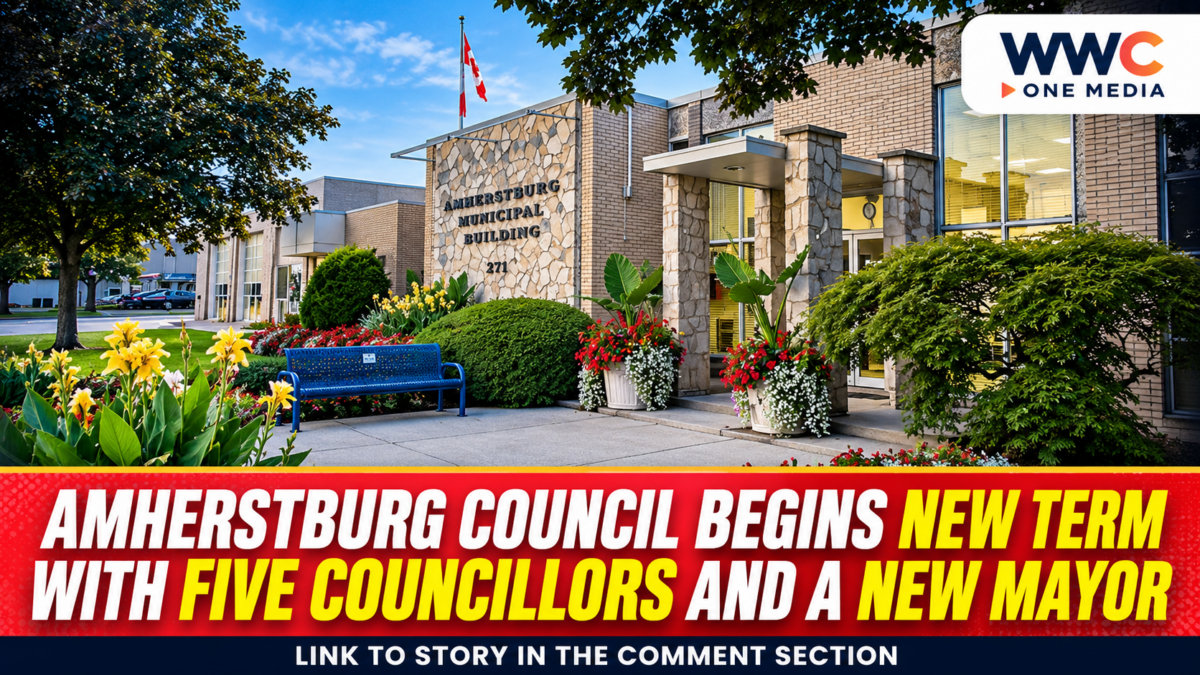
AMHERSTBURG, Ontario — November 24, 2026 — Amherstburg has entered its 2026–2030 municipal council term following an election that placed Chris Gibb in the mayor’s office, William (Bill) Petruniak in the deputy mayor’s position and five councillors on the town’s governing body.
The new council’s inaugural ceremony was scheduled for November 23 at the Libro Credit Union Centre, following the certification of municipal election results on October 27. The election recorded 9,028 ballots from 21,759 eligible electors, producing a voter turnout of 41.49%.
The leadership transition marks the beginning of a four-year period in which Amherstburg’s elected representatives will be responsible for municipal decisions affecting local services, infrastructure, development, public spending and community priorities. Town of Amherstburg+2
Amherstburg council enters a new four-year mandate
The certified election results identify Chris Gibb as Amherstburg’s next mayor, succeeding the previous municipal leadership after the October 26 election.
William (Bill) Petruniak secured the deputy mayor’s position. Five councillors were also elected to serve alongside them: Molly Allaire, Keith Boussey, Peter Courtney, Jen DeLuca and Wes Ewer.
The town’s inaugural ceremony was announced for November 23, 2026, at 6 p.m. in the Community Room at the Libro Credit Union Centre, located at 3295 Meloche Road.
The municipality’s announcement stated that the formal proceedings would include the signing of Declarations of Office and remarks recognizing the new council term.
The ceremony was also scheduled to be livestreamed through the town’s official website.
The distinction between an election result and the formal organization of a council matters. Winning an election establishes who has been chosen by voters, while the required declarations and organizational procedures allow the incoming governing body to formally undertake its responsibilities. Town of Amherstburg+2
Election results show how Amherstburg voted
The certified results provide a clearer picture of the choices made by local voters.
Gibb received 3,928 votes in the mayoral contest, ahead of Bill Fryer, who received 3,284, and Michael Prue, who received 1,704.
In the deputy mayor’s race, Petruniak received 5,146 votes, compared with 3,590 for Linden Crain.
The five councillors elected were:
| Councillor | Votes |
|---|---|
| Jen DeLuca | 5,597 |
| Molly Allaire | 5,226 |
| Peter Courtney | 3,813 |
| Wes Ewer | 3,370 |
| Keith Boussey | 2,896 |
These figures are important because they establish the actual results rather than relying on campaign expectations or unofficial projections.
DeLuca received the highest vote total among the councillor candidates. The figures also show that the five available council positions attracted candidates with differing levels of voter support.
The certified election record additionally lists 11 declined and rejected ballots. Town of Amherstburg+1
What the 41.49% turnout says about local participation
One of the most significant figures from the election is the 41.49% turnout.
Of the 21,759 eligible electors, 9,028 ballots were recorded. This means fewer than half of the eligible electorate participated in the municipal vote.
That figure does not establish why other eligible electors did not vote. It would be inappropriate to assume that non-participation reflected dissatisfaction, political disengagement or support for any particular candidate.
However, turnout remains an important measure when examining participation in local democracy.
Municipal governments make decisions that can have direct effects on residents’ everyday lives. These include roads, drainage, recreation facilities, development approvals, waste services and local financial planning.
For that reason, public engagement does not end when election results are certified. Residents can continue participating through council meetings, public consultations, written submissions and other established municipal processes.
WWC ONE MEDIA has previously examined how local government leadership changes can affect the continuity of City Hall operations.
The new council’s first major task: governing beyond election promises
An election determines who receives public office, but the work of governing begins with the decisions made after the campaign.
Amherstburg’s incoming leadership will have to address the municipality’s operational priorities while balancing public expectations with available resources.
The town’s approved 2026 meeting schedule identifies early 2027 as the period for deliberations on the 2027 municipal budget following the election and inaugural meeting.
That makes the budget process an important early test of the new council’s priorities.
Municipal budgets translate policy decisions into spending plans. They determine how available resources are allocated among operating services, infrastructure, maintenance, capital projects and other municipal responsibilities.
Residents and businesses have an interest in understanding how those decisions are made because local spending priorities can influence service delivery and the municipality’s longer-term financial position.
The incoming council will therefore need to demonstrate how its decisions respond to community needs while remaining financially responsible. pub-amherstburg.escribemeetings.com+1
Why transparency will matter during the 2026–2030 term
The new council’s responsibilities extend beyond approving individual projects or attending scheduled meetings.
Public confidence in local government also depends on the availability of information about decisions, spending and municipal priorities.
Open meetings, accessible agendas, published minutes and clear explanations of major decisions help residents understand how their elected representatives exercise public authority.
This is particularly relevant when councils consider infrastructure spending, development proposals and changes to municipal services.
The issue is not unique to Amherstburg. Across different jurisdictions, local governments face continuing pressure to make decision-making more accessible and accountable.
WWC ONE MEDIA has also reported on the importance of transparency and accountability among local government leaders.
Another relevant debate concerns the length and continuity of elected officials’ mandates, including proposals to change the terms of barangay and Sangguniang Kabataan officials.
Although those Philippine developments involve a different legal system, they illustrate a broader governance question: how can local institutions maintain continuity while ensuring that public officials remain accountable to voters?
For Amherstburg, the answer will ultimately be reflected in the new council’s decisions and the public’s ability to scrutinize them.
What happens next
The immediate next step is the council’s regular governing work following its inaugural proceedings.
The town’s published meeting schedule points to early 2027 budget deliberations as a significant upcoming responsibility.
Residents can monitor council business through the municipality’s meeting agendas, minutes and livestream facilities. These records provide opportunities to follow proposed decisions and understand how municipal policies develop.
The 2026–2030 term gives the newly elected leadership a defined period to translate its mandate into public decisions.
Whether the council meets residents’ expectations will depend not only on the promises made during the election but also on the quality, transparency and financial discipline of its work throughout the term.
Frequently asked questions
1. Who is the new mayor of Amherstburg, Ontario?
Chris Gibb won the mayoral position in Amherstburg’s 2026 municipal election.
2. Who is the new deputy mayor?
William (Bill) Petruniak won the deputy mayor’s position with 5,146 votes.
3. Who are the five Amherstburg councillors for 2026–2030?
The elected councillors are Molly Allaire, Keith Boussey, Peter Courtney, Jen DeLuca and Wes Ewer.
4. How many people voted in Amherstburg’s 2026 municipal election?
The certified results recorded 9,028 ballots from 21,759 eligible electors, representing 41.49% turnout.
5. When was Amherstburg’s new council inaugural ceremony scheduled?
The town scheduled its inaugural ceremony for November 23, 2026, at 6 p.m. at the Libro Credit Union Centre.
6. What is the new Amherstburg council expected to work on first?
One major upcoming responsibility is deliberating on the municipality’s 2027 budget, scheduled for early 2027.