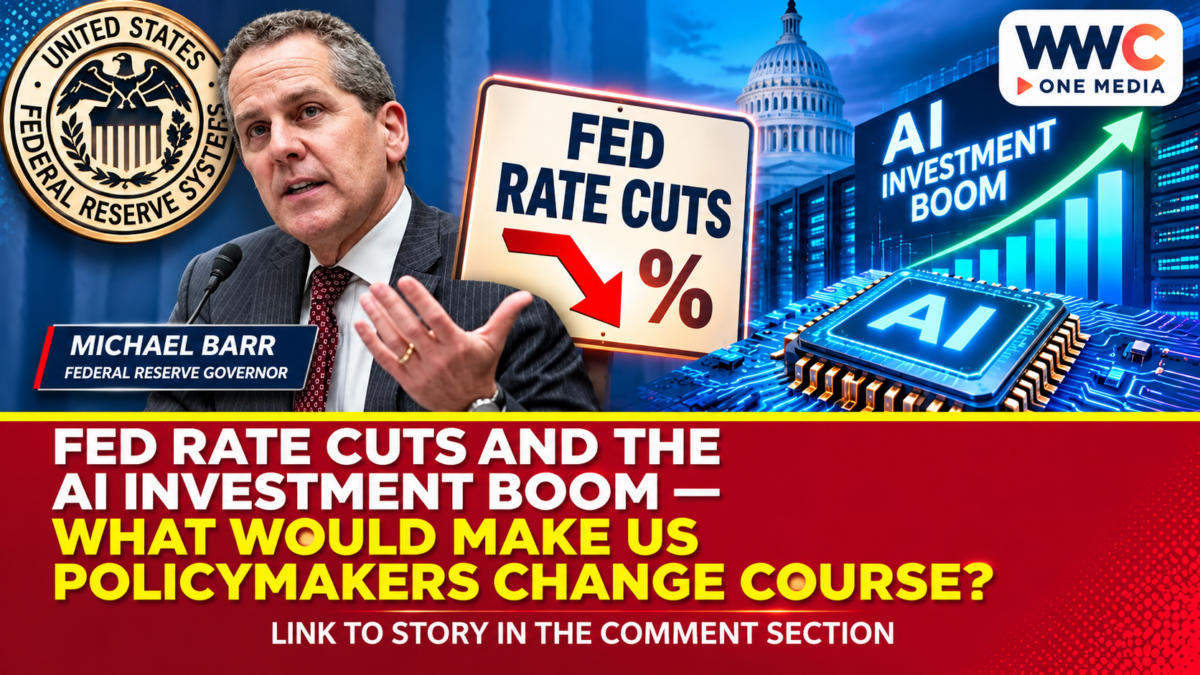
WASHINGTON — Federal Reserve Governor Michael Barr warned on Nov. 16, 2026, that disappointing returns from artificial intelligence investment could have consequences for US economic growth. Minutes of the central bank’s October policy meeting, released Nov. 18, showed that policymakers were also examining the relationship between asset prices, borrowing and financial stability.
The prospect of Fed rate cuts therefore deserves examination as a conditional economic scenario, not an announced policy change. With inflation still elevated, the central bank faces a difficult question: would a technology investment downturn sufficiently weaken demand to justify lower interest rates?
For households, companies and investors, the answer depends less on the size of a stock market decline than on what happens to employment, spending and access to financing afterwards.
Fed rate cuts face an inflation hurdle
The Federal Open Market Committee maintained its benchmark interest-rate range at 3.75% to 4.00% on Oct. 28. The decision passed by a 10–2 vote, with the dissenting members preferring a quarter-percentage-point increase.
The minutes show that almost all participants anticipated further increases under their baseline economic outlooks. That assessment was conditional rather than a binding commitment.
WWC ONE MEDIA’s earlier coverage of Philadelphia Fed President Anna Paulson’s monetary policy outlook provides additional context for the debate over persistent inflation.
WWC analysis: A decline in technology shares alone would not establish that monetary policy is too restrictive. Policymakers would need to assess whether the decline changes the outlook for the wider economy and the return to their 2% inflation objective.
AI financing creates risks beyond share prices
Barr’s November remarks highlighted the growing obligations associated with the expansion of computing infrastructure. He projected that balance-sheet debt at the seven largest AI companies would exceed US$800 billion before the end of 2026.
He also discussed estimates placing the potential maximum nominal value of off-balance-sheet obligations above US$3 trillion. These include contractual commitments and guarantees. That estimate is not equivalent to an immediate payment requirement or a forecast of losses.
Consider a hypothetical data-centre developer that depends on borrowed funds and long-term customer contracts. If expected demand weakens, its ability to finance additional construction could deteriorate. A project that initially appeared commercially attractive might then require renegotiation or postponement.
The financial question extends beyond the market value of technology companies. It concerns whether commitments made during a period of optimism remain affordable when expectations change.
WWC’s previous examination of AI bond spreads and data-centre investment provides further context for assessing those financing pressures.
How an investment slowdown could reach households
WWC analysis: A technology-sector adjustment could affect the wider economy through several channels. Businesses could postpone construction, suppliers could receive fewer orders and households experiencing investment losses could become more cautious about discretionary purchases.
These outcomes would not necessarily occur together. A company with sufficient cash and firm customer commitments could continue investing even when its share price falls. Another business dependent on fresh financing might respond differently.
The distinction matters because a central bank cannot determine the appropriate interest rate simply by observing the value of listed companies. It must assess whether changing financial conditions alter demand, employment and inflation.
Federal Reserve Vice Chair for Supervision Michelle Bowman addressed related concerns in her Nov. 10 speech, noting weaker technology valuations and tighter private financing conditions. She also identified a substantial equity correction as a potential economic risk if AI returns disappoint.
Why financial stability does not automatically require cheaper money
The October meeting minutes distinguish between measures intended to maintain functioning financial markets and changes to the broader monetary policy stance. Several participants questioned the suitability of monetary policy as a direct response to financial stability vulnerabilities.
WWC analysis: This distinction gives policymakers more than one possible course of action. If a financial institution faces temporary funding difficulties while inflation remains persistent, targeted liquidity assistance may address a different problem from a reduction in the benchmark rate.
Conversely, a sustained downturn affecting employment and household demand could alter the economic case for interest-rate policy itself.
The two approaches should not be confused. Measures intended to preserve orderly markets are not necessarily evidence that policymakers intend to stimulate the entire economy.
What the uncertainty means for Philippine businesses
For Philippine companies, the implications of US monetary policy are not confined to American equity markets. As an analytical matter, changes in global borrowing costs and investor appetite can affect the terms on which businesses seek dollar financing.
A lower US policy rate would not guarantee cheaper corporate loans. Lenders could demand additional compensation for credit risk during a period of uncertainty. Currency movements could also change the peso cost of servicing dollar-denominated obligations.
WWC’s earlier analysis of US Treasury yields and the December interest-rate debate illustrates why government bond yields and the benchmark policy rate deserve separate attention.
For local businesses, reviewing debt maturity schedules and exposure to exchange-rate movements may be more useful than assuming a particular Federal Reserve decision.
What happens next
The FOMC is scheduled to meet on Dec. 8–9, with updated economic projections expected alongside its decision.
The important evidence will be whether inflation moderates, labour demand weakens and financing conditions deteriorate sufficiently to change policymakers’ assessment. Corporate disclosures on investment commitments and actual spending could also help clarify whether technology-sector uncertainty is translating into a broader slowdown.
An AI investment correction is a risk scenario, not proof of an impending recession. Equally, an economically useful technology can coexist with investments that fail to meet initial commercial expectations.
The central issue is whether a change in investment activity materially alters the outlook for the US economy. Until that evidence emerges, neither a rate cut nor another increase should be treated as certain.
Frequently asked questions
Has the Federal Reserve announced AI-related rate cuts?
No. Its October decision maintained the target range at 3.75%–4.00%.
Could an AI investment downturn lead to lower interest rates?
Potentially, if its consequences for demand, employment and inflation justify easing. A stock market decline alone does not guarantee that outcome.
Does US$3 trillion represent expected AI investment losses?
No. The figure refers to an estimated maximum nominal value of certain off-balance-sheet obligations, not forecast losses.
When is the next Federal Reserve meeting?
The next scheduled FOMC meeting is Dec. 8–9, 2026.