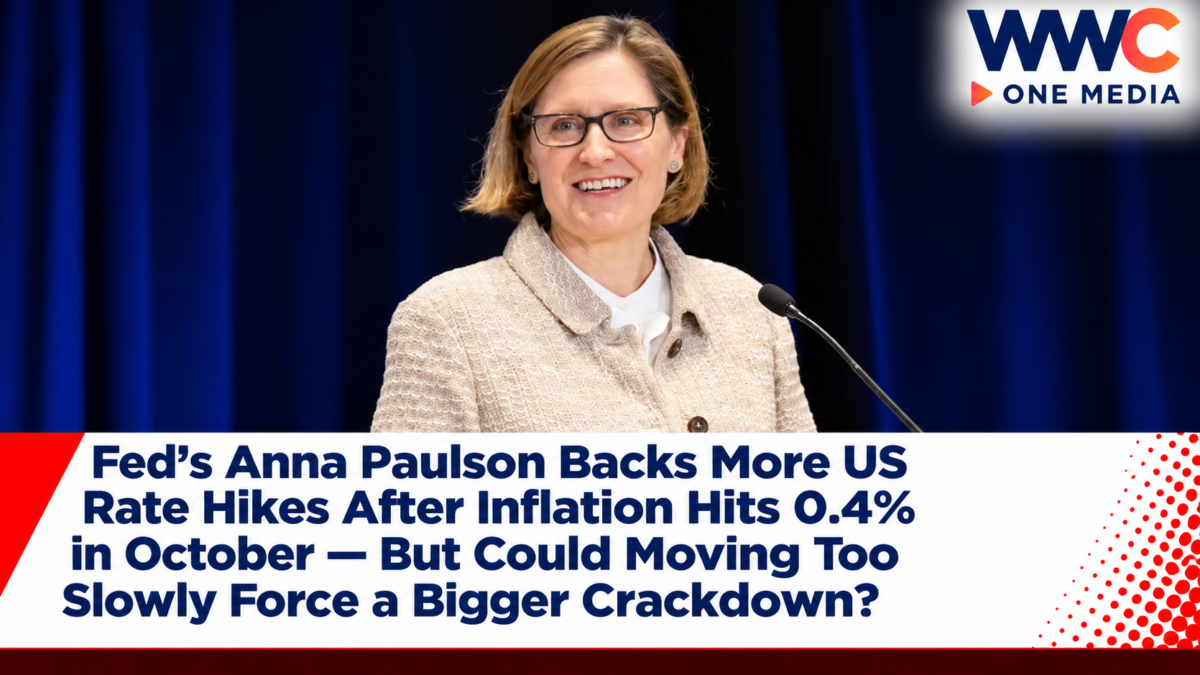
PHILADELPHIA, UNITED STATES / MANILA, PHILIPPINES — November 11, 2026 — The Federal Reserve is facing renewed pressure to raise interest rates after a hotter-than-expected US inflation report, but one influential central bank official believes the best approach is to keep tightening monetary policy gradually rather than risk shocking the economy.
Federal Reserve Bank of Philadelphia President Anna Paulson said on November 10 that additional interest-rate increases remain appropriate because inflation has stayed above the central bank’s 2% target for more than five years.
Her remarks came during the 81st Annual Field Meeting Capstone gathering in Conshohocken, Pennsylvania, and followed new government data showing consumer prices rose 0.4% in October.
The increase was higher than economists had expected.
Paulson, a voting member of the Federal Open Market Committee in 2026, believes the Fed needs to maintain a sufficiently restrictive policy stance to bring inflation under control.
But she cautioned that raising rates too aggressively could create unnecessary difficulties for families, businesses and financial institutions.
Her preferred strategy is to increase borrowing costs in measured steps while monitoring how the economy responds.
The warning arrives as other Fed officials, including Governor Christopher Waller, discuss the possibility of faster tightening.
The question now is whether the Federal Reserve can bring inflation back to 2% through gradual increases—or whether persistent price pressures will eventually force policymakers to take more painful action.
Anna Paulson Says the Federal Reserve Still Has Work to Do
Paulson delivered a clear message in her November 10 economic outlook speech.
Although the US economy remains resilient, monetary policy may need to become more restrictive.
The Philadelphia Fed president supported the central bank’s September interest-rate increase and its decision to leave rates unchanged in October.
She explained that pausing at one meeting does not necessarily signal the end of a tightening cycle.
For Paulson, the policy direction remains toward additional increases, provided economic conditions continue to justify them.
She favors a gradual pace because households and businesses need time to adjust to changes in borrowing costs.
She also believes incremental decisions allow officials to evaluate whether previous increases are having their intended effects.
This does not mean she would oppose faster action in every circumstance.
Paulson identified several developments that could justify a more aggressive response.
These include rising inflation expectations, stronger wage pressures and an acceleration in underlying inflation.
For now, she sees sufficient evidence to continue moving cautiously.
US Inflation Rises 0.4%, Exceeding Wall Street Forecasts
The timing of Paulson’s remarks was particularly important.
On November 10, the US Bureau of Labor Statistics reported that the Consumer Price Index rose 0.4% in October on a seasonally adjusted basis.
Economists had generally expected a 0.3% increase.
Core inflation, which excludes food and energy, increased 0.3% from September.
That was above the commonly reported forecast of 0.2%.
However, October’s monthly headline inflation rate was lower than September’s 0.6%.
The surprise was therefore not that inflation accelerated from the previous month, but that the slowdown was smaller than economists had anticipated.
Several categories continued contributing to higher household costs.
Food prices rose 0.5% during October.
Shelter costs increased 0.3%.
Energy prices advanced 0.7%, following a much larger 5.2% increase in September.
Medical care, airfares and several other services also became more expensive.
The figures suggest that price pressures remain present across important parts of the economy.
In related coverage, WWC ONE MEDIA examined the forecasts ahead of the November 10 inflation release and the possibility of another Federal Reserve interest-rate increase.
Those forecasts were published before the actual data became available.
The stronger October reading has since reinforced concerns that inflation may take longer to return to the Fed’s objective.
Why Paulson Prefers Gradual Rate Increases
Paulson’s approach rests on two central arguments.
The first is that higher interest rates affect the economy with a delay.
When the Federal Reserve raises borrowing costs, banks may adjust loan prices, companies reconsider investment projects and households reassess major purchases.
These adjustments do not happen simultaneously.
A gradual tightening strategy gives businesses and consumers more time to respond.
It can also reduce the risk of unexpectedly severe disruption.
The second argument concerns the information policymakers receive.
By making smaller changes and examining subsequent economic data, the Fed can learn how sensitive the economy is to higher rates.
That can help officials avoid unnecessary tightening.
Paulson also emphasized the financial pressures faced by community banks.
Higher rates can increase their funding costs, influence loan pricing and affect customers’ ability to repay.
A measured policy path can give financial institutions more time to manage those changes.
But the strategy depends on inflation expectations remaining reasonably stable.
If the public begins anticipating persistently higher inflation, the Fed may have less room to move slowly.
Inflation Has Remained Above Target for More Than Five Years
One of Paulson’s biggest concerns is the persistence of inflation.
She noted that inflation has remained above the Federal Reserve’s target for approximately five and a half years.
The central bank targets 2% inflation as measured by the Personal Consumption Expenditures price index, rather than the Consumer Price Index itself.
That distinction matters because the two measures use different methodologies and expenditure weights.
The Fed monitors both, but its formal inflation objective is based on PCE.
According to Paulson, underlying inflation has remained around 2.5% to 3%, depending on the measure and period being examined.
Those levels remain above the central bank’s objective.
The longer inflation stays elevated, the greater the concern that households and businesses may adjust their expectations.
Companies might become more willing to increase prices.
Workers may seek higher wages to compensate for living costs.
Those reactions can make inflation more persistent.
However, Paulson said she had not observed widespread wage acceleration or a significant deterioration in long-term inflation expectations.
That is one reason she still believes gradual tightening remains feasible.
Christopher Waller Opens the Door to a Bigger Rate Hike
Paulson’s comments came on the same day that another Federal Reserve official adopted a more forceful tone.
Governor Christopher Waller said he was leaning toward supporting a 25-basis-point increase at the Fed’s December meeting.
But he also warned that another strong inflation reading could justify a larger move.
His remarks were delivered before the October CPI report was released.
The subsequent data showed core inflation rising 0.3%, the kind of reading he had identified as concerning.
However, Waller did not announce a decision to support a 50-basis-point increase.
Nor did the Federal Reserve approve such a move.
His comments show that policymakers are debating the appropriate speed of tightening.
Paulson prefers smaller steps while inflation expectations remain anchored.
Waller has expressed concern that the Fed may need to act more forcefully if price pressures continue.
Both officials agree that inflation remains too high.
The disagreement concerns how quickly borrowing costs may need to rise.
The Fed’s Current Interest Rate Remains at 3.75%–4%
The Federal Reserve’s benchmark target range currently stands at 3.75% to 4%.
The central bank raised the range by 25 basis points in September before keeping it unchanged at its October meeting.
The September increase followed a period in which policymakers had previously eased monetary policy.
Now the Fed is reconsidering how restrictive conditions need to become.
Its next scheduled monetary policy meeting takes place December 8–9.
Financial markets have been assigning high probabilities to another quarter-percentage-point increase.
But market expectations are not official decisions.
The FOMC will evaluate incoming inflation and employment information before voting.
Paulson’s remarks do not establish that the committee has reached a consensus.
Other officials may place different weights on the risk of persistent inflation and the potential harm from tighter financial conditions.
Michelle Bowman Warns Inflation Is Becoming More Widespread
Federal Reserve Vice Chair for Supervision Michelle Bowman also delivered an important speech on November 10.
Bowman said inflation had remained more persistent than she expected.
She noted that price pressures linked to tariffs, energy and the artificial intelligence investment boom had contributed to inflation.
Her analysis suggested that these factors accounted for substantial portions of above-target core inflation during the 12 months through September.
She also identified evidence that some price pressures were spreading beyond the categories initially affected.
However, Bowman emphasized that monetary policy cannot directly eliminate supply shocks.
Higher interest rates cannot produce more oil, remove tariffs or instantly expand the supply of high-tech components.
Instead, the Fed attempts to prevent those price increases from becoming embedded throughout the economy.
Bowman also noted that financial conditions had already tightened somewhat because of higher private borrowing costs, a stronger dollar and falling equity valuations.
Her remarks show why policymakers must weigh the potential benefits of additional tightening against the economic costs.
Artificial Intelligence Is Creating an Unexpected Inflation Problem
A particularly notable element of the Fed’s recent analysis concerns artificial intelligence.
The rapid expansion of AI data centers has increased demand for specialized computing equipment, power infrastructure and related technologies.
When supply cannot keep pace with investment demand, prices can rise.
Waller and Bowman have highlighted the possibility that AI-related investment is contributing to inflation in selected categories.
But this does not mean AI is responsible for the entire US inflation problem.
Energy costs, tariffs and other economic factors also matter.
For the Federal Reserve, the challenge is that AI investment can support economic growth while simultaneously creating supply bottlenecks.
Higher interest rates may restrain some investment projects.
However, the central bank cannot directly resolve every shortage of equipment or infrastructure.
This complicates the decision about how aggressively to tighten policy.
The Fed must distinguish between price pressures that respond to reduced demand and those that require time for supply to expand.
Strong Employment Gives the Fed Room to Tighten
Paulson’s confidence in gradual tightening also reflects the relative resilience of the US labor market.
According to official October employment figures, the unemployment rate stood at approximately 4.1%.
US employers added around 165,000 jobs during the month.
The figures suggested that economic activity remained sufficiently strong to support further efforts against inflation.
Paulson said the labor market appeared stable.
Wage growth had not accelerated enough to become a major new inflation concern.
But a stable labor market does not eliminate the possibility of future weakness.
Businesses may reduce hiring or postpone expansion as financing becomes more expensive.
Some households may respond to higher borrowing costs by reducing consumption.
Paulson warned that recent stock-market volatility could also influence consumer spending.
If the economy becomes less resilient, the appropriate pace of monetary tightening could change.
Wall Street’s Recent Selloff Is Complicating the Fed’s Decision
Stock markets have experienced significant volatility as investors reassess technology valuations and the financial demands of the AI boom.
Paulson specifically identified the recent swings in equities and oil prices as reasons to retain flexibility.
Financial-market declines can reduce household wealth and affect confidence.
They may also make it harder for companies to raise money.
If those developments weaken spending and employment, they could reduce the need for aggressive rate increases.
However, the Fed does not set interest rates simply to support stock prices.
Its statutory goals involve price stability and maximum employment.
A market correction alone does not necessarily justify easier monetary policy.
The relevant question is whether financial-market developments meaningfully change the economic outlook.
Paulson’s preference for gradual tightening reflects uncertainty about those potential effects.
The Dollar and Gold React to Higher Rate Expectations
Federal Reserve policy expectations are also influencing international markets.
Following the October inflation report, the US dollar strengthened against several major currencies.
Higher expected interest rates can increase the appeal of dollar-denominated assets.
Treasury yields also rose as traders considered the possibility of further tightening.
These movements contributed to pressure on gold.
Bullion does not pay interest, so higher bond yields can increase the opportunity cost of holding it.
In related reporting, WWC ONE MEDIA examined the dollar’s strength near an 18-month high as investors increasingly anticipated another Federal Reserve rate increase.
That report reflected market conditions before the latest inflation announcement.
These market developments demonstrate why Federal Reserve statements matter well beyond American borrowers.
But currency and commodity prices are influenced by multiple factors, and no single Fed speech determines their direction.
Higher Interest Rates Could Put Pressure on American Household Debt
Another important issue involves household borrowing.
Credit cards, variable-rate loans and other consumer financing arrangements can become more expensive when benchmark rates increase.
The effect depends on loan terms and lenders’ decisions.
Existing fixed-rate borrowers may not experience immediate changes.
But consumers seeking new loans or refinancing existing debt could face higher costs.
The pressure is especially relevant because consumer borrowing has recently increased.
Federal Reserve data showed that US consumer credit rose approximately $27.8 billion in September.
As WWC ONE MEDIA reported on the sharp rise in American consumer credit and its implications for household finances, rising debt can increase exposure to higher interest expenses.
However, borrowing growth alone does not prove that households are experiencing widespread financial distress.
Debt affordability also depends on income, employment, savings and repayment behavior.
That is part of the balance Paulson is trying to preserve.
The Fed wants to contain inflation without unnecessarily weakening borrowers’ ability to manage their obligations.
Other Fed Officials Also See More Tightening Ahead
Paulson is not the only policymaker suggesting that the central bank may need to raise rates further.
Dallas Fed President Lorie Logan has argued for additional increases.
San Francisco Fed President Mary Daly has also indicated that tighter policy may be necessary despite the recent technology-stock selloff.
Cleveland Fed President Beth Hammack has emphasized maintaining sufficiently restrictive conditions to restore price stability.
However, policymakers differ on the timing and pace of action.
Some prefer frequent smaller increases.
Others want more data before moving.
The differences reflect uncertainty about how quickly inflation will fall and how sensitive the economy is to borrowing costs.
As WWC ONE MEDIA examined in its broader analysis of the Federal Reserve’s inflation challenge and the risks to employment, the central bank must manage competing risks.
Too little tightening could leave inflation elevated.
Too much could unnecessarily damage investment, consumer spending and employment.
Paulson’s argument is that gradual steps can help policymakers respond to both dangers.
What This Means for the Philippines
The Fed’s interest-rate decisions can influence financial conditions in the Philippines.
Higher US yields may encourage international investors to favor dollar-denominated securities.
This can create pressure on emerging-market currencies, including the peso.
Changes in the exchange rate can affect the peso cost of imported fuel, machinery and other goods priced in dollars.
Businesses with foreign-currency obligations may also face higher financing or repayment costs.
However, the Bangko Sentral ng Pilipinas does not automatically copy Federal Reserve decisions.
The BSP evaluates Philippine inflation, economic conditions and financial stability when setting domestic monetary policy.
The effect of a US rate hike on Philippine lending rates therefore depends on several factors.
For local businesses and investors, the Federal Reserve’s December decision is relevant because it can influence global capital flows and market sentiment.
But it should not be interpreted as a guarantee that Philippine borrowing costs will rise by the same amount.
Why the Fed’s Inflation Data Requires Careful Interpretation
One unusual complication in the latest US inflation report involves missing historical data.
Because of the 2025 federal government shutdown, the Bureau of Labor Statistics did not collect all the information needed to calculate normal year-over-year changes for October 2026.
As a result, standard annual comparisons are unavailable for many CPI categories.
The October report still provides valid monthly inflation measures.
But analysts must be careful when comparing monthly and annual figures.
For example, October’s 0.4% headline increase cannot be directly compared with September’s 3.7% annual inflation rate as though they measure the same period.
Nor should the slower monthly increase from September to October be portrayed as a complete resolution of inflation.
Prices continued increasing.
The question is whether the pace will moderate enough to bring longer-term inflation measures back toward the Fed’s objective.
What Could Force Paulson to Support Faster Tightening?
Paulson identified three major conditions that could justify a faster policy response.
One would be rising inflation expectations.
If households and businesses begin assuming inflation will remain high, that could make price stability more difficult to restore.
Another would be accelerating wage pressures.
Although wage growth is not currently her main concern, persistent increases beyond productivity growth could complicate the inflation outlook.
The third would be stronger underlying inflation.
If price increases become more widespread or accelerate again, smaller policy adjustments may not be sufficient.
These conditions do not guarantee a larger interest-rate increase.
They describe the circumstances in which Paulson would reconsider her preferred pace.
Her position is therefore neither an unconditional commitment to gradual tightening nor a promise that the Fed will avoid aggressive action.
It is a data-dependent strategy.
What Happens Before the December Fed Meeting?
The Federal Open Market Committee will meet December 8–9.
Between now and then, policymakers will assess new information about employment, inflation and financial conditions.
The November employment report is expected before that meeting.
The October Personal Consumption Expenditures inflation report will also provide additional information.
Those releases may help officials determine whether price pressures are becoming more entrenched.
The October CPI figures have already strengthened the case for further tightening.
But the committee will still need to consider the resilience of consumer spending, the labor market and financial markets.
The decision will involve the full FOMC rather than any single regional bank president.
Paulson’s comments offer insight into the debate, not a predetermined policy outcome.
The Bigger Picture: The Federal Reserve Is Running Out of Easy Choices
The Federal Reserve is confronting a difficult economic environment.
Inflation has remained above its objective for years.
Energy costs, tariffs and AI-related investment pressures have complicated the outlook.
Yet economic activity has remained resilient, and employment has not deteriorated enough to remove the case for tighter policy.
Anna Paulson believes further interest-rate increases are necessary.
But she also wants to avoid moving so quickly that the economy suffers unnecessary disruption.
Her strategy is to tighten gradually while monitoring whether inflation expectations, wages or underlying price pressures demand a stronger response.
Other officials are considering different approaches, including the possibility of larger increases.
The disagreement reflects uncertainty about how much additional restriction the economy needs.
For households, higher interest rates could make borrowing more expensive.
For businesses, they could complicate investment decisions.
For financial markets, they may create additional volatility.
And for the Fed, the ultimate test will be whether inflation can return to 2% without a severe deterioration in employment or economic activity.
Philadelphia Fed President Anna Paulson wants to raise interest rates gradually as the central bank battles persistent inflation. But with October consumer prices exceeding expectations and other policymakers considering more aggressive action, will her cautious strategy give the US economy enough room to adjust—or will another inflation shock force the Federal Reserve into a much bigger crackdown?