Trump Picks DOJ Insider for Key Civil Rights Agency — But His Appointment Could Reshape America’s Workplace Rules
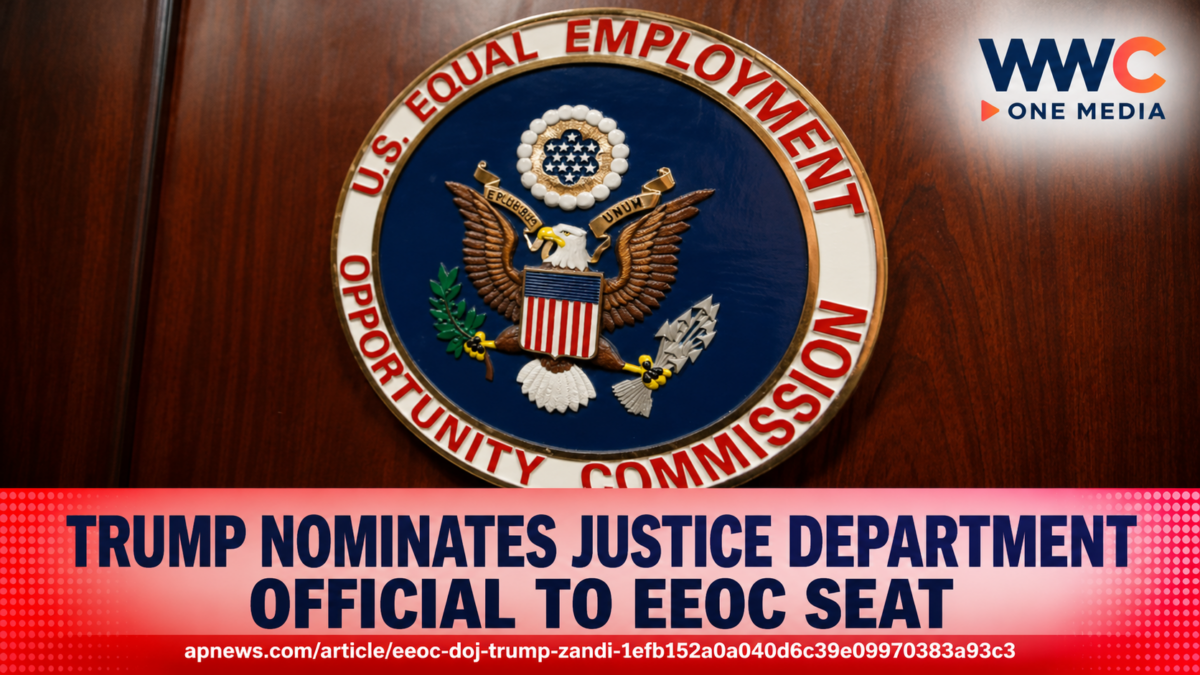
WASHINGTON, November 11, 2026 — President Donald Trump is moving to strengthen Republican influence over one of America’s most important workplace civil rights agencies, nominating Justice Department official Matthew “Matt” Zandi to fill a vacant seat on the Equal Employment Opportunity Commission (EEOC).
The appointment could have significant consequences for how the federal government investigates workplace discrimination, evaluates corporate diversity programs and enforces protections for American employees.
The White House announced Zandi’s nomination on November 9, filling a position previously held by Democratic commissioner Jocelyn Samuels, whom Trump removed before the end of her term.
If confirmed by the Senate, Zandi would further strengthen the Republican presence on the five-member commission, giving Trump-appointed Republicans three of the agency’s five seats, with one Democratic commissioner remaining and another seat vacant.
The nomination comes as the administration intensifies its campaign against diversity, equity and inclusion (DEI) policies it considers discriminatory, while civil rights organizations warn that the agency could become increasingly political.
But the timing presents another complication: Democrats are preparing to take control of the Senate in January 2027, potentially giving them greater leverage over the confirmation process.
The decision could therefore shape the future of America’s workplace discrimination enforcement long after the nomination itself leaves the headlines.
Who Is Matt Zandi, and Why Does His Nomination Matter?
Matthew Zandi previously served as chief of staff for the Justice Department’s Civil Rights Division under former Assistant Attorney General Harmeet Dhillon.
His professional background includes work involving False Claims Act litigation, federal prosecution and legal consulting.
Before joining the Justice Department, Zandi worked as a managing director at Guidepost Solutions. He also served as an assistant U.S. attorney from 2002 to 2006 and worked at the law firms Nixon Peabody and Kaufman Borgeest & Ryan.
His experience is particularly relevant because the Trump administration has increasingly used federal legal mechanisms to challenge corporate diversity initiatives.
The Justice Department has pursued companies and organizations over DEI practices it considers unlawful, including programs involving hiring, contracting and workplace opportunities.
Reuters reported that civil rights advocates have criticized Zandi’s association with the Justice Department’s enforcement strategy under Dhillon.
If confirmed, Zandi would serve a five-year term ending July 1, 2031.
That would give him a position on the commission extending beyond Trump’s current presidential term, potentially allowing him to influence federal employment discrimination policy for years.
What Is the EEOC, and Why Should American Workers Care?
The Equal Employment Opportunity Commission is an independent federal agency created under the Civil Rights Act of 1964.
Its central responsibility is enforcing federal laws that prohibit employment discrimination.
The agency investigates complaints involving discrimination based on race, color, religion, sex, national origin, disability, age and other protected categories under applicable federal laws.
It also provides guidance to employers, pursues enforcement actions and works to protect employees against unlawful workplace practices.
The EEOC can investigate allegations involving:
- Discriminatory hiring and recruitment practices.
- Unequal pay and compensation.
- Workplace harassment and retaliation.
- Discrimination involving pregnancy and disability.
- Unlawful termination and promotion decisions.
- Employment practices that violate federal civil rights protections.
The agency’s leadership matters because its commissioners help determine enforcement priorities, regulatory interpretations and the direction of investigations.
A change in the political balance could therefore influence which workplace practices receive greater scrutiny.
However, a change in leadership does not automatically repeal federal anti-discrimination laws or eliminate existing worker protections.
Those laws remain binding unless changed through lawful legislative or judicial processes.
Trump’s Nomination Could Give Republicans Greater Control of the Commission
The EEOC has five commissioner positions.
Before Zandi’s nomination, the commission had two Republicans and one Democrat serving.
The Republican commissioners are Chair Andrea Lucas and Brittany Panuccio. The remaining Democratic commissioner is Kalpana Kotagal.
Another seat became vacant following Trump’s removal of Democratic commissioner Charlotte Burrows.
Samuels’ former position is the seat now targeted by Zandi’s nomination.
If the Senate confirms him, Republicans would hold three of the five authorized seats, compared with one Democratic commissioner, while the fifth position would remain vacant.
That would give Republicans a majority of the occupied commission seats.
Under Chair Lucas, the agency has increasingly aligned its enforcement priorities with Trump’s civil rights agenda.
The commission has investigated corporate diversity programs and examined whether certain workplace initiatives violate federal anti-discrimination laws.
The administration argues that employers must apply civil rights protections equally rather than use diversity programs that discriminate against particular groups.
Supporters say the approach ensures that anti-discrimination laws protect all Americans.
Critics, however, argue that the administration risks turning the EEOC away from its traditional role of expanding workplace equality and toward political enforcement against organizations that support DEI initiatives.
The DEI Battle Is Becoming a Major Part of Trump’s Civil Rights Agenda
Diversity, equity and inclusion programs have become one of the most controversial areas of Trump’s domestic policy.
Many American companies adopted DEI initiatives to address historical barriers in recruitment, career advancement and workplace representation.
These programs have included mentorship opportunities, diversity recruitment, employee resource groups and corporate workforce targets.
The Trump administration argues that certain programs may violate federal civil rights laws when they use race- or sex-based preferences.
It has encouraged employers and government contractors to reconsider policies it believes could constitute unlawful discrimination.
The Justice Department has also used the False Claims Act in an effort to challenge allegedly discriminatory practices involving government contractors and grant recipients.
Zandi’s professional experience in this area could become particularly significant if he joins the EEOC.
Reuters reported that civil rights advocates have connected his previous Justice Department work to the administration’s campaign against DEI programs.
However, it is important to distinguish between lawful diversity initiatives and policies that actually violate federal discrimination laws.
Not every DEI program is automatically illegal.
The legality of an employment practice depends on its design, implementation and compliance with applicable federal statutes and court decisions.
The EEOC will continue to be responsible for enforcing the law rather than simply implementing political preferences.
Major Workplace Rules Could Also Be Heading for Change
Zandi’s nomination comes as the EEOC prepares several important regulatory changes.
One involves the long-standing requirement for many employers to submit demographic workforce information through the EEO-1 reporting system.
The data has historically helped federal authorities examine workforce composition and identify possible patterns of employment discrimination.
The Trump administration is preparing to end the approximately 60-year-old requirement for collecting certain demographic workforce data from employers.
This proposal has attracted attention because workforce reporting provides information that regulators and researchers can use to evaluate employment patterns.
Another major issue involves the Pregnant Workers Fairness Act.
The law requires covered employers to provide reasonable accommodations for qualified employees affected by pregnancy, childbirth and related medical conditions, subject to statutory limitations.
The EEOC is considering revisions to its enforcement rules.
Chair Andrea Lucas has argued that the existing regulations improperly extended certain protections involving abortion, birth control and fertility treatments.
These issues could generate further legal and political disputes.
Any changes, however, must be evaluated against the actual language of the law, applicable court decisions and the agency’s statutory authority.
For employers, the outcome could affect compliance policies, human resources procedures and workplace accommodation practices.
For employees, it could influence how certain protections are interpreted and enforced.
Civil Rights Groups Warn Against Politicizing the EEOC
Zandi’s nomination has already attracted criticism from organizations concerned about the future independence of the agency.
The National Women’s Law Center expressed opposition to the appointment, arguing that Zandi’s involvement in the Justice Department’s DEI enforcement strategy raises concerns about the direction of the commission.
Lauren Khouri, the organization’s senior director of workplace equality and senior counsel, criticized the nomination as part of what the group views as an effort to redirect the EEOC away from its traditional mission.
Civil rights advocates argue that the commission should remain focused on protecting workers from discrimination rather than targeting organizations simply because they maintain diversity initiatives.
They also point to Trump’s removal of Democratic commissioners Jocelyn Samuels and Charlotte Burrows as evidence of an increasingly partisan approach to agency leadership.
Democratic lawmakers have similarly criticized the dismissals, arguing that the commission’s independence and bipartisan structure have been undermined.
Republicans, meanwhile, defend the administration’s direction.
Senator Bill Cassidy of Louisiana praised the EEOC’s approach during a Senate hearing, saying the agency has strengthened its focus on even-handed enforcement of employment discrimination laws.
The disagreement reflects a broader debate over what equal treatment should mean in modern American workplaces.
Supreme Court Ruling Strengthens Trump’s Position Over Independent Agencies
Trump’s efforts to reshape the EEOC have also received an important legal boost.
The Supreme Court upheld his authority to remove leaders of several independent agencies, significantly expanding presidential power over parts of the federal administrative system.
That ruling weakened the legal position of former Democratic commissioner Jocelyn Samuels, who had challenged her removal.
Following the decision, Samuels abandoned her lawsuit.
The development matters because the EEOC was established as a bipartisan commission intended to operate with a degree of independence from direct political control.
The Supreme Court’s ruling has changed the legal environment surrounding presidential removal authority.
However, it does not mean that the president can disregard the statutes governing federal employment discrimination enforcement.
The commission remains subject to congressional law, judicial review and applicable constitutional requirements.
Democrats Could Block or Delay Zandi’s Confirmation in January
The timing of Trump’s nomination could become a major obstacle.
Republicans currently control the Senate and are expected to have an opportunity to consider Zandi’s nomination before the new Congress convenes.
However, Democrats are preparing to take control of the Senate in January 2027 following their victories in the November 3 midterm elections.
Several Democratic senators have already vowed to oppose Trump’s EEOC nominees in protest over the removal of the two Democratic commissioners.
Wisconsin Senator Tammy Baldwin criticized Zandi’s nomination, arguing that the administration is abandoning the traditional practice of balancing nominees from different political parties.
The confirmation dispute could therefore become another confrontation between the White House and the incoming Democratic majority.
If the Republican-controlled Senate does not act before its current session ends, Trump may need to resubmit the nomination to the new Senate.
That could make confirmation considerably more difficult.
For the administration, the immediate objective is to secure enough support while Republicans still control the chamber.
For Democrats, delaying or blocking the appointment could prevent the administration from further consolidating Republican control of the commission.
The outcome will determine whether Zandi joins the agency before the political balance in Washington changes.
What the Appointment Could Mean for Businesses and Employees
The EEOC’s direction matters to more than politicians and civil rights organizations.
It could affect millions of American workers and employers operating under federal employment discrimination laws.
For businesses, a stronger focus on DEI investigations could mean increased scrutiny of recruitment policies, employee development programs and workplace diversity initiatives.
Human resources departments may need to review their employment practices to ensure compliance with federal anti-discrimination requirements.
For employees, changes in enforcement priorities could influence which complaints receive greater attention and how the agency interprets certain workplace protections.
Companies operating across different states may also need to consider how federal requirements interact with state employment laws.
International businesses with American operations could face similar compliance considerations.
However, no immediate change to an individual employee’s legal rights should be assumed simply because Trump nominated a new commissioner.
Zandi must still be confirmed, and future regulatory changes must go through the applicable legal and administrative processes.
The Bigger Picture: Is Trump Reshaping America’s Civil Rights Institutions?
Zandi’s nomination represents another step in the administration’s effort to reshape federal agencies responsible for civil rights enforcement.
The Justice Department’s Civil Rights Division, the EEOC and other federal institutions have become increasingly important battlegrounds in the debate over DEI, employment discrimination and the limits of presidential authority.
The administration argues that its policies restore equal treatment under the law.
Civil rights advocates counter that some of the changes could weaken protections designed to address workplace discrimination and unequal opportunities.
Both sides are now preparing for a prolonged legal and political dispute.
For employers, the practical concern is compliance.
For workers, the central issue is whether federal protections will remain effective regardless of the political direction of the agency enforcing them.
For lawmakers, the nomination presents another test of the Senate’s constitutional responsibility to review presidential appointments.
The immediate question is whether Republicans can confirm Zandi before Democrats take control of the Senate.
But the larger question extends far beyond one nomination.
If Matt Zandi joins the EEOC, could Trump’s administration fundamentally change how workplace discrimination is investigated and enforced in America—and what will that mean for the millions of workers who depend on the agency for protection?