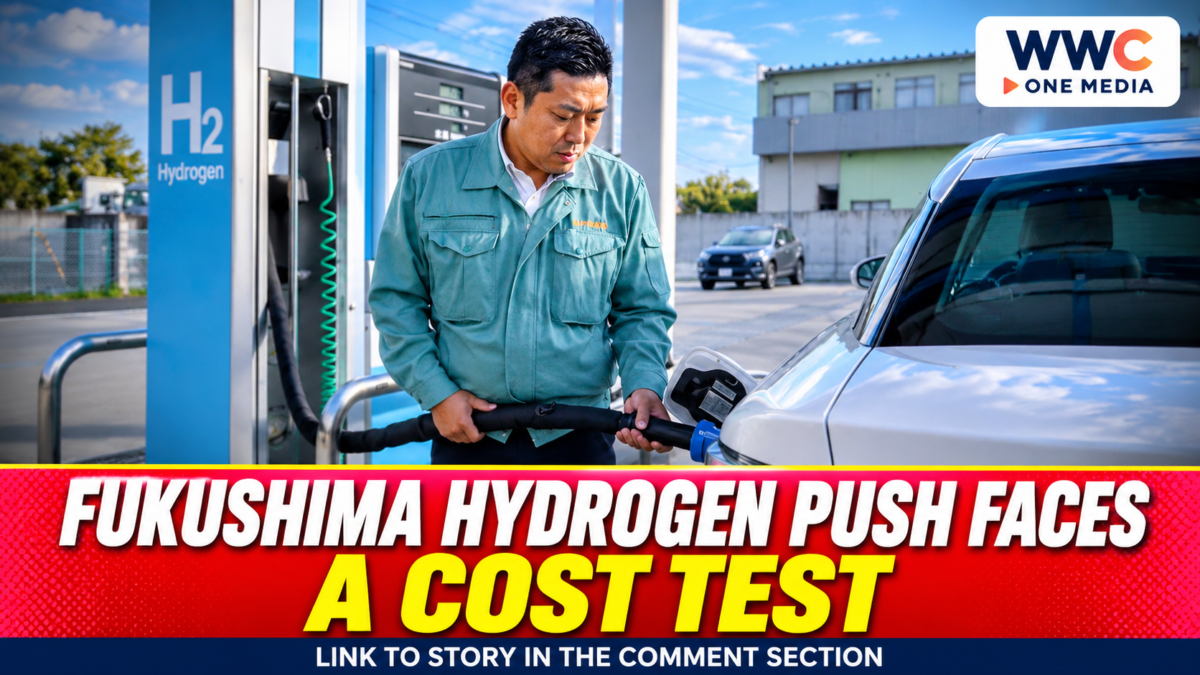
NAMIE, Fukushima — November 24, 2026. Fukushima Prefecture’s hydrogen programme is facing a commercial challenge that infrastructure announcements alone cannot solve: keeping stations supplied, maintained and financially workable while the number of vehicles using hydrogen remains limited. A local operator’s documented experience in Namie illustrates how procurement, transport, servicing and customer demand can complicate the economics of a hydrogen business.
The issue matters because Fukushima is not treating hydrogen as a laboratory experiment alone. The prefecture has established production and research facilities, supported vehicle deployment and set a target of 20 stationary hydrogen stations by fiscal 2030. But its own industrial assessment describes the local hydrogen market as immature and participation by prefectural businesses as limited. 福島県ホームページ+1
The gap between building infrastructure and sustaining its commercial use is now one of the central tests for the region’s energy strategy.
Fukushima Hydrogen Development Has an Infrastructure Head Start
Namie is home to the Fukushima Hydrogen Energy Research Field, known as FH2R, a demonstration facility for producing hydrogen using renewable electricity. The town’s public information also identifies several practical applications: hydrogen fuel-cell power at local facilities, a fuel-cell school bus, a mobile sales vehicle and fixed and mobile hydrogen stations. 浪江町ホームページ+1
The fixed Namie Hydrogen Station is operated by Date Juki in a joint project with Japan H₂ Mobility, or JHyM. A town presentation identifies its business start date as December 12, 2022, and describes it as a medium-scale, off-site supply facility. The presentation lists Iwatani Corporation as the equipment manufacturer and identifies Tomoe Shokai and NEDO among its hydrogen suppliers. |+1
That arrangement connects local infrastructure with a wider supply network. It also means the station’s performance cannot be understood simply by looking at the presence of a hydrogen production facility nearby. Production, procurement, transport and retail supply are separate parts of the chain, each with its own costs and operational requirements.
Fukushima’s March 2026 industrial assessment recorded 474 registered fuel-cell vehicles in the prefecture as of the end of January, the highest total in the Tohoku region, alongside 24 registered fuel-cell trucks. Those figures show an existing user base, but they also provide a measure of the market that stations and suppliers must serve. pref.fukushima.lg.jp
Namie’s Station Shows Where Operating Costs Become a Problem
A presentation included in Namie Town’s public materials identifies several specific difficulties experienced by the station operator. These include a limited number of vehicles using hydrogen, procurement prices that had not declined, distance from suppliers, expensive periodic inspections and the possibility of a two-week interruption during scheduled inspections. It also notes that repairs could take as long as two weeks, depending on the fault. |
These are not minor administrative inconveniences. A station has to maintain equipment and staff even when customer activity is limited. If inspection or repair work interrupts supply, customers may also have to find another source of fuel. That can make it harder to build the regular usage needed to support the business.
The same presentation records steps taken by the operator to address some of these problems. In July 2023, it purchased a trailer to transport hydrogen itself, aiming to reduce transportation expenses. It had also acquired 50 Toyota Mirai fuel-cell vehicles for leasing to businesses and offered free 30-minute test drives to local residents and companies. |+1
Those efforts reveal the two-sided challenge of developing a new fuel market. Operators need customers to justify the infrastructure, but potential customers need dependable access to fuel before committing to vehicles. Leasing vehicles and offering test drives can help build demand, but they do not automatically guarantee recurring commercial use.
Government Support Addresses the Economics, Not Every Business Risk
Japan’s national government has acknowledged that hydrogen stations need support beyond construction grants. Materials presented to the Mobility Hydrogen Public-Private Council in March 2026 describe assistance for both installation and operating expenses. The programme includes support for station operating costs, with additional assistance in priority areas linked to hydrogen supplied to commercial vehicles. Ministry of Economy, Trade and Industry+1
The same policy materials set out support levels that vary by station size and location. For medium-scale stations outside priority areas, the document lists operating-cost support of up to ¥21 million. For large stations operating around the clock in priority areas, it lists support of up to ¥45 million. These are programme limits, not evidence that Namie’s operator received either amount. Ministry of Economy, Trade and Industry
Fukushima Prefecture also maintains its own hydrogen-related subsidy programmes. Its published materials identify support for hydrogen supply facilities and other activities intended to expand hydrogen use. 福島県ホームページ+1
The policy response recognises a basic commercial reality: hydrogen stations face costs that do not necessarily fall in proportion to the amount of fuel sold. However, subsidies cannot by themselves create a large customer base, guarantee reliable deliveries or remove the need for specialised maintenance workers.
For readers following other energy technologies, the distinction is familiar. WWC has examined how Japan’s Osaka Gas is positioning hydrogen-linked e-methane projects, where development agreements and future production plans must still be distinguished from established commercial operations.
The Next Growth Market May Be Commercial Transport
Fukushima’s policy planners are looking beyond private passenger cars. The prefecture’s hydrogen mobility working group is examining demand from fuel-cell commercial vehicles, particularly trucks, and how existing stations could be used more effectively. Its stated prefectural target is 20 stationary hydrogen stations by fiscal 2030. 福島県ホームページ
That focus is significant because commercial fleets can potentially provide more predictable demand than individual vehicle owners. Businesses operating regular routes may be able to plan refuelling schedules and coordinate vehicle deployment with station locations.
But this is an opportunity to be tested, not a result that can already be claimed. Fleet operators need suitable vehicles, dependable fuel supply, competitive operating costs and a station network that fits their routes. The economics must work for both the transport company and the station operator.
Fukushima’s March 2026 assessment also identifies industrial applications, including hydrogen use in manufacturing processes. Examples listed include hydrogen-related work at DENSO Fukushima and other companies pursuing research or industrial demonstrations. These uses could diversify demand beyond road transport, although individual demonstrations should not be confused with large-scale commercial consumption. pref.fukushima.lg.jp+1
The technology debate also extends beyond Japan. WWC has covered research into hydrogen fuel-cell performance in China, while Palawan’s interest in naturally occurring hydrogen illustrates how different countries are exploring different parts of the hydrogen value chain. Neither technological research nor resource potential, however, substitutes for a commercially workable supply-and-demand system.
What Happens Next
The next meaningful indicators for Namie will be practical operating results: whether more vehicles use the station, whether supply becomes less expensive and more dependable, and whether maintenance interruptions can be reduced. Publicly available records reviewed for this report do not establish the station’s current annual sales volume, profitability or actual subsidy receipts.
At the prefectural level, the 2030 station target will need to be matched by enough vehicles and industrial customers to justify the network. The government’s working group has already identified the need to examine commercial-vehicle demand and the more effective use of existing stations.
For Fukushima, the wider ambition is to turn research, renewable electricity and local industrial participation into a functioning hydrogen economy. Namie’s experience shows why that transition is difficult: the infrastructure is only one part of the business.
The central question is no longer simply whether Fukushima can produce hydrogen. It is whether enough customers can use it regularly, at a cost that makes the entire chain sustainable.
Frequently Asked Questions
1. Why is Fukushima investing in hydrogen?
Fukushima is developing hydrogen as part of its energy-transition and industrial-development strategy. Its programme includes renewable-energy research, hydrogen production, mobility applications and industrial use.
2. Where is the Fukushima Hydrogen Energy Research Field?
The Fukushima Hydrogen Energy Research Field, or FH2R, is located in Namie Town, Fukushima Prefecture.
3. What problems has the Namie hydrogen station documented?
The operator’s presentation identifies limited vehicle demand, hydrogen procurement costs, supplier distance, expensive inspections and possible interruptions during maintenance or repairs.
4. Does Japan subsidise hydrogen stations?
Yes. National policy materials describe support for station construction and operating costs, with additional assistance in designated priority areas. Actual support received by an individual operator must be verified separately.
5. Does Fukushima have a target for hydrogen stations?
Yes. Fukushima Prefecture’s working group identifies a target of 20 stationary hydrogen stations by fiscal 2030.