Taiwan Secom and Taiwan’s National Science and Technology Center for Disaster Reduction (NCDR) signed a memorandum of understanding on November 23 to explore cooperation on disaster-prevention technology and its practical use in businesses and other operating environments.
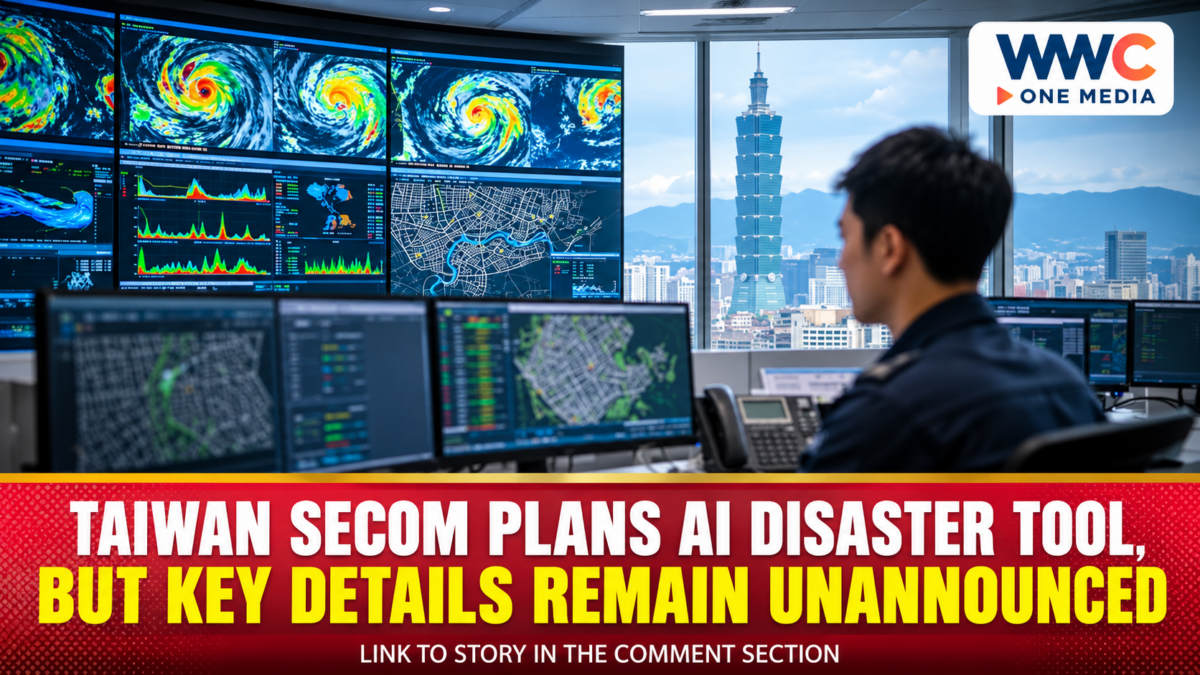
The agreement brings together NCDR’s disaster research and information-analysis expertise with Taiwan Secom’s artificial intelligence, cloud-platform and field-service capabilities. Separately, the company has outlined a proposed platform called Secom Disaster Prevention Hub, designed to connect disaster information with the locations of employees, business facilities and important assets.
The announcement marks a potential expansion of technology-assisted risk management into corporate disaster preparedness. But the distinction between a cooperation framework and a functioning commercial product remains important: the company has not announced a launch timetable, final feature set, investment amount or confirmed customer deployment.
What the Taiwan Secom-NCDR agreement establishes
The November 23 memorandum creates a framework for technology exchange and cooperation. The two organisations intend to share experience involving disaster-information applications, operational requirements at different sites and AI-assisted analysis.
NCDR contributes research expertise in disaster prevention, technology and information integration. Taiwan Secom brings its work in AI, cloud platforms and services delivered at operating locations.
The stated objective is to examine how research and disaster information can be made more useful in practical settings, including companies and other facilities. The announcement says the partners will consider specific implementation details later, based on their cooperation discussions. It does not identify a completed system integration, a commercial procurement arrangement or a schedule for deployment.
That distinction matters for businesses evaluating the announcement. An MOU establishes an area of cooperation, but it does not, by itself, demonstrate that a product has passed testing, entered regular operation or generated revenue.
How the proposed Secom Disaster Prevention Hub is designed
Taiwan Secom says it is independently planning and developing the Secom Disaster Prevention Hub. The proposed system would use AI to help organise information and analyse potential risks by comparing disaster areas with the locations of people, corporate facilities and important assets.
The company’s outline identifies several intended information sources: disaster alerts, weather information, water-level data and road closed-circuit television feeds. These would be obtained from government agencies and other relevant organisations where the information is publicly available or licensed for use.
The planned platform would combine those feeds with user-location information, company-site records and duty-related data. AI agents would then prepare risk summaries and information intended to support response planning.
The proposed features include consolidated disaster alerts, matching personnel and sites against affected areas, location- and role-based notifications, map displays, CCTV-assisted checks and push notifications.
However, the announcement makes clear that the functions remain subject to later disclosure. It also states that access to and use of external data must follow the rules and licensing conditions imposed by the organisations providing it.
For that reason, the platform should be described as a product under development or planning—not as an established emergency-warning service.
Why data access could determine the platform’s usefulness
The proposed system depends on more than the quality of its AI tools. It also needs reliable access to information from different public agencies and service providers.
Weather forecasts, water-level readings, disaster alerts and road-camera images may be managed by separate organisations. Each source can have its own technical arrangements, update schedules and conditions for reuse.
If a platform cannot obtain timely information or is restricted from using certain feeds, its ability to match hazards with business locations could be limited. A map or automated summary is only as useful as the information behind it.
Data licensing is therefore not a minor administrative detail. It is one of the practical conditions that could shape which features are available, how frequently information is updated and whether the service can be offered consistently to customers.
There is also a separate operational question: companies must maintain accurate records of their facilities, personnel and duty assignments if they expect a location-based system to produce useful alerts. Outdated employee or site information could weaken the quality of the resulting risk assessment.
AI can support decisions, but it does not replace official warnings
Taiwan Secom has expressly framed the platform’s AI-generated information as a reference for response. The company says users should continue to follow warnings and instructions issued by the relevant authorities and consider actual conditions at the affected location.
That limitation is important in disaster management. An AI-generated summary may help a manager identify which facilities could be affected or which teams may need to review their response plans. It should not be treated as an official evacuation order, a substitute for emergency services or proof that a particular site is safe.
The distinction is relevant to businesses that rely on several layers of preparedness. Digital tools can help organise information, but companies still need clear emergency procedures, responsible decision-makers, reliable communication channels and staff who understand what to do when an alert arrives.
WWC has examined a related issue in its report on AI-supported weather forecasting and the challenge of turning better data into decisions for businesses. The same broad principle applies here: more information does not automatically produce better decisions unless it is accurate, accessible and connected to practical response procedures.
What the partnership could mean for corporate risk management
For Taiwan Secom, the proposed platform points towards a possible extension of its security and monitoring services into a broader disaster-information and business-continuity role.
The Taiwan Stock Exchange’s company profile identifies Chung Hsing Security Technology Co., Ltd. under stock code 9917. Its listed business activities include security protection against theft, fire and disasters, system consulting, and equipment-integration technical services. The company’s existing product information also describes building-management services that include fire and water-level monitoring. These records provide context for why disaster-related information services could fit within its broader business activities.
The new proposal nevertheless represents a different level of service from monitoring individual equipment. A system that compares external hazard information with employee and facility locations would require coordination across data sources, company records and operational procedures.
If developed and adopted, such a platform could help organisations organise information for business-continuity planning. Its commercial value, however, will depend on factors not yet disclosed, including the final product scope, data permissions, reliability, customer demand and service arrangements.
The announcement does not disclose pricing, subscription terms, projected revenue or a target number of corporate users. It would therefore be premature to treat the MOU as evidence of a new revenue stream or a completed commercial launch.
The wider disaster-technology challenge has also appeared in WWC’s coverage of AI-assisted information coordination during Nepal’s flood response and regional cooperation on disaster warnings and shared information. Those reports concern different initiatives, but they underline the importance of connecting information systems with people and organisations responsible for action.
What happens next
The next steps are expected to involve continued exchanges between Taiwan Secom and NCDR, followed by discussions on specific cooperation activities. Taiwan Secom will be responsible for developing the proposed platform and its services, with actual functions subject to further company announcements.
Several details remain open: when the platform will be launched, which data feeds will be available, what licensing arrangements will be secured, how the system will be tested and whether it will be offered as a standalone service or incorporated into existing customer arrangements.
Until those details are published, the November 23 MOU is best understood as a cooperation framework and the Disaster Prevention Hub as a proposed product. The key test will be whether the planned system can turn fragmented hazard information into reliable, useful support for real-world business decisions.
Frequently asked questions
What is Taiwan Secom’s Secom Disaster Prevention Hub?
It is a proposed platform being planned and developed by Taiwan Secom. The company says it is intended to use AI to organise disaster information and compare hazard areas with employee locations, business sites and important assets.
What is the purpose of the Taiwan Secom-NCDR MOU?
The memorandum establishes a framework for exchanging expertise and exploring practical applications of disaster information, AI-assisted analysis and operational requirements at businesses and other sites.
Has the Secom Disaster Prevention Hub launched?
The announcement does not provide a launch date. It says the platform’s actual functions will be subject to later company announcements.
What information is the proposed platform expected to use?
The company identifies disaster alerts, weather information, water-level data and road CCTV information from government agencies and other relevant providers, subject to their rules and licensing conditions.
Can businesses use the platform’s AI output as an official emergency instruction?
No. Taiwan Secom says AI-generated information is intended as a reference for response. Users should continue to follow official warnings, instructions from the competent authorities and conditions at the site.