
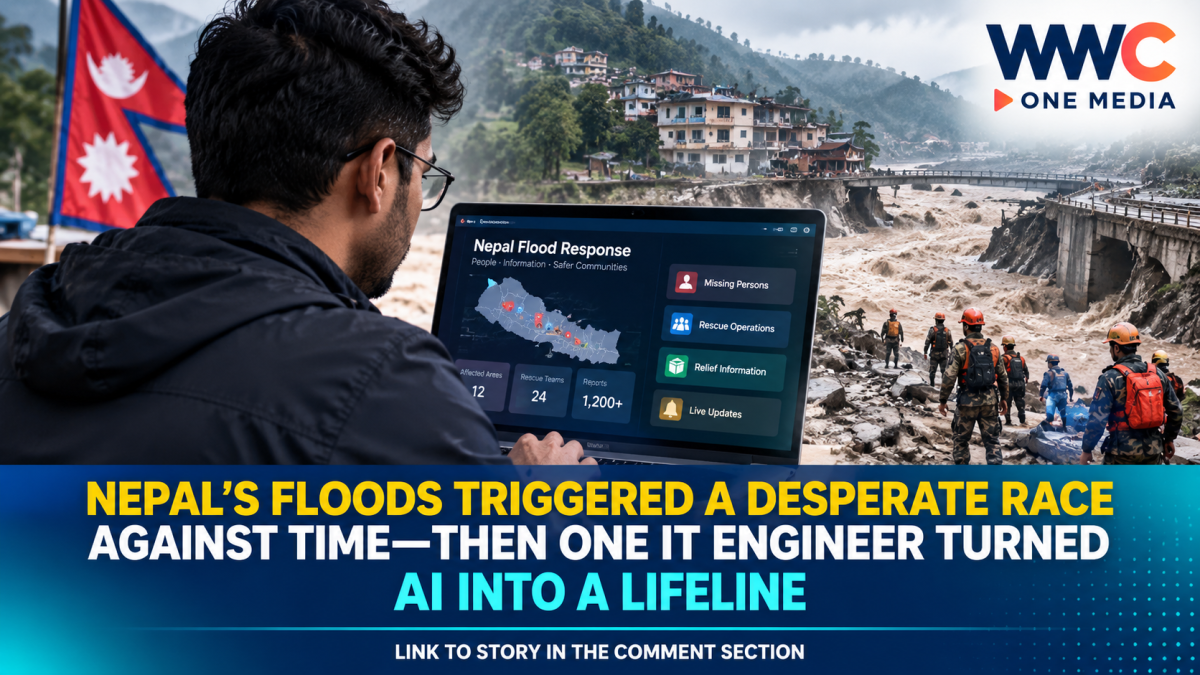
KATHMANDU — As catastrophic floods and landslides tore through parts of Nepal, destroying roads, bridges, hydropower facilities and communities, one government IT engineer turned to artificial intelligence to help solve a problem that can become just as dangerous as the disaster itself: the lack of reliable, centralized information.
Niraj Bhusal, an IT engineer at Nepal’s Ministry of Finance, worked through the night after the August 26 disaster to develop an AI-assisted online portal designed to track casualties, missing people, rescue operations and relief information.
The initiative emerged as authorities struggled to consolidate rapidly changing information from multiple agencies and sources during one of Nepal’s worst recent disasters.
According to The Kathmandu Post, Bhusal used Grok, the AI model developed by Elon Musk’s xAI, to help generate the layout, design and JavaScript code for the web application, which became known as the Rasuwa-Bhote Koshi Flood portal.
AI became an information-gathering tool
The portal was designed to automatically collect and organize information from a wide range of sources, including Nepal’s Department of Hydrology and Meteorology, Nepal Police, the Nepali Army, the National Disaster Risk Reduction and Management Authority, news organizations, government statements and satellite-data APIs.
But Bhusal did not simply allow AI to publish information unchecked.
He reportedly established a manual verification process to reduce the risk of inaccurate information being circulated during the emergency. The system sent updates to his phone every five minutes, which he then checked before relying on them.
That human verification was particularly important in a disaster environment where casualty figures, missing-person reports and rescue developments could change rapidly.
The portal initially operated in Nepali before an English version was added, allowing Nepalis overseas, humanitarian organizations and international observers to follow developments.
What began as a basic Google Form for collecting information about missing people eventually developed into a broader information platform. After Nepal’s government launched its own official rescue portal, Bhusal integrated his database with the government system and directed users toward official state rescue and relief services.
Satellite technology added another layer
The project also incorporated satellite imagery from Copernicus, the European Union’s Earth-observation program, to help visualize damage to homes, roads and bridges.
That capability is significant in a mountainous country such as Nepal, where floods and landslides can rapidly cut off communities and make ground assessments difficult.
The broader disaster response has also involved drones equipped with thermal cameras and LiDAR technology. According to The Kathmandu Post, drone operators were deployed to help locate stranded people, assess mud and debris flows and map areas where roads and bridges had been destroyed.
The combination of AI-assisted information processing, satellite imagery, drones and conventional rescue equipment shows how digital technology is increasingly becoming part of disaster-response operations.
But technology alone has not been enough.
Nepal’s high-tech response faces a harsh reality on the ground
Reporting from Nepal has highlighted a striking contrast between increasingly sophisticated digital tools and the limited equipment available to rescuers in some of the hardest-hit areas.
Authorities and independent technology groups have used digital maps, drones, GIS data, satellite imagery, emergency portals and online databases. At the same time, rescuers have faced enormous quantities of mud and debris, damaged infrastructure and difficult terrain.
The challenge became particularly severe around hydropower projects, where workers were believed to be trapped inside tunnels buried by the flood.
Reuters reporting carried by CNA found that a WhatsApp group involving more than 500 engineers was also being used to support rescue teams. Engineers shared tunnel drawings, facility layouts and information about missing workers to help rescuers understand underground networks that had been dramatically altered by the flood.
In some locations, rescue teams had to clear enormous quantities of mud, rocks and debris simply to reach tunnel entrances.
That means the role of AI and other digital technologies has largely been about making information faster, more organized and more accessible, while human rescuers remain responsible for the dangerous physical work.
A one-person project attracts unexpected support
Bhusal’s initiative also attracted support from people outside Nepal.
According to The Kathmandu Post, individuals contributed funds and server credits to help keep the portal operational as traffic increased. One Nepali living in Australia reportedly contributed US$210 in server credits, while another supporter connected with SpaceX AI contributed an additional US$100. Other supporters also provided smaller contributions.
The effort also received recognition from Copernicus, while Nepal’s Finance Minister Swarnim Wagle publicly praised Bhusal’s work and shared updates from the portal.
Bhusal has said he eventually hopes to formally hand the system over to the government so it can potentially become part of Nepal’s permanent emergency-communications infrastructure.
The bigger lesson for disaster response
Bhusal’s experience highlights a growing question for governments around the world: Can artificial intelligence make emergency response faster without becoming another source of misinformation?
Nepal’s experience suggests that AI can be valuable when it is used to collect, organize and surface information from multiple sources—but human verification remains essential.
That lesson is especially important in disasters, when social media can become overwhelmed with outdated reports, unverified casualty figures and even fabricated or AI-generated videos.
Nepal has already experienced a parallel misinformation crisis following the floods, with fact-checkers identifying old and AI-generated footage being falsely presented as scenes from the disaster.
For Bhusal, however, the goal was not to replace emergency workers with machines.
It was to help people find the right information faster.
As Nepal continues dealing with the aftermath of the floods, the overnight project created by one government engineer has become a striking example of how a relatively small digital initiative can complement traditional rescue operations during a national emergency.
And perhaps its most important message is simple: in a disaster, technology does not have to replace people to save time—it can help people work together when every minute matters.
WWC ONE MEDIA J.M.S




Leave a Reply