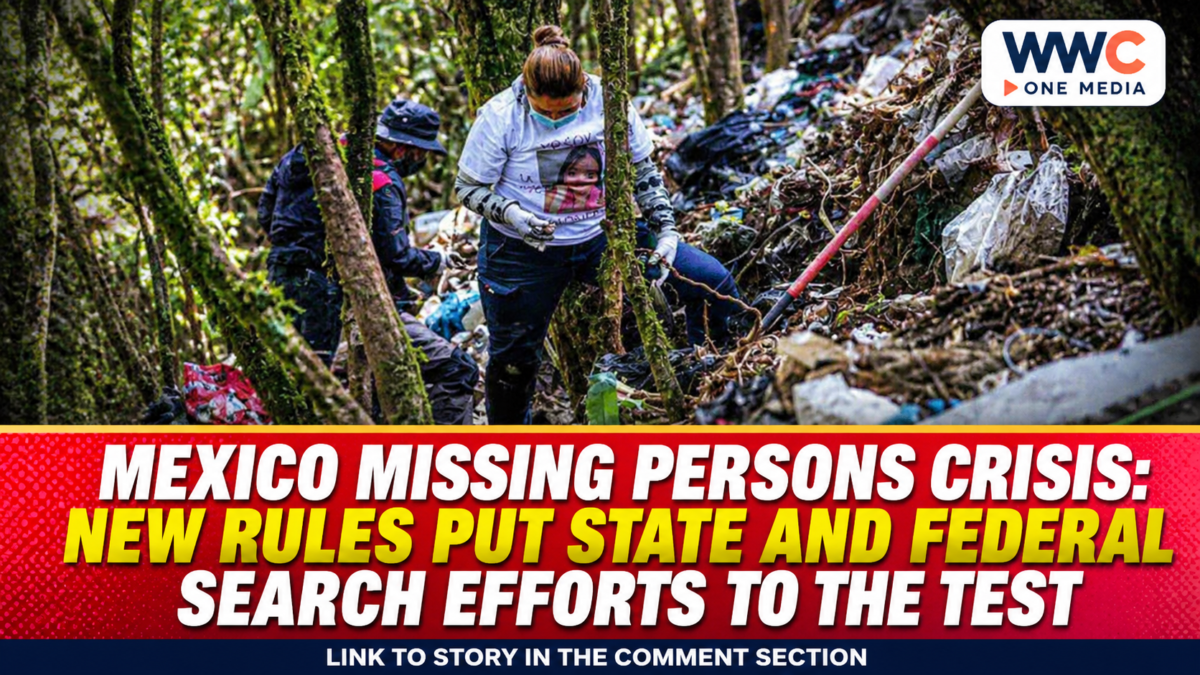
INTERNATIONAL NEWS • MEXICO • NOVEMBER 24, 2026
Mexico’s federal government reported on November 19, 2026, that 18,508 people had been located through its National Search Strategy, highlighting the scale of a nationwide effort involving federal institutions, state governments and search organizations. Yet the country’s missing-persons system continues to face a difficult institutional challenge: ensuring that every report triggers an immediate investigation and that information follows cases across administrative and international boundaries.
The issue is particularly important for families who continue searching for relatives long after an initial disappearance. Mexico’s updated legal framework establishes responsibilities for prosecutors, national and local search commissions, forensic institutions and other government agencies, while formally recognizing families’ participation in search operations.
The central question is no longer simply whether Mexico has established national search mechanisms. It is whether those mechanisms can consistently deliver timely investigations, reliable identification and answers for families.
Mexico missing persons: What the latest government figures reveal
The Mexican Ministry of the Interior reported that the National Search Strategy had resulted in 18,508 people being located as of its November 19 announcement.
The government itemized the results across several mechanisms:
- 6,939 people located through the Single Identity Platform, using information checks across public and private databases.
- 5,688 people located through coordination with state governments, with cases documented in the National Registry of Missing and Unlocated Persons.
- 1,473 people located alive through operations conducted by the National Search Commission.
- 4,408 people located through the Immediate National Search Alert.
These figures describe government-reported results from different search mechanisms. They should not be mistaken for the total number of people who remain missing, nor do they establish that every historical disappearance has been resolved.
The National Registry of Missing and Unlocated Persons, known by its Spanish abbreviation RNPDNO, is the country’s central public information system for disappearance-related records.
Its public portal allows users to consult available missing-person records, submit initial reports and access statistical information. Government authorities, including federal and state prosecutors and search commissions, are responsible for supplying and updating information.
The distinction is important: a national registry can organize information, but its effectiveness depends on the quality, completeness and timely updating of records submitted by participating institutions. gob.mx+3
The 2025 legal reform changed the responsibility of prosecutors
A major development came on July 16, 2025, when Mexico published amendments to its General Law on Forced Disappearance, Disappearance Committed by Private Individuals and the National Search System.
The changes strengthened the country’s search framework by introducing additional identification and coordination mechanisms.
Among the most important measures were the Single Identity Platform, the National Search Alert and the National Database of Investigation Files.
The reform also established an immediate investigation requirement for prosecutors receiving a report, complaint or information about a disappearance.
This requirement addresses an important institutional problem: a family should not have to wait for a case to become sufficiently developed before authorities begin investigating and searching.
In December 2025, the National Search System approved an updated Homologated Search Protocol to establish more detailed operational responsibilities.
The protocol identifies five principal search approaches:
- Immediate search.
- Individualized search.
- Pattern-based search.
- Generalized search.
- Family search.
These approaches address different circumstances. Immediate searches focus on locating someone following a report. Individualized searches examine the specific circumstances of a disappearance. Pattern-based searches examine connections among cases, while generalized searches compare records across institutions. Family searches seek to reconnect located individuals or identified remains with relatives.
This framework matters because locating a person, identifying remains and reuniting a family are related but separate responsibilities. scjn.gob.mx+1
Why searches can extend beyond one Mexican state
A disappearance does not necessarily remain within the jurisdiction where the person was last seen.
Someone may travel between states, be held in an institution elsewhere or leave the country. A family may also live far from the location where the disappearance occurred.
Mexico’s updated search protocol recognizes these complications by assigning responsibilities to different levels of government.
State search commissions and prosecutors have important roles in local investigations, while the National Search Commission coordinates broader search efforts.
The protocol also identifies the Ministry of Foreign Affairs, Mexican embassies and consulates, and federal investigative representatives as participating authorities in appropriate cases.
Where available information indicates that a missing person or their remains could be outside Mexico, authorities must interact with foreign institutions through established international cooperation mechanisms or legal assistance procedures.
The protocol specifically addresses missing migrants and the need to coordinate searches across countries of origin, transit and destination.
This is particularly significant for families whose relatives disappeared while travelling through migration routes.
The implications are not limited to Mexico. WWC ONE MEDIA previously examined the difficulties families face when missing-person records and identification efforts cross international borders.
Families are formally recognized as participants in searches
One of the most important elements of the updated protocol concerns the role of families.
Relatives and their representatives may participate in planning and carrying out search actions, as well as supervising their implementation. They also have the right to receive information about progress and results.
The protocol extends relevant participation and information rights to a person’s social family, recognizing that close relationships are not always limited to formal legal relatives.
This is important because families often possess information that cannot be obtained through administrative databases alone.
They may know a missing person’s routines, personal relationships, previous travel, last communications and other details that could help investigators develop search hypotheses.
The protocol also recognizes the risks faced by relatives participating in searches.
It directs authorities to adopt specific protection and prevention measures to safeguard families against intimidation, retaliation and criminalization connected to their search activities.
This protection is essential. Family participation should strengthen investigations, not expose relatives to additional danger.
WWC previously examined how an intensive search can evolve into continuing community-led efforts in its report on the extended search for a missing teenager in Sagada. The circumstances are different, but both situations illustrate why continued communication between authorities and families matters. sidof.segob.gob.mx+1
Forensic identification remains a separate challenge
Finding a person is not always the end of the process.
When unidentified remains are recovered, authorities must establish identity through appropriate forensic procedures before families can receive reliable confirmation.
Mexico’s updated protocol includes procedures for locating unidentified remains, recovering forensic evidence, conducting identification work and arranging dignified restitution to families.
The protocol also provides for family participation in certain exhumation and identification activities. Independent experts proposed by relatives may participate in human identification processes.
These provisions recognize that forensic identification requires cooperation between prosecutors, forensic specialists, search commissions and families.
They also demonstrate why a disappearance registry cannot, by itself, resolve every case.
A database entry may indicate that someone is missing, but a definitive resolution can require physical evidence, forensic comparison, reliable documentation and communication with relatives.
The issue is especially important in long-running cases where information may have been collected by different agencies over several years.
WWC’s coverage of a missing-person investigation in New Zealand has also highlighted why the latest official status must be distinguished from an earlier public appeal.
What happens next
Mexico’s next challenge is implementing its legal and operational framework consistently across the country.
The November 19 government announcement indicates that several search mechanisms are producing reported results. However, the effectiveness of the system must also be assessed through the completeness of its records, the quality of investigations, forensic identification and the treatment of families.
The public registry, identity platform and immediate alert system will require continuing cooperation among federal agencies, state governments and prosecutors.
For families, meaningful progress means more than a person appearing in a government database. It means receiving credible information, knowing that investigations are advancing and obtaining reliable answers about what happened.
The legal framework now provides more explicit procedures for those responsibilities. Its lasting value will depend on whether institutions carry them out consistently, including in cases that cross state borders or involve international cooperation.
Frequently asked questions
1. What is Mexico’s National Registry of Missing and Unlocated Persons?
The RNPDNO is Mexico’s national registry for information about people reported missing or unlocated. It provides public consultation and statistical tools and receives information from government authorities.
2. Does Mexico require prosecutors to investigate disappearances immediately?
Yes. The July 2025 reform established an obligation for prosecutors to initiate an investigation immediately upon receiving a report, complaint or information about a disappearance.
3. Can families participate in searches for missing relatives?
Yes. Mexico’s updated Homologated Search Protocol recognizes the right of relatives and their representatives to participate in planning, conducting and supervising search activities.
4. What happens when a missing person may be outside Mexico?
Authorities must coordinate with relevant foreign institutions through established international cooperation mechanisms or legal assistance procedures.
5. Does locating unidentified remains automatically close a missing-person case?
No. Authorities must establish identity through appropriate forensic procedures and follow the applicable notification and restitution processes.