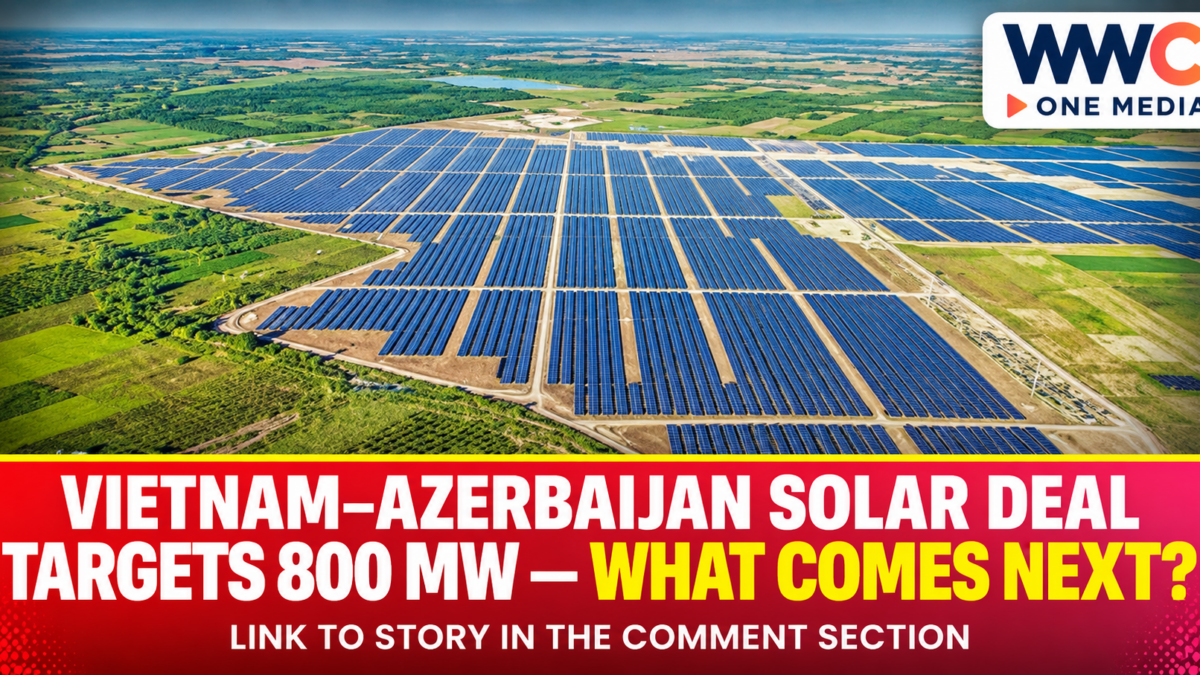
HANOI, Vietnam — Nov. 22, 2026. Azerbaijan and Vietnam advanced a renewable-power partnership on Nov. 21 when Azerbaijan’s Ministry of Energy and Vietnamese conglomerate ROX Group exchanged an implementation agreement covering solar and wind projects in Azerbaijan. Earlier official energy-ministry documentation identifies 600 megawatts (MW) of possible onshore wind development and 200 MW of solar power, providing a clearer picture of the development ambitions behind the latest diplomatic announcement.
The 800 MW figure is an exploratory project pipeline, not an operating electricity fleet or confirmed construction order. The test is whether studies, financing and grid arrangements can turn proposals into power stations.
Azerbaijan Solar Deal Builds on Earlier Agreements
The Nov. 21 ceremony in Hanoi was witnessed by Azerbaijani President Ilham Aliyev and Vietnamese President To Lam. Energy Minister Parviz Shahbazov and ROX Group founder and chairman Tran Anh Tuan exchanged the implementation agreement, whose official title covers the assessment, development and implementation of one solar and one wind power project in Azerbaijan.
The presidential announcement establishes that the document was exchanged; it does not publish a final project budget, construction schedule, electricity tariff or commitment that either plant is already being built. Cooperation is not commissioning.
The agreement also followed an earlier memorandum signed in September. The sequence shows continuing talks, not physical progress or financial close.
Where the Proposed 800 MW Comes From
A Sept. 25 announcement by Azerbaijan’s Ministry of Energy describes a memorandum with ROX Group Joint Stock Company to assess the potential for a 600-MW onshore wind project in Azerbaijan and a 200-MW solar project in the Nakhchivan Autonomous Republic. The government’s stated aim included examining electricity-export opportunities.
The September statement identifies deputy energy minister Elnur Soltanov and ROX energy executive Pham Minh Tuan as signatories. It also specifies feasibility studies, an assessment of grid capacity and the possibility of integrating part of the generation into Azerbaijan’s own power network.
An Oct. 16 ministry briefing subsequently discussed wind development in the vicinity of Baku, while referring again to prospective solar facilities in Nakhchivan. Neither statement proves that a final site has been secured or that environmental reviews and construction permits are complete.
For readers following investment approvals elsewhere in Asia, the distinction is similar to the one in WWC’s coverage of Philippine renewable-energy targets and project delivery: announcements about capacity cannot be treated as electricity already entering the grid.
The Grid Question Could Determine the Outcome
Wind and solar capacity are normally stated in megawatts, a measure of maximum power output under suitable conditions. Actual generation varies with weather, plant availability and technical conditions. A proposal for 800 MW therefore does not imply 800 MW of continuous production.
Grid access presents an additional challenge. A developer needs to know whether transmission lines can accept new generation and where that electricity would go. If a project targets exports, the required connection and cross-border arrangements matter as much as the turbines and solar panels themselves.
Azerbaijan’s energy ministry has discussed links connecting Nakhchivan with Azerbaijan’s main power system and with Türkiye. Those discussions do not establish booked export capacity.
A regional comparison appears in WWC’s reporting on Indonesia’s AZEC 2.0 energy investment programme, where generation plans and the financial and transmission milestones needed to deliver them are treated separately.
Energy Cooperation Goes Beyond Renewables
The ROX agreement is part of a broader Azerbaijan–Vietnam relationship. During an Oct. 16 meeting with Vietnam’s Deputy Minister of Industry and Trade Phan Thi Thang, the Azerbaijani energy ministry reported that more than 1.1 million tonnes of Azerbaijani crude oil had been supplied to Vietnam since 2023.
The meeting also covered possible cooperation between Azerbaijan’s state oil company SOCAR and PetroVietnam, along with oil refining, petrochemicals and liquefied natural gas. These are areas under discussion, not automatically separate contracts resulting from the Nov. 21 renewable-energy exchange.
The two countries’ presidents adopted a joint statement in Hanoi. The ceremony also involved documents concerning fire and rescue services and cooperation between presidential offices. Those agreements had separate purposes and should not be represented as additional renewable-energy projects.
From an investment perspective, the growing range of discussions suggests a relationship spanning traditional energy and emerging renewable technologies. It does not establish a single financing package covering every proposal.
Why Financing Matters as Much as Capacity
Analysis: The most useful way to judge the new agreement is by measurable future disclosures rather than the headline sum of megawatts. Developers must establish technical feasibility, select project locations, arrange buyers or market access, obtain relevant approvals and secure capital before construction can proceed.
An implementation agreement may help organise those tasks, but it is not, on its own, a public record of committed project expenditure. No verified investment amount or construction completion date for the two ROX projects appears in the reviewed Nov. 21 presidential announcement.
Financing is a practical issue across renewable markets. WWC’s coverage of Alternergy’s green-power financing programme offers a Philippine comparison of how funding arrangements and future generation targets must be assessed as different milestones. The companies and national approval systems are unrelated.
What Happens Next
The next substantive developments would be a more detailed implementation schedule, final project sites, completed feasibility results, grid-connection decisions, financing commitments and evidence of construction. Project-specific authorisations and agreements for the sale or export of electricity would make the commercial pathway easier to assess.
For now, Azerbaijan and ROX Group have an officially documented path for examining wind and solar developments with 800 MW of previously identified potential capacity. That is a meaningful project-development benchmark—but it is not yet an operating renewable-energy investment.
Frequently Asked Questions
Did Vietnam and Azerbaijan sign a renewable-energy agreement in November 2026?
Yes. On Nov. 21, Azerbaijan’s Ministry of Energy and Vietnam’s ROX Group exchanged an implementation agreement concerning the assessment, development and implementation of solar and wind projects in Azerbaijan.
How much renewable capacity is being examined?
A September 2026 ministry announcement described the potential development of 600 MW of onshore wind and 200 MW of solar generation. These are proposals, not commissioned capacity.
Where is the proposed solar plant?
The earlier ministry memorandum identified Nakhchivan Autonomous Republic as the location for the proposed 200-MW solar project. Final site and permitting details were not established in the reviewed statements.
Are the wind and solar projects already under construction?
The official records reviewed do not establish that construction has started or that financing has closed. The projects require further verified milestones.
Could electricity be exported from these developments?
Export opportunities were part of the September cooperation framework. The documents reviewed do not establish an approved export contract or a guaranteed transmission route for electricity from these projects.