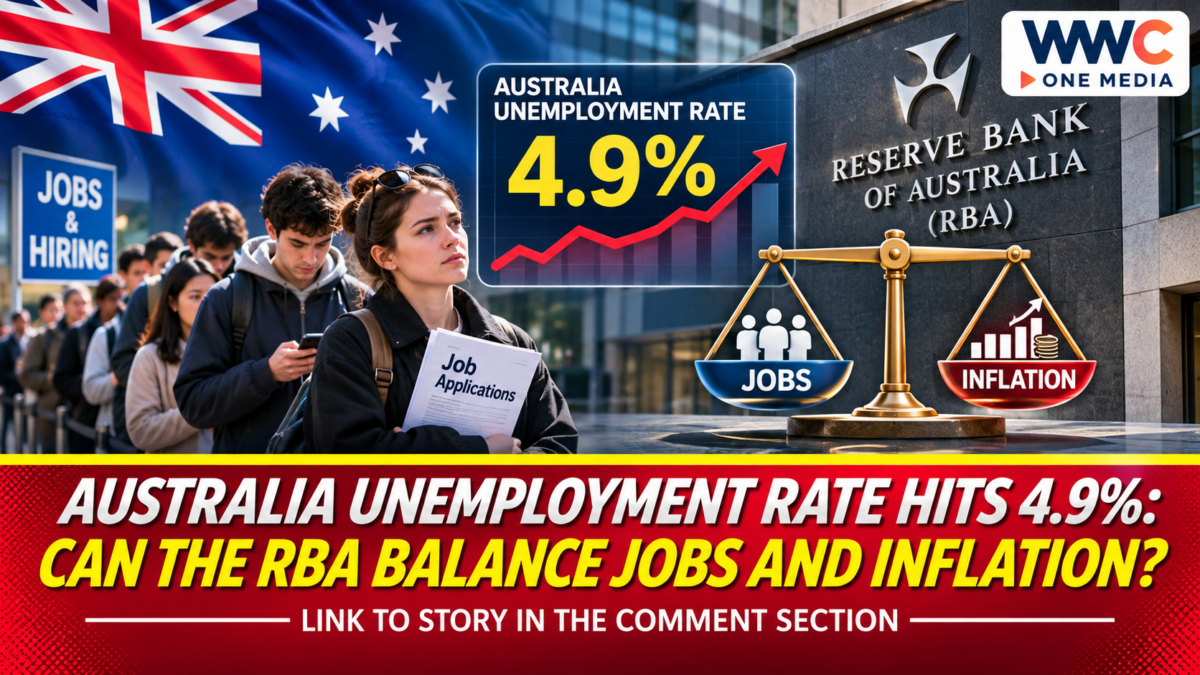
SYDNEY, Australia — Nov. 22, 2026. Australia’s unemployment rate reached 4.9% in October, the Australian Bureau of Statistics (ABS) reported on Nov. 19, as employment fell and the number of people seeking work increased. The result, the highest unemployment rate since October 2021, has sharpened scrutiny of the Reserve Bank of Australia’s (RBA) decision to lift its cash-rate target earlier in November.
The central question is not whether a single monthly jobs report dictates interest rates. It is how policymakers will weigh evidence of weakening employment against inflation that the RBA says remains too high. Official data provide a more useful guide than predictions of an inevitable rate cut or recession.
Australia Unemployment Rate: What Changed in October?
The ABS recorded 14,738,600 employed Australians in October on a seasonally adjusted basis, down 43,500 from September. The number of unemployed people increased by 17,800 to 753,700, while the unemployment rate was published at 4.9%, versus 4.7% for September.
There is a statistical detail worth keeping intact. Although the two published one-decimal rates appear to differ by 0.2 percentage points, the ABS’s change column records a 0.1-point increase. It calculates changes from unrounded estimates, which can yield a different result from subtracting displayed rounded numbers.
Employment relative to population declined to 63.3%, from 63.6%, and labour-force participation decreased to 66.6%, from 66.8%. Monthly hours worked slipped from 2,010 million to 2,006 million. These measures show that October’s labour market weakness involved more than just the headline unemployment rate.
Part-Time Work and Young People Show the Pressure
The employment decrease was concentrated in part-time work. Part-time employment fell by 40,600 to 4,509,900, while full-time employment decreased by 2,900 to 10,228,700. This split is important because a large fall in part-time positions can affect people seeking flexible work or a foothold in the labour market.
Youth unemployment increased to 11.3%, from 11.1% in September. The ABS said the October reading for people aged 15 to 24 was the highest since October 2021. That does not establish why each young worker could not find employment, but it identifies a group facing greater difficulties than the overall workforce.
There was one counterweight. The seasonally adjusted underemployment rate fell to 6.2%, from 6.3%, and the combined underutilisation rate stayed at 11.1%. Unemployment measures people without work who meet the survey criteria; underemployment also helps reveal people who have jobs but want more hours. Both belong in an assessment of labour-market conditions.
Why the Trend Data Matter More Than One Month
The ABS cautions against treating every monthly movement as a lasting change. Its trend series smooths some short-term fluctuations. In October, trend employment rose by 7,200 to 14,797,500, even as seasonally adjusted employment declined sharply.
At the same time, trend unemployment edged up to 4.8%, from 4.7%, while the trend employment-to-population ratio dipped to 63.6%. The trend numbers therefore suggest a softer labour market, but not the same abrupt contraction implied by the seasonally adjusted employment fall.
Analysis: The combination warrants attention without supporting a definitive claim that Australia is already in recession. A recession is an economy-wide question, and the labour-force release by itself does not establish the condition of overall output. Future jobs and activity readings will show whether the October weakness persists.
The Reserve Bank Faces Two Competing Risks
On Nov. 3, the RBA raised its cash-rate target by 25 basis points to 4.85%, effective Nov. 4. Its official November monetary-policy statement said inflation remained elevated and that it expected a longer period of above-target price increases.
The RBA’s assessment also recognised that the labour market had eased and that unemployment was expected to rise further. Its price-stability mandate and concern for employment make this a difficult balance: tighter financial conditions can help restrain inflation but may also weigh on business activity and hiring.
WWC previously examined the RBA board’s disagreement over its November increase. That debate now has another official labour-market data point to consider, although the October survey period preceded the November rate decision.
For households, the risk is not limited to employment. The interaction of borrowing costs and weaker job prospects matters to housing demand, a tension explored in WWC’s coverage of Australia’s slowing auction market. The labour figures do not prove that unemployment caused any particular housing transaction to fail.
What This Could Mean for Businesses and Regional Readers
Employers may respond to uncertain demand by limiting recruitment, reducing hours or postponing investment. But the ABS statistics do not identify a single cause for the nationwide decline, and they cannot be attributed automatically to individual corporate restructuring programmes.
For Philippine readers, Australia’s employment cycle matters because the two economies are connected through trade, education, travel and services. Yet the October jobs report does not establish a specific change in Philippine employment, remittances or the peso. Those would require separate official datasets.
WWC’s earlier report on the Australian dollar and high interest rates helps distinguish observed currency movements from unsupported predictions. A weaker Australian labour market may influence expectations, but it does not guarantee an exchange-rate direction.
What Happens Next
The RBA’s next monetary-policy decision is scheduled for Dec. 8, 2026. The ABS has scheduled the November labour-force release for Dec. 17, after that policy meeting. Officials will therefore have to assess October’s jobs figures alongside other available inflation and economic information.
Analysis: The evidence now supports caution on both sides. Rising unemployment makes further tightening more consequential for workers, while elevated inflation limits the case for immediate relief. Neither a December rate cut nor another increase is predetermined by this one report.
Frequently Asked Questions
What was Australia’s unemployment rate in October 2026?
The seasonally adjusted unemployment rate was 4.9%, the highest since October 2021, in the ABS release dated Nov. 19, 2026.
How many jobs did Australia lose in October?
Seasonally adjusted employment fell by 43,500 people. That is a change in the survey estimate of employed people, not a count of announced redundancies.
Why does the ABS show a 0.1-point change from 4.7% to 4.9%?
The agency calculates monthly changes using unrounded figures, which can differ from subtraction of its published one-decimal rates.
What is the RBA’s cash-rate target?
It is 4.85%, effective Nov. 4, following the Monetary Policy Board’s Nov. 3 decision.
When are the next Australian jobs figures due?
The ABS has scheduled its November 2026 labour-force release for Dec. 17, 2026.