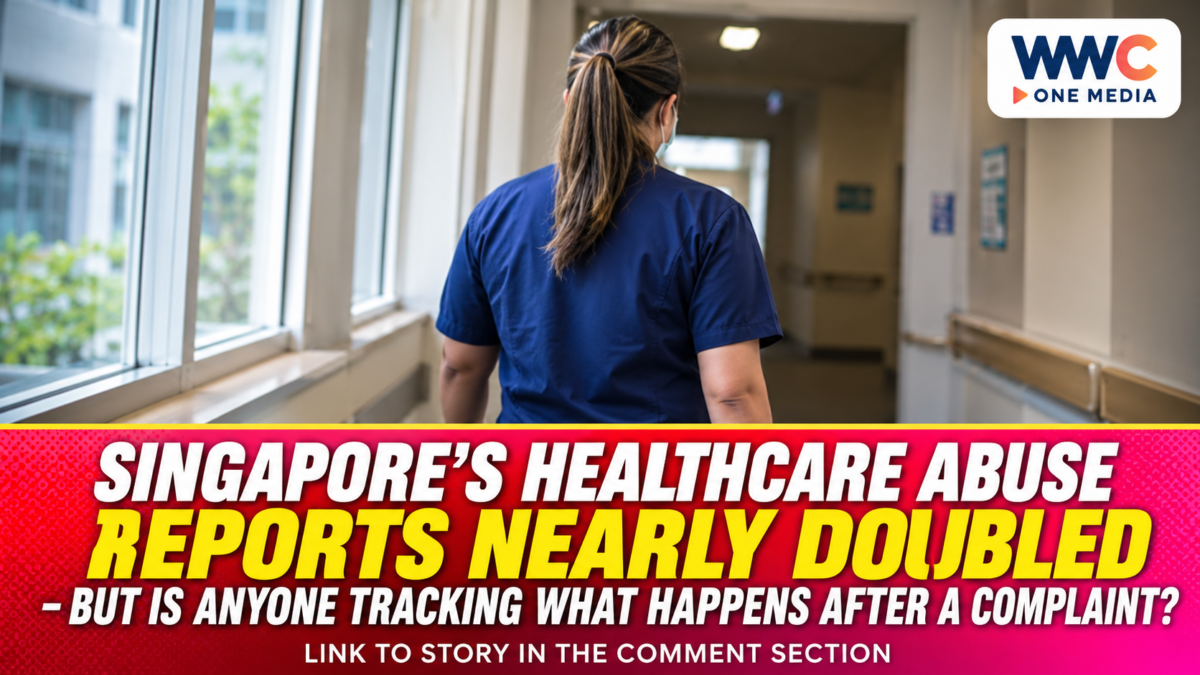
Singapore’s Ministry of Health recorded 4,200 reports of abuse and harassment involving public healthcare workers in 2025, almost twice the approximately 2,200 reported in 2023. Yet a separate government response reveals a significant accountability gap: the ministry does not centrally track how individual cases are resolved after they are reported.
The figures highlight a difficult challenge for hospitals and nursing homes. Healthcare workers must protect themselves from threats, intimidation and harassment while continuing to provide care to patients, including people whose medical conditions may contribute to difficult or aggressive behaviour.
The issue is no longer simply whether healthcare institutions have rules against abuse. It is whether those rules consistently translate into protection, follow-up and support for the people affected.
Healthcare abuse reports climbed to 4,200 in 2025
Singapore established the Tripartite Workgroup for the Prevention of Abuse and Harassment of Healthcare Workers in 2022. The group brought together government representatives, healthcare employers and the Healthcare Services Employees’ Union to develop a coordinated approach across public, private and community healthcare.
Its September 2026 public report documented the work undertaken between 2022 and 2026.
The Ministry of Health reported that public healthcare institutions recorded approximately 2,200 incidents in 2023. The number rose to 3,000 in 2024 and 4,200 in 2025.
Police reports involving healthcare workers also increased. The number rose from approximately 350 in 2023 to 550 in 2025.
These figures require careful interpretation. The workgroup said the increase was consistent with greater awareness of unacceptable behaviour and growing confidence among healthcare workers to report incidents.
In other words, the higher number does not automatically prove that abuse itself became more common. More workers may have started reporting conduct that previously went unrecorded.
A separate parliamentary response dated March 3, 2026, provided another important measure of the problem. The ministry said about 7% of reported cases in 2024 and 2025 were considered high severity, involving a high level of harm or distress. It also said 15% of all cases were reported to the police.
Why healthcare workers can find it difficult to report abuse
The workgroup’s 2023 engagement involved more than 3,000 healthcare workers and more than 1,500 members of the public through surveys and focus group discussions.
About two in three healthcare workers surveyed said they had witnessed or experienced abuse or harassment.
Verbal abuse was among the most prevalent forms. The ministry also identified unclear reporting channels, fear of repercussions and the belief that mistreatment was simply part of the job as reasons incidents went unreported.
These barriers can be particularly complicated in healthcare settings.
Workers may have to continue treating the same patient after an incident. They may also encounter family members who remain involved in decisions about a patient’s care.
This creates a difficult balance between maintaining access to treatment and protecting employees from repeated intimidation or aggression.
The challenge is not limited to hospitals. Nursing homes and community care facilities also deal with residents who may have difficulty communicating, as well as relatives who may become confrontational over treatment or facility rules.
A response that protects employees must still account for patients’ medical needs and rights.
Singapore introduced a sector-wide protection framework
The Tripartite Framework for the Prevention of Abuse and Harassment in Healthcare was launched in 2023 to establish common definitions and standardised institutional responses.
Under the framework, public healthcare institutions can issue warnings, remove abusive individuals from their premises or discharge abusive patients who do not require urgent medical care.
The institutions have also established dedicated healthcare-worker protection functions, including the appointment of Chief Wellness Officers.
The ministry said more than 6,000 healthcare workers had received advanced training in de-escalation and self-defence techniques. Basic training is provided to frontline staff and included in onboarding for new healthcare workers.
Support for affected employees can include medical attention, mental health assistance, time off and reassignment of duties.
These measures matter because a policy cannot protect workers if employees do not know how to report incidents or what assistance is available afterwards.
The framework also recognises that preventing abuse is not solely the responsibility of hospital management. Patients, relatives, visitors and the wider public all have a role in maintaining respectful healthcare environments.
The accountability question: Who checks whether cases are resolved?
One of the most significant details in the government’s parliamentary records concerns the monitoring of complaints.
On May 5, 2026, the Ministry of Health answered a parliamentary question about what healthcare workers could do when institutions failed to follow up on internally reported incidents that did not involve police investigations.
The ministry said it did not centrally track the resolution and post-incident management outcomes of all abuse and harassment cases. It also said it did not plan to introduce such central tracking.
Its position was that healthcare institutions should own and internalise the framework rather than treat it as an exercise in setting and monitoring numerical targets.
That approach places responsibility on individual healthcare organisations to manage incidents and support affected staff.
Earlier, on March 4, the ministry said all public healthcare institutions had established internal mechanisms for follow-up. These included immediate incident response, reporting procedures, post-incident support and action against perpetrators.
The distinction is important. Singapore has institutional reporting and response mechanisms, but the ministry does not maintain a central record showing how every case was ultimately resolved.
For the public, that makes it harder to assess the consistency of follow-up across institutions using one national set of outcome figures.
It also raises a legitimate question about how workers can seek further assistance when they believe an internal complaint has not been handled properly.
Abuse by patients requires a careful response, not silence
Healthcare institutions face a more complicated problem when the person responsible for aggressive behaviour is also medically vulnerable.
A patient may be frightened, confused, distressed or unable to communicate needs clearly. Some conditions can also affect behaviour.
That context may help explain an incident, but it does not mean healthcare workers should be expected to accept threats or harassment without protection.
The framework gives institutions options that can be adapted to the circumstances. These include immediate intervention by supervisors or security personnel, written warnings, restrictions on visitors and police escalation for serious cases.
The ministry said serious incidents, particularly those resulting in physical harm to a healthcare worker, should be reported to the police.
This approach recognises that patient care and staff safety are connected. Workers who feel unsafe may struggle to maintain a stable environment for themselves and the people they serve.
The issue also connects with the wider discussion about employee well-being in the Philippines. WWC has examined LANDBANK’s expanded healthcare and mental health support for employees, as well as mental health pressures across the Philippine workforce.
These are separate developments, but they reflect a common workplace concern: employee welfare depends not only on access to healthcare services but also on whether organisations respond when workers face difficult conditions.
The pressure on medical institutions is also visible when hospitals experience surges in patient demand. WWC previously reported on the strain placed on San Lazaro Hospital during the leptospirosis surge, another example of the demanding environment in which healthcare personnel work.
What happens next
The tripartite workgroup concluded its term on June 30, 2026. Its work is transitioning into an employer-led Community of Practice involving public healthcare clusters, community care organisations, private healthcare providers and the Healthcare Services Employees’ Union.
The new body is intended to provide a platform for institutions to exchange experiences, strengthen capabilities and share effective approaches to preventing abuse and harassment.
Singapore’s #NoExcuseforAbuse public education campaign is also part of the effort to encourage respectful behaviour in healthcare settings.
The next measure of progress should not be the number of policies announced or training sessions completed alone. It should include whether workers feel safe reporting incidents, whether institutions respond appropriately and whether affected employees receive meaningful support.
The 4,200 reports recorded in 2025 show why the issue deserves attention. The absence of central tracking of case outcomes leaves another question for healthcare institutions: how can the system demonstrate that reporting an incident actually leads to lasting protection?
Frequently asked questions
How many healthcare worker abuse cases were reported in Singapore in 2025?
Singapore’s public healthcare institutions reported 4,200 abuse and harassment incidents in 2025, compared with approximately 2,200 in 2023.
Did abuse against healthcare workers actually double?
The number of reported incidents nearly doubled. However, the Ministry of Health said the increase was consistent with greater awareness and confidence in reporting. The figures alone do not establish that the actual prevalence of abuse doubled.
What protections are available to healthcare workers in Singapore?
The tripartite framework allows institutions to intervene, issue warnings, restrict abusive visitors, remove perpetrators from premises and discharge abusive patients who do not require urgent medical care. Support may include medical attention, mental health assistance and reassignment of duties.
Can healthcare workers report serious abuse to the police?
Yes. The framework encourages police reporting at the worker’s discretion and identifies serious cases, particularly those involving physical harm, as requiring police involvement.
Does Singapore’s Ministry of Health track the outcome of every abuse complaint?
No. In a May 5, 2026 parliamentary response, the ministry said it did not centrally track the resolution and post-incident management outcomes of all reported cases.