A community-led restoration effort in Tanjung Leban, a village in Bengkalis Regency, Indonesia’s Riau province, has turned a fire-damaged peatland site into a place for research, environmental learning and community engagement. But as the area attracts renewed attention in 2026, a crucial question remains: how will the work be maintained over the long term?
The experience matters beyond one village. Indonesia’s peatlands are important environmental landscapes, and restoration requires more than planting trees or opening a demonstration site. Water management, monitoring, community participation and continuing resources all influence whether damaged land can recover and remain protected.
The public record documents years of work in Tanjung Leban, including a community revegetation programme and a knowledge-sharing facility supported by a grant. It does not, however, disclose a current village-level restoration budget or confirm a permanent funding arrangement for ongoing maintenance.
Tanjung Leban’s restoration began with damaged land
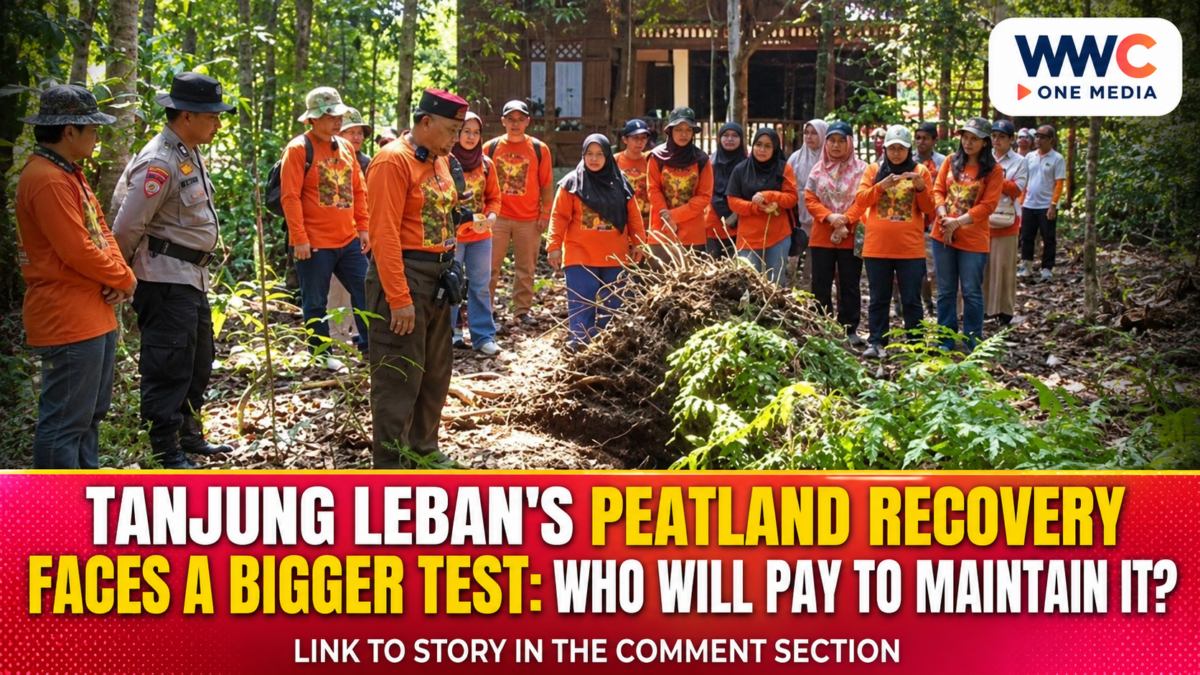
The Tanjung Leban site was not always a restoration learning area. The Center of Excellence for Peatland and Disaster Studies at Universitas Riau describes it as peatland previously planted with oil palms and severely damaged by fire.
The university says restoration experiments were carried out over several years. Some attempts failed, but the experience contributed to later work at the site. After nearly eight years of sustained effort, the area began showing signs of successful peatland restoration.
That history is important because it places the project in a longer process rather than presenting it as a quick environmental intervention.
Peatland recovery is different from simply planting trees on ordinary dry ground. The condition of the soil and its water levels matter. When peat becomes dry, it can become more vulnerable to fire, while restoring suitable moisture conditions is a central part of rehabilitation.
Tanjung Leban’s experience therefore offers a practical example of why restoration needs to consider the wider landscape, not only the number of seedlings planted.
A community programme put restoration on local land
A study published in the Universitas Riau Conference Series documented a community-based revegetation project in Tanjung Leban under the Japan International Cooperation Agency Partnership Program.
The project involved JICA, Kyoto University and Universitas Riau. Its community approach included village facilitators and the development of local groups, followed by seedling preparation, land clearing and planting.
The research described work on 28.4 hectares of community land, involving 23,450 trees. The trees were divided into natural wood and fruit-tree categories.
The project also involved members of the Peat Care Community Group, known by its Indonesian abbreviation MPG. The researchers said the community empowerment activities helped change local peatland management behaviour in relation to fire prevention.
This is a significant part of the Tanjung Leban model. Restoration was not described only as a technical exercise conducted by outside specialists. Local residents were included in activities and in the management approach.
That does not mean the study proves the entire village has been restored or that all planted trees survived. Its findings relate to the specific project and area documented in the research.
The UNOPS grant supported a learning facility
Another part of the project’s development came in 2021, when Universitas Riau’s Center of Excellence for Peatland and Disaster Studies received a grant from the United Nations Office for Project Services to establish facilities for knowledge-sharing on peatland restoration.
The university says the facilities have attracted students, school groups, government agencies, the Peatland Restoration Agency and international researchers interested in restoration practices.
The distinction between this grant and operational funding is important. The university record describes support for facilities dedicated to knowledge-sharing. It does not say the grant created a permanent fund for village maintenance, paid all restoration expenses or guaranteed future financing.
For readers assessing the project’s financial sustainability, those are different questions. A learning centre can help spread technical knowledge, but it does not automatically pay for water-control structures, field monitoring, replacement planting or community work.
A November gathering put the site back in focus
Tanjung Leban remained a focus of peatland learning in November 2026.
Universitas Riau reported that an excursion to Rumah Runding in the village was held on Nov. 1 as part of the International Conference on Peatland Research and Innovation programme. The activity was presented as an opportunity for participants to observe restoration work, exchange community knowledge and visit the living laboratory.
The conference programme listed support for the excursion from PT Riau Andalan Pulp and Paper, HKI, APHI, PT Sinarmas, Pertamina Hulu Rokan and Riau Petroleum.
However, the programme identifies these organisations as supporters of the event. It does not establish that each company funds Tanjung Leban’s restoration operations or contributes to a recurring village maintenance budget.
Universitas Riau’s account also described the site as the result of a long process involving research, cooperation among institutions and community participation. The university said the visit connected academic knowledge with the experience of residents managing peatland challenges.
The renewed attention is useful for sharing lessons. The next step is ensuring that the work being demonstrated can continue after visitors leave.
Why maintenance matters as much as planting
The long-term test for a peatland restoration project is whether the conditions that support recovery can be maintained.
That can involve monitoring water levels, maintaining water-control infrastructure, protecting recovering vegetation and supporting local groups that take part in prevention and management. These activities require people, technical capacity and resources over time.
The importance of prevention is also clear in Indonesia’s wider fire challenge. WWC has previously examined why peatland conditions and land management matter before fires begin. The issue is not limited to responding after a fire has spread; the condition of the landscape before a fire can influence the risk.
There is also a regional policy connection. ASEAN’s One Billion Trees Growing Initiative and its emphasis on restoration quality highlight why survival, ecological suitability and long-term monitoring matter alongside planting targets.
A Philippine example offers another comparison. The Monkayo forest restoration project includes a plot-adoption programme that helps cover nursery production, planting, maintenance and monitoring. It is a separate project and not a funding model confirmed for Tanjung Leban, but it illustrates how restoration programmes can identify support for activities beyond initial planting.
For Tanjung Leban, the public records reviewed do not yet provide equivalent detail about a continuing funding mechanism.
What happens next
Tanjung Leban’s experience shows how research partnerships and community participation can help turn damaged peatland into a restoration learning site. Its next challenge is to make the work durable.
That requires clearer public information about who is responsible for maintenance, what activities need recurring support, how local residents participate and where the money for those activities comes from.
Future disclosures could help answer whether the project has continuing government allocations, institutional support, private-sector contributions or other funding arrangements. They should also distinguish between money for research and education events and funding for field operations.
The central question is not whether Tanjung Leban has attracted attention. It has. The more important measure is whether the restoration practices can continue to protect the site and support the community after the current cycle of projects and visits.
Frequently asked questions
Where is Tanjung Leban?
Tanjung Leban is a village in Bengkalis Regency, Riau province, on the Indonesian island of Sumatra.
What happened to the peatland before restoration?
Universitas Riau describes the restoration site as formerly oil-palm-planted peatland that was severely damaged by fire.
How large was the documented community revegetation project?
A Universitas Riau study documented restoration activity on 28.4 hectares of community land involving 23,450 trees.
Did UNOPS fund the entire restoration project?
The university record says its peatland research centre received a UNOPS grant in 2021 to establish facilities for knowledge-sharing. It does not establish that UNOPS financed all restoration work or ongoing village maintenance.
Is there confirmed long-term funding for Tanjung Leban?
The public records reviewed for this article do not disclose a current village-level maintenance budget or confirm a permanent funding arrangement. Further official documentation is needed to establish the current financing position.