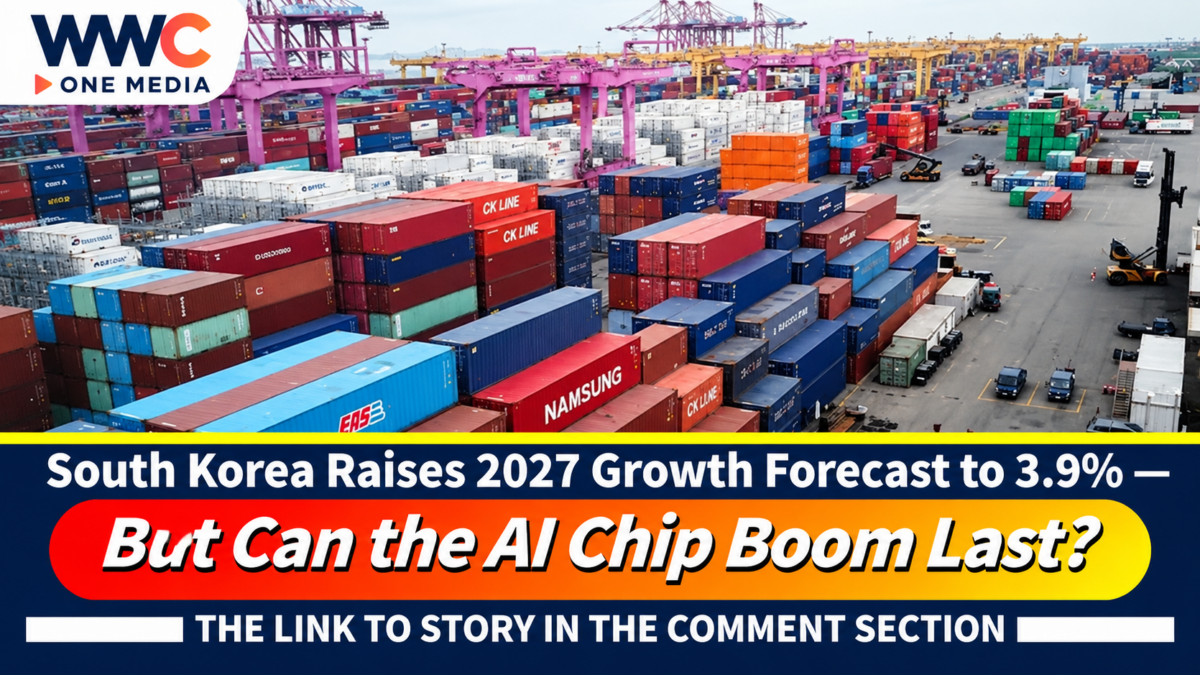
South Korea’s growth outlook for 2027 jumped to 3.9% on Nov. 18, 2026, after the Korea Development Institute (KDI) revised its earlier 2.2% projection amid stronger demand for semiconductors and artificial intelligence infrastructure. The state research institute also raised its 2026 growth forecast to 3.8% from 3.2%, reflecting the importance of chip-related exports and equipment investment.
The economy is benefiting from global spending on AI computing, yet the research institute says the recovery is reaching households more slowly than the headline GDP numbers suggest.
South Korea growth forecast: what changed since August?
KDI’s latest outlook lifted its 2027 gross domestic product growth estimate by 1.7 percentage points, from 2.2% to 3.9%. Its 2026 projection rose by 0.6 percentage point, from 3.2% to 3.8%.
The updated study projects exports will increase 10.3% in 2026 and 8.1% in 2027, helped by demand for semiconductors and other equipment used to build AI infrastructure. Its new 2027 export forecast therefore rests on sustained overseas purchasing, rather than a self-contained domestic boom.
KDI also expects equipment investment to rise by 8.7% in 2026 and 8.1% in 2027.
The trade side of this change is closely related to WWC’s earlier report on South Korea’s semiconductor-led export momentum. That earlier report addressed export developments; the new KDI release measures the consequences for the broader growth outlook.
Why AI infrastructure is changing the economic picture
KDI describes a prolonged expansion in global AI infrastructure spending as a major force behind Korean exports and industrial investment. The products benefiting extend beyond memory chips to computers, electronic and optical equipment, steel and non-ferrous metals linked to data-centre construction.
Its November economic assessment recorded third-quarter GDP growth of 3.4% from a year earlier and 1.0% from the preceding quarter.
Semiconductor production has become especially consequential for the overall economy. KDI cautions that changes in chip output could have a larger effect on national GDP in 2027 because of the sector’s growing economic weight.
The supply side matters too. WWC has separately examined plans to accelerate a South Korean semiconductor manufacturing hub.
Analysis: A concentrated export boom can lift national growth rapidly while making forecasts more sensitive to the decisions of a relatively narrow group of technology customers. This does not establish that demand will collapse; it explains why seemingly strong numbers can carry material uncertainty.
Will stronger exports reach Korean households?
The research institute expects private consumption to grow 1.8% in 2026 and 2.4% in 2027. That improvement is slower than projected GDP growth, underscoring the difference between rising corporate output and immediate gains in household spending power.
KDI’s November monthly assessment reported that the effects of stronger chip earnings had not yet spread widely through household incomes. It also identified elevated energy costs and restrained real-wage growth as pressures on consumers.
The employment outlook is similarly measured. KDI estimates an increase of about 120,000 employed people in 2026 and around 200,000 in 2027.
For households, the relevant tests include wages, jobs and everyday purchasing power. An export-led improvement can eventually support domestic services and consumption, but the timetable and distribution of benefits cannot be read directly from headline GDP growth.
Inflation may ease, but price pressure remains
KDI forecasts consumer-price inflation of 2.7% for 2026 and 2.4% for 2027. It expects some relief from lower oil prices while warning that demand-driven inflationary pressure could remain persistent.
The outlook puts core inflation, which excludes food and energy, at 2.6% in 2026 and 2.5% in 2027.
KDI assumes Dubai crude oil import prices will average approximately US$86 per barrel in 2027, compared with about US$94 in 2026. These assumptions could prove inaccurate if energy supply conditions or global demand change.
The Bank of Korea’s August outlook projected 2.9% growth for 2027, illustrating that economic institutions can publish different forecasts using different information and assumptions.
What could interrupt the 2027 AI-led recovery?
KDI identifies a potential pullback in global AI investment as an important downside risk. Delays or reductions in US data-centre construction, or more difficult financing conditions for major technology companies, could reduce orders for Korean suppliers and weaken growth.
Its alternative scenario is also clear: if AI companies demonstrate stronger profitability and Korean manufacturers expand supply faster than expected, growth could exceed the baseline projection.
South Korea’s public spending priorities are another part of the discussion. WWC previously covered the government’s proposed 2027 budget and AI investment priorities. Fiscal programmes and private-sector export demand are distinct drivers, and neither should be presented as proof that the other’s targets will be met.
Why it matters: For Philippine businesses and investors watching regional electronics supply chains, the forecast shows how strongly AI infrastructure demand is affecting neighbouring economies. It does not, by itself, quantify any specific increase in Philippine exports or investment.
What happens next
The next meaningful evidence will come from subsequent official export releases, semiconductor production data, household consumption figures and updated growth projections. Those indicators can show whether the benefits continue spreading beyond chip producers.
As of Nov. 18, 2026, the central finding is a sharply upgraded forecast, not a completed 2027 outcome. KDI expects stronger growth because AI-related demand remains high, while warning that dependence on that same demand could amplify an eventual slowdown.
FAQ
What is South Korea’s 2027 GDP growth forecast?
KDI forecasts 3.9% economic growth in 2027 in its Nov. 18 outlook, up from its previous 2.2% estimate published in August.
Why did South Korea’s growth forecast rise?
KDI attributes the change chiefly to strong global demand for semiconductors, AI infrastructure equipment and the associated expansion in exports and investment.
Will Korean households benefit from the AI chip boom?
KDI forecasts private consumption growth improving from 1.8% in 2026 to 2.4% in 2027, but says gains from the semiconductor boom have so far spread unevenly across households.
What could derail Korea’s 2027 economic outlook?
A slowdown in global AI capital spending, delayed data-centre projects, tighter financing or renewed energy-cost pressure could weaken the forecast. None is established as a certain outcome.