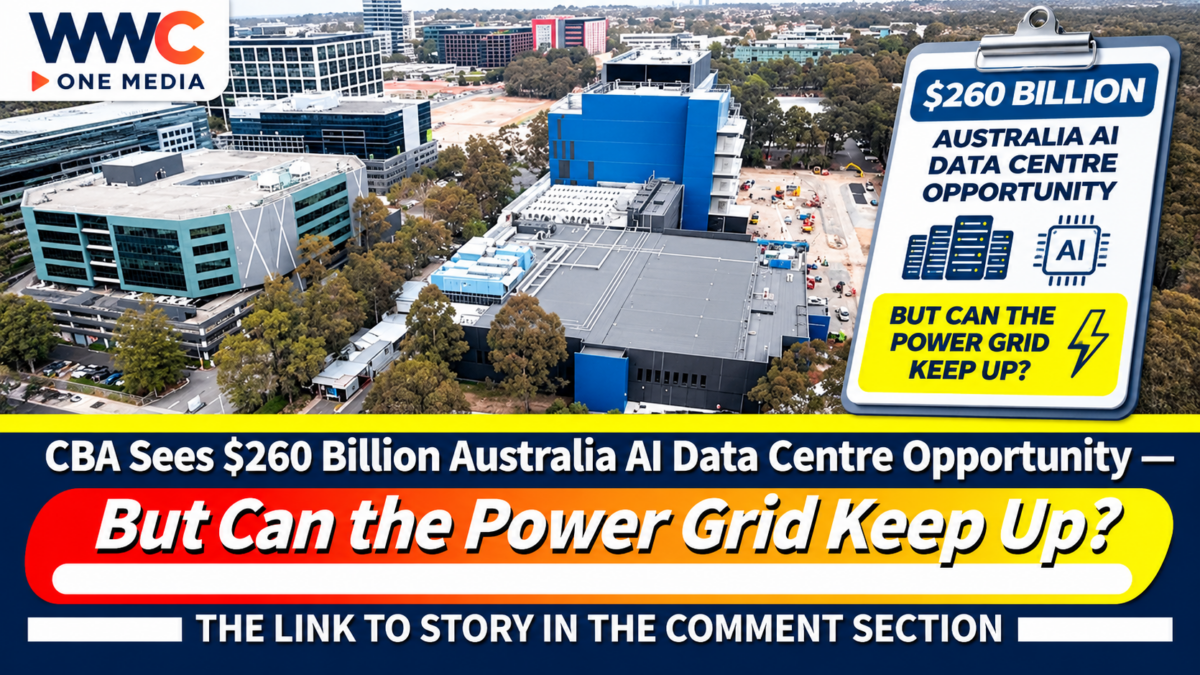
Australia’s AI data centre investment pipeline could reach approximately A$260 billion by the mid-2030s, Commonwealth Bank of Australia (CBA) estimated in research published in October 2026. The bank’s analysis also warned that electricity availability, planning uncertainty and community concerns could prevent much of the announced infrastructure from being built.
The contrast is important: a large investment forecast does not represent money already spent or capacity already operating. As Australia competes for artificial intelligence workloads, the more meaningful test is how many proposed facilities can secure power, approvals, customers and financing.
Australia AI data centres: a 7-gigawatt reality check
CBA economists revised their estimate of feasible additional data centre capacity from 6 gigawatts (GW) to 7 GW. That could lift Australia’s total rated capacity to about 9.2 GW by the mid-2030s, more than four times its current level on the bank’s assumptions.
The headline development pipeline is much larger: roughly 23 GW of capacity has been announced. Yet only around 3.6 GW was under construction or expansion, while another 2 GW had approval or had reached pre-construction. Together those categories made up 24% of announced capacity; the remaining 76% was in planning or earlier stages.
These numbers describe different things. Announcements measure developer ambition. CBA’s feasible pipeline attempts to account for the possibility that projects are delayed, downsized or never built.
The bank forecast around A$150 billion of investment by 2030 and a further A$110 billion after that, bringing its central estimate to roughly A$260 billion by the mid-2030s. It estimated that specialised information-technology equipment would account for about 70% of construction costs.
Why Anthropic matters to CBA’s forecasts
CBA is both an investor in and a strategic partner of Anthropic, the company developing Claude AI models. Its March 2025 announcement described an expanded relationship intended to help its teams use AI while strengthening safety practices and customer services.
That existing relationship should not be confused with a commitment by Anthropic to purchase a specified amount of Australian computing capacity. In CBA’s data centre study, demand potentially associated with Anthropic and OpenAI is used in hypothetical scenarios, not presented as signed contracts.
The central scenario assumes Australia attracts 10% of the two companies’ estimated global compute demand. Under those assumptions, additional national capacity could reach approximately 6.5–7.9 GW. A more ambitious scenario puts capacity at 9.2–11 GW, if Australia becomes a major centre for AI training and large-scale inference.
The difference matters to investors. Models can help assess an industry’s potential, but cannot by themselves establish customer commitments or future revenue. WWC has also examined Anthropic’s enormous disclosed computing commitments, a separate question from where those workloads will ultimately be hosted.
Electricity could decide which projects advance
The Australian electricity system is a central constraint. CBA’s report, drawing on the Australian Energy Market Operator’s figures, stated that data centres consumed an estimated 5 terawatt-hours (TWh) in 2025–26, or about 2.8% of electricity supplied through the National Electricity Market.
The same research cited forecasts of approximately 15 TWh in 2029–30 and 34 TWh by 2035–36. Those are projections rather than measured future consumption, and actual demand will depend on the pace and location of development.
The government has published expectations that new data centres should avoid placing upward pressure on electricity prices, contribute to the energy transition and cover their share of network infrastructure costs. It also expects developers to address water use, workforce development and access to computing resources for Australian researchers and smaller enterprises.
WWC previously explored the importance of renewable power and storage for Australian AI data centres. That wider issue is relevant here: reliable electricity is not an optional extra for facilities designed to run intensive computing workloads.
Government policy encourages investment, with conditions
Australia’s National AI Plan, launched in December 2025, identifies infrastructure investment, domestic AI capability and safe adoption as priorities. Its stated aims include attracting international investment while developing local skills and protecting the public.
In April 2026, the Australian government announced a memorandum of understanding with Anthropic. The document outlined cooperation on AI safety, research, skills and assessing future infrastructure needs. It also contemplated expanding Anthropic’s presence in Australia and working with local institutions.
An agreement to explore these opportunities does not itself establish that a new data centre has been approved, financed or built. It is a framework for engagement, and any future commercial project would need separate evidence of execution.
Australia also faces local approval and consultation challenges. WWC has covered community objections affecting a proposed Australian data centre. These concerns are relevant to the national pipeline but do not demonstrate that every proposed facility faces the same obstacles.
What the investment forecast does—and does not—mean
Analysis: CBA’s forecast suggests Australia has the potential to participate meaningfully in the expansion of global AI infrastructure. However, the estimate is conditional on developers converting announcements into operating facilities and on customers ultimately using the capacity.
The spending estimate should not be read as a government budget, an Anthropic purchase order or a guarantee of financial returns. Nor does a rise in proposed capacity establish how costs and benefits will be distributed among electricity consumers, developers and local communities.
CBA’s research provides a useful counterweight to the biggest announced project totals. It distinguishes between developments with more concrete progress and projects still in preliminary planning. That separation is essential for evaluating whether an investment narrative has tangible support.
What happens next
The indicators worth watching are grid connections, planning approvals, construction starts, signed capacity commitments and updates to electricity demand forecasts. These milestones would help establish how much of the proposed pipeline is moving toward actual operation.
As of Nov. 18, 2026, CBA’s A$260 billion projection remains a forecast, not a completed investment tally. Australia may have a significant commercial opening in AI computing, but turning it into durable capacity will depend on delivery—not announced gigawatts alone.
FAQ
How large is Australia’s AI data centre investment opportunity?
CBA’s October 2026 central estimate was approximately A$260 billion through the mid-2030s, including around A$150 billion by 2030. It is a forecast, not confirmed expenditure.
Is Anthropic building all the proposed Australian data centres?
No. CBA’s industry analysis covers multiple developers and possible customers. Its assumptions about Anthropic and OpenAI demand are scenarios, not evidence that either company has committed to the entire pipeline.
What is stopping Australia’s AI data centre projects?
CBA identifies power supply, social acceptance and policy uncertainty among important constraints. Financing, customer demand and planning decisions can also influence project delivery.
What is the difference between 23 GW and 7 GW?
About 23 GW represents announced projects. CBA’s 7 GW estimate is its assessment of feasible additional capacity, allowing for the likelihood that some proposals will not proceed.