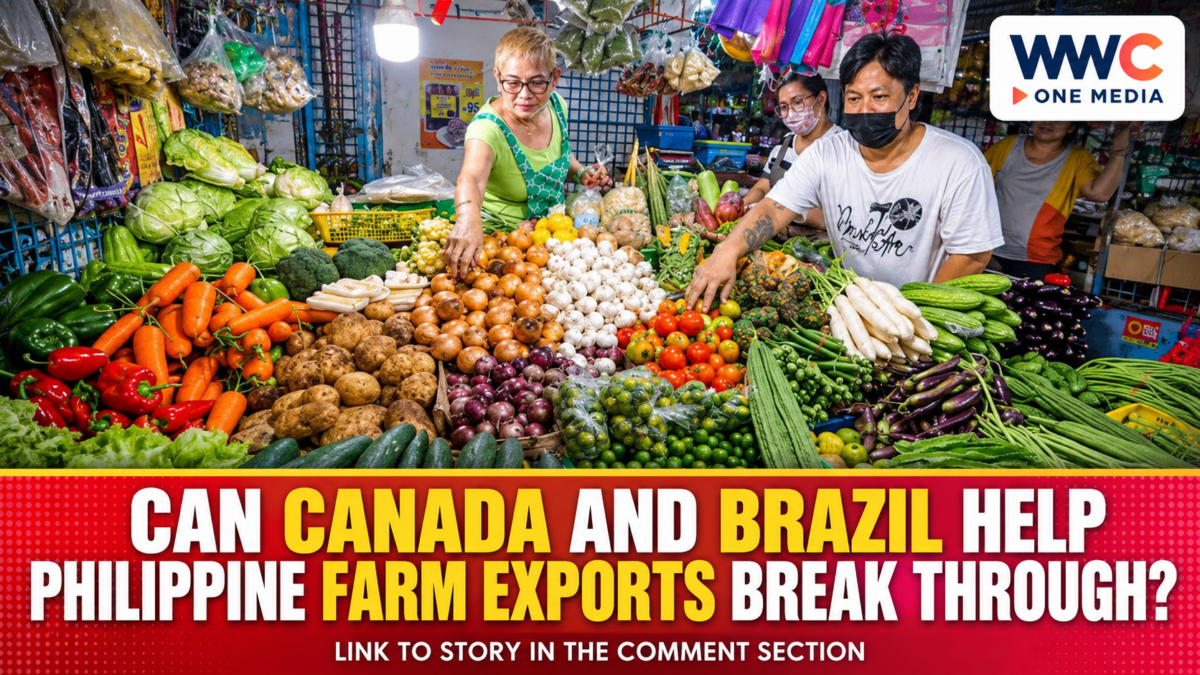
The Philippines is pursuing wider agricultural trade opportunities in Canada and Brazil, with recent government engagements covering export markets, farm technology and cooperation between producers. The effort comes as official trade figures show Philippine agricultural exports falling in September, underscoring the gap between opening foreign markets and earning more from them.
The opportunity is significant, but market access alone will not guarantee stronger farm incomes. Exporters still need products that meet importing countries’ food-safety and plant-health rules, dependable supply, competitive transport costs and buyers willing to place repeat orders.
Philippine farm exports need more than new destinations
The latest Philippine Statistics Authority figures provide a clear measure of the challenge. Agricultural exports reached US$642.11 million in September 2026, down 21.2% from US$814.40 million in the same month last year.
Agricultural imports, meanwhile, totalled US$1.89 billion, up 4.2% year on year. The resulting agricultural trade deficit stood at US$1.25 billion, 24.8% larger than the deficit recorded in September 2025. Philippine Statistics Authority
The figures show why the search for additional overseas buyers matters. More export destinations could give Philippine producers more routes to sell their products, but they will not automatically reverse the trade imbalance.
The export basket also remains concentrated in particular product groups. Edible fruits and nuts, including citrus fruit and melon peel, generated US$229.55 million in September, accounting for 35.7% of agricultural export revenue. Philippine Statistics Authority
That concentration makes product diversification and the development of higher-value agricultural goods important parts of the export strategy.
Canada offers a route for Philippine tropical fruit
Canada is already becoming a destination for selected Philippine fresh produce. In September, the Department of Agriculture documented trial shipments of durian and mangosteen bound for Vancouver and Toronto.
The Vancouver shipment included 300 kilograms of durian and 120 kilograms of mangosteen for Canadian buyer Fresh Makers Ltd. A further shipment scheduled for Toronto comprised 300 kilograms of durian and 200 kilograms of mangosteen. da.gov.ph
These shipments provide a practical example of what market development can look like: identifying buyers, arranging transport and testing whether Philippine produce can reach overseas customers.
The broader trade relationship may also receive support from the proposed Philippines-Canada Free Trade Agreement. On Nov. 14, the two governments announced the conclusion of negotiations and said they were working towards signing the agreement in 2027. Agriculture is among the sectors covered by the proposed pact. The public announcement, however, did not provide product-by-product tariff schedules or specific agricultural market-access commitments. Presidential Communications Office
That distinction matters. The conclusion of negotiations is not the same as an agreement already in force. Exporters should not assume that Philippine farm products automatically receive lower tariffs or easier entry into Canada.
For growers and processors, the immediate opportunity is to build relationships with buyers and ensure that their products meet Canadian requirements. Any future tariff benefits will depend on the final agreement and its implementation.
Brazil brings a different kind of opportunity
The Philippines’ engagement with Brazil combines trade promotion with technical cooperation. During Brazilian President Luiz Inácio Lula da Silva’s state visit on Nov. 14, the two governments advanced agricultural cooperation covering production, animal and plant health, sustainability, research, technology and agribusiness.
A memorandum of understanding signed by Philippine Agriculture Secretary Francisco P. Tiu Laurel Jr. and Brazil’s Agriculture and Livestock Minister André de Paula provides a framework for exchanges involving researchers, specialists, technical visits, training and joint projects. It also identifies sanitary and phytosanitary information exchange as part of the cooperation agenda. Ministério da Agricultura e Pecuária
The commercial relationship is already substantial, although the trade currently runs heavily in Brazil’s favour. Brazil’s agriculture ministry reported that Brazilian agricultural and agro-industrial exports to the Philippines reached US$1.84 billion in 2025. Meat products accounted for 86% of that value, with pork, beef and poultry among the leading categories. Ministério da Agricultura e Pecuária
The Philippine opportunity is to broaden the relationship beyond its existing import profile. The government has identified products such as desiccated coconut and carrageenan among Philippine exports to Brazil, while discussions have also pointed to potential opportunities for other local commodities.
A larger Brazilian market could offer room for Philippine producers, but the scale of the opportunity should not be confused with confirmed orders. The public announcements reviewed do not establish new export contracts or guarantee market entry for specific Philippine farm products.
The trade relationship also has competing interests
The Brazil partnership highlights a more complicated side of agricultural trade. Brazil is an important supplier of meat to the Philippines, but the Philippine government has also introduced a temporary safeguard measure affecting certain pork imports.
Brazil’s agriculture ministry said the Philippine measure under Department of Agriculture Order No. 33, Series of 2026, restricts selected pork products and edible offal from several supplier countries, including Brazil, for 60 days. The measure followed a preliminary investigation into the effects of increased imports on local production. Ministério da Agricultura e Pecuária
This is a reminder that trade expansion does not mean removing every restriction. Governments must weigh access to imported food against the interests of domestic producers and the conditions affecting local industries.
For Philippine exporters seeking access to Brazil, the same principle applies in reverse: products must satisfy the importing country’s applicable requirements before commercial shipments can become routine.
What could turn market openings into export growth?
The next stage requires implementation. The Philippines and Canada must complete the remaining steps towards signing and putting their proposed trade agreement into effect. For Brazil, the agricultural memorandum provides a framework, but the practical value will depend on the projects and market-access work that follow.
Exporters will also need to address the operational side of international trade. Fresh produce can be particularly demanding because quality, handling, shelf life and transport schedules affect whether a shipment arrives in saleable condition.
Smaller growers may need stronger coordination through cooperatives, consolidators or exporters to meet volume and consistency requirements. Processors, meanwhile, may have opportunities to add value through packaging, preservation and other forms of processing.
The Department of Agriculture has also established an Agri-Export Help Desk to coordinate support for agricultural exporters across relevant agencies. Such assistance can help businesses navigate export procedures, although it cannot replace the need for commercially viable products and reliable buyers. da.gov.ph
WWC has previously examined the country’s widening agricultural trade deficit, the expanding Brazil-Philippines food and agriculture relationship and the potential effects of the Philippines-Canada trade agreement on exporters. Together, these developments point to a common issue: trade opportunities matter only when local businesses can use them.
What happens next
The key developments to watch are the finalisation and signing of the Philippines-Canada FTA, the specific agricultural projects created under the Philippines-Brazil memorandum, and any new product approvals or commercial shipments involving either market.
The PSA’s next agricultural trade releases will also show whether export receipts recover from September’s decline. Until then, the latest figures offer a reminder that diplomatic engagement and export performance are different measures.
Canada and Brazil may become more important destinations for Philippine farm products. Whether that translates into stronger earnings for growers and exporters will depend on the work that follows the announcements.
Frequently asked questions
What Philippine farm products are being explored for export to Canada?
Recent Department of Agriculture shipments included fresh durian and mangosteen. The department has also identified crops such as cacao, coffee and okra as part of its wider export-development agenda.
Has the Philippines-Canada Free Trade Agreement taken effect?
No. The governments announced the conclusion of negotiations on Nov. 14, 2026, and were working towards signing the agreement in 2027. The announcement did not establish that the agreement was already in force.
What is the Philippines’ agricultural trade relationship with Brazil?
Brazil is a major supplier of agricultural and agro-industrial products to the Philippines. Brazilian agricultural and agro-industrial exports to the country reached US$1.84 billion in 2025, according to Brazil’s agriculture ministry.
What does the Philippines-Brazil agricultural memorandum cover?
It provides a framework for cooperation in agricultural and livestock production, animal and plant health, sustainable agriculture, research, technology, agribusiness and trade.
Why is the Philippines seeking more agricultural export markets?
New markets can provide additional buyers and reduce reliance on a limited number of destinations. However, sustained export growth also requires competitive products, reliable supply, regulatory compliance and efficient logistics.