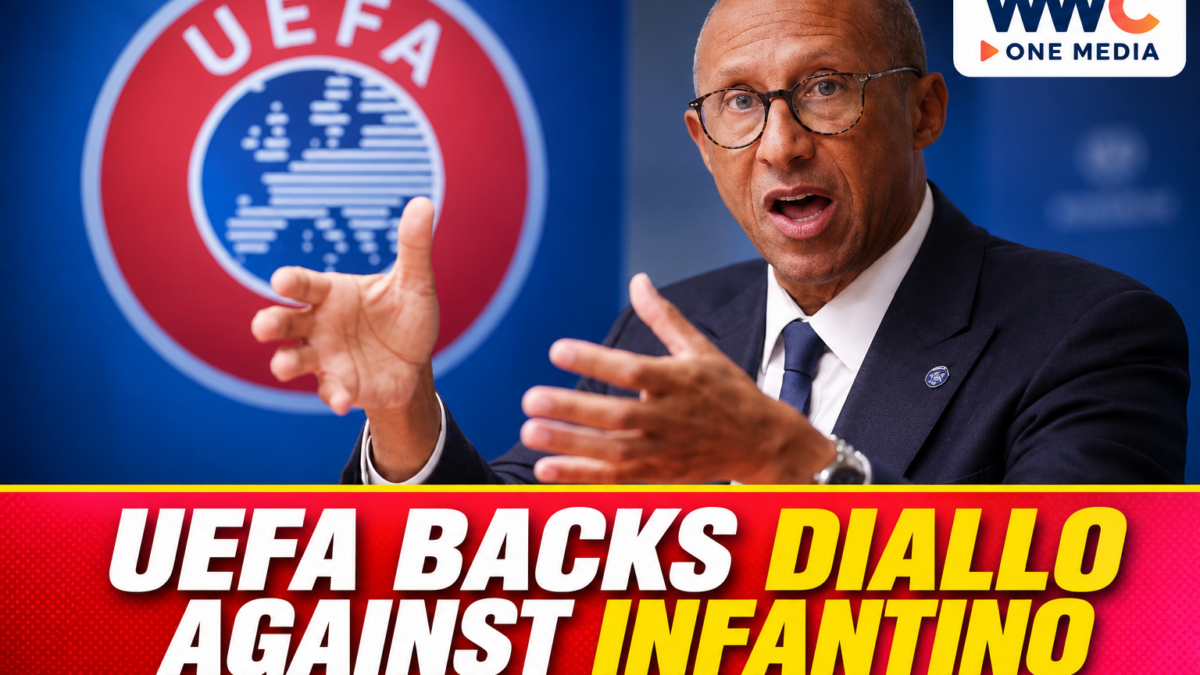
European football has put forward a challenger to FIFA President Gianni Infantino, with UEFA announcing on Nov. 16, 2026, that Philippe Diallo, president of the French Football Federation (FFF), had accepted an invitation to contest the March 2027 FIFA presidential election. The national associations represented on UEFA’s Executive Committee and the FIFA Council pledged their unanimous support for his candidacy.
The announcement changes the shape of a leadership contest that had appeared increasingly favourable to Infantino, who declared in May that he would seek re-election. But European backing alone does not settle the result: FIFA’s presidency is decided through its member associations, making support beyond Europe essential to any challenger’s campaign.
UEFA puts forward a challenger
The decision followed a meeting chaired by UEFA President Aleksander Čeferin. In its official statement, UEFA said the national associations represented at the meeting had invited Diallo to stand and unanimously pledged their full support.
Diallo accepted the invitation. UEFA described his experience across several levels of football administration, including leadership of the organisation representing French professional clubs, service on the French professional league’s board and work within FIFA’s dispute-resolution structures. He became FFF president and a member of UEFA’s Executive Committee in 2023. UEFA.com
The distinction between UEFA’s endorsement and the final FIFA election is important. The announcement represents a coordinated European political position, not a declaration that Diallo has secured the votes needed to become FIFA president.
UEFA has 55 member associations, but its announcement specifically refers to the national associations represented on its Executive Committee and the FIFA Council. It should not be interpreted as proof that every European association has independently committed its presidential-election vote to Diallo.
Why Infantino faces a more complicated contest
Infantino announced at the 76th FIFA Congress in Vancouver on April 30, 2026, that he intended to stand for re-election in 2027. FIFA confirmed that the 77th Congress, which will hold the presidential election, is scheduled for March 18, 2027, in Rabat, Morocco. Rusecure+1
The leadership dispute has developed alongside disagreements over FIFA’s governance and commercial direction.
One major point of contention was the proposed FIFA Forward Enterprise initiative, which involved creating a commercial structure connected to FIFA competitions and opening part of its ownership to outside investors. The proposal was subsequently abandoned.
The French federation had already withdrawn its support for Infantino’s re-election in September. In an official statement dated Sept. 10, the FFF said its Executive Committee had unanimously decided to withdraw that support, citing concerns about FIFA governance and the proposed commercial company involving World Cup rights. uk.fff.fr
That earlier decision helps explain why Diallo’s candidacy is more than a change in personnel. France’s football leadership had publicly broken with Infantino before UEFA formally invited Diallo to become its candidate.
WWC previously examined the controversy in its report on Infantino’s promise of greater dialogue after the abandoned World Cup investment plan. The new candidacy brings the governance debate directly into the election.
The real test is support beyond Europe
FIFA lists 211 affiliated member associations. Its presidential contest is therefore not decided by UEFA alone, regardless of how unified European officials appear. FIFA Legal
This creates a significant challenge for Diallo. A European endorsement gives him an organised platform, but a winning campaign would require support across the wider international football community.
The election also has implications for football associations outside Europe, including the Philippine Football Federation. Decisions made by FIFA leadership affect the global development framework, competition structures and the distribution of resources across member associations.
For the Philippines, the leadership contest is relevant because FIFA development programmes form part of the wider support available to national federations. The country’s own football infrastructure ambitions, including the planned redevelopment of Rizal Memorial Stadium, illustrate why international football governance matters beyond the election itself. WWC One Media+1
However, a change in FIFA leadership would not automatically guarantee additional funding or a different allocation of resources to the Philippines. Those outcomes would depend on policies, approved programmes and decisions made after the election.
What happens next?
The next major test is whether Diallo can turn UEFA’s backing into wider support among FIFA member associations before the March 18, 2027 election.
Infantino has already announced his intention to seek another term. Diallo’s candidacy now gives the contest a prominent European challenger, but the final outcome remains open.
The campaign will also test whether calls for stronger governance and renewed confidence in FIFA can attract support beyond the officials who have publicly questioned its direction.
For now, UEFA has made its choice. The question is whether the rest of world football will follow.