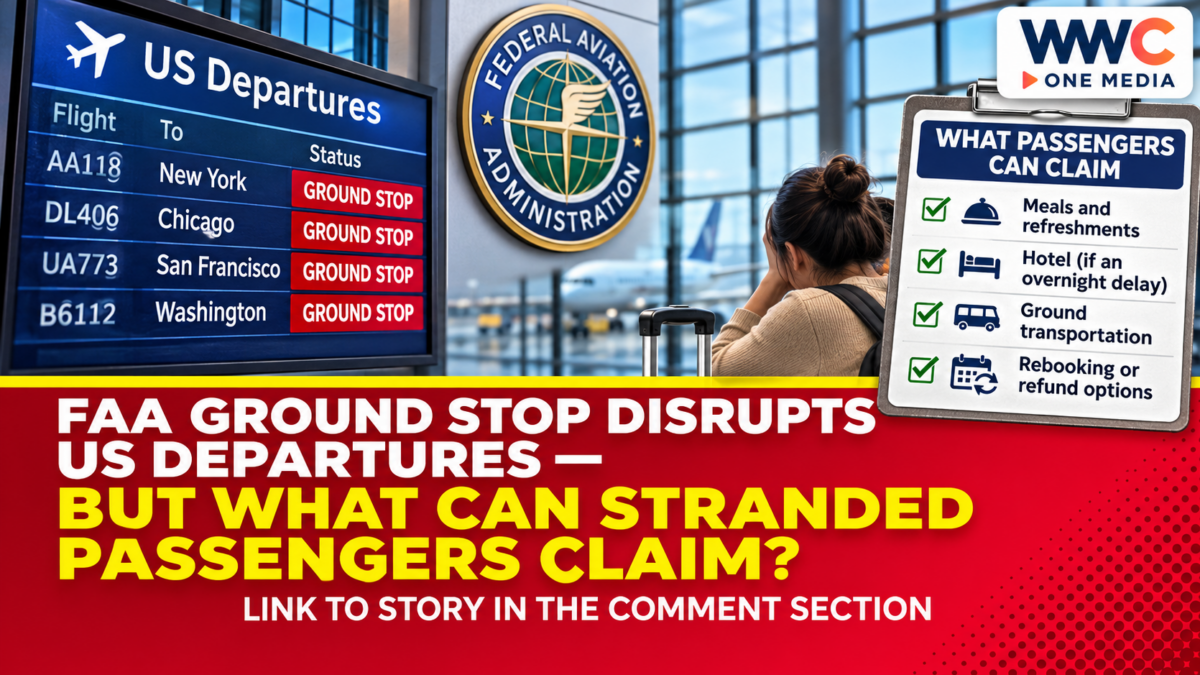
The Federal Aviation Administration ordered a nationwide ground stop on Nov. 13, 2026, directing departing aircraft at US airports to remain on the ground after a major aviation-system disruption. Its official air-traffic advisory cited safety and extraordinary circumstances, while identifying the operational restriction as an equipment outage.
For passengers, the immediate question is not only when aircraft can depart. It is also whether a cancelled or significantly changed flight brings a refund, rebooking, food or a hotel room—and who must provide it.
FAA Ground Stop: What the Official Order Says
The FAA Air Traffic Control System Command Center issued nationwide advisory 111 on Nov. 13. The instruction covered departures at all airports, with international inbound flights to be handled individually. Rather than closing every airport, the order restricted aircraft departures while the air-traffic system dealt with a safety-related problem.
A ground stop is an air-traffic-management measure, not automatically an airline cancellation. An aircraft may remain scheduled even if departure clearance has been temporarily withheld. Airline decisions about specific flights, connecting passengers and replacement services therefore have to be checked separately.
The nationwide advisory is a record of the restriction, not a technical incident report. Its equipment-outage designation does not identify a failed component, a software update, an attacker or a responsible contractor. Those are different questions requiring official investigative findings.
The Difference Between a Refund and Extra Assistance
US Department of Transportation rules make an important distinction between getting money back for unused transportation and receiving additional care for disruption. If an airline cancels a flight and a traveller declines the replacement offered, the passenger is entitled to a refund of the ticket price under the applicable rules, regardless of why the airline cancelled.
A significant schedule change or significant delay can also create a refund right when the customer chooses not to travel. A traveller who accepts and takes an alternate flight generally should not assume a second full refund is owed for transportation already provided.
The airline’s responsibilities concerning meals, hotel rooms and ground transfers are different. The Department’s cancellation-and-delay dashboard lists specific promises made by US carriers for controllable disruptions, such as maintenance or crew problems. It does not establish that the same promises automatically apply to a nationwide air-traffic-control outage.
Passengers should ask the airline to state which options are available on their particular booking. A request for a refund and a request for an overnight hotel are not the same legal question.
What Delayed Travellers Should Check First
The first practical step is to establish whether the airline has cancelled the flight, formally rescheduled it, or merely shown it as delayed. Those statuses determine which choices can be made immediately. Next, check the itinerary as a whole. A delayed first leg can make a connection unusable even when the second flight remains scheduled. That is why travellers should contact the original airline or ticket issuer before purchasing replacement transportation independently.
If a flight is cancelled, the traveller can compare the offered rebooking with the option of declining travel and receiving a refund. For a significantly changed flight, the same decision may arise under the Department’s refund rules. A refund ordinarily returns payment; it does not guarantee a substitute seat at the same price with a competing carrier.
These distinctions are familiar beyond the United States. WWC has previously examined Philippine flight schedule adjustments around the ASEAN summit, where changes to itineraries also left passengers needing timely, airline-specific instructions. The rights applicable to that Philippine event should not be confused with US federal refund law.
Why Restoring Departures Is Not the End of Disruption
A nationwide pause can affect passenger journeys after the restriction itself changes. Aircraft may be in an airport different from the one assigned for their next flight. Crews, boarding gates and connecting schedules must also be coordinated before each airline can run its planned service.
A useful comparison is WWC’s earlier coverage of disruptions to Singapore–Jakarta travel after volcanic ash. Different causes can create the same passenger problem: a network must reconnect aircraft, crews and travellers after the initial restriction ends.
The important editorial distinction is that a transport network reopening and every affected passenger completing a journey are not identical milestones. Anyone travelling on Nov. 14 should rely on the latest airline-specific itinerary rather than infer a confirmed departure from a systemwide announcement.
Why the Cause Matters—but Must Not Be Guessed
The FAA’s official advisory used an equipment-outage label. It did not establish that a new software system was responsible, that the disruption was deliberate or that one company caused it. A public explanation of the underlying failure would require a more detailed government record.
WWC has also reported on Philippine Airlines flight cancellations on its Manila–Riyadh route. That episode had a different trigger and jurisdiction, but demonstrates why passengers must check the airline’s actual advisory rather than rely on broad accounts of an aviation emergency.
Why it matters: The case tests public communication as much as technical resilience. A safety restriction can be justified without leaving passengers to guess whether their flights are delayed, cancelled or eligible for a refund.
What Happens Next
The next relevant official records would be a detailed FAA incident explanation, any subsequent air-traffic advisories and the airlines’ individual passenger notices. Until they are available and checked, precise passenger counts, causes, final restoration times and specific compensation outcomes should not be asserted as established facts.
Passengers can preserve their booking confirmation, airline messages, receipts and any request for a refund. For an unresolved US airline refund dispute, the Department of Transportation provides a consumer complaint process.
Frequently Asked Questions
What happened during the Nov. 13 FAA ground stop?
The FAA issued a national order restricting aircraft departures for safety reasons. Its archived advisory describes an equipment outage but does not provide a final technical-cause finding.
Does a nationwide ground stop automatically cancel my flight?
No. A ground stop restricts departures. The airline must separately tell passengers whether a particular flight is delayed, rescheduled or cancelled.
Can I get a refund if my flight was cancelled?
Under US Department of Transportation rules, passengers generally have a refund right when the airline cancels and they choose not to travel or accept alternatives, regardless of the cancellation’s cause.
Must an airline pay for meals or a hotel during an FAA outage?
Not automatically. Carrier commitments displayed by the Department generally concern disruptions within an airline’s control. Ask your airline what it will provide in your specific circumstances.
Was a software update or cyberattack confirmed as the cause?
Not by the FAA ground-stop order reviewed for this report. The advisory is an operational instruction, not a final investigation into the failure’s technical origin.