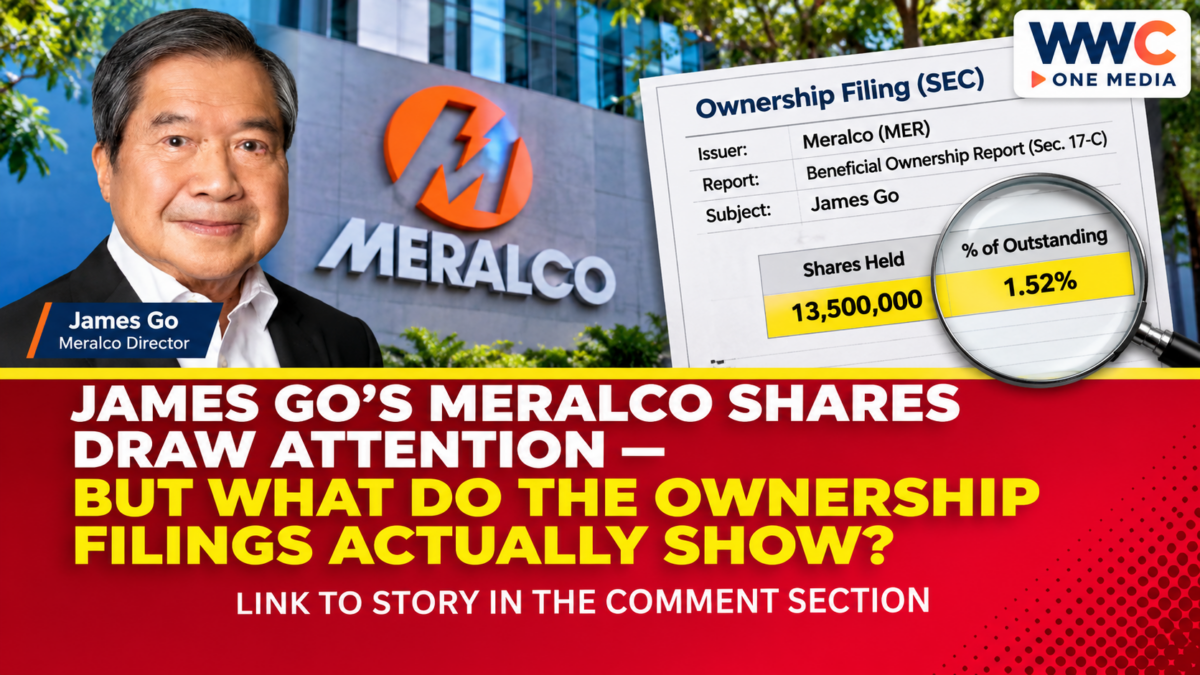
MANILA, Philippines — Meralco director James L. Go reported a change in his beneficial shareholdings in July 2026, bringing the total disclosed in the company’s filing to 219,450 shares. An August disclosure subsequently described an administrative shift between direct and indirect holdings without a further increase in the combined total.
The distinction is important as investors examine claims about an unusually large buildup in the businessman’s personal Meralco position. Public ownership filings document specific changes, but they do not, by themselves, establish his reasons for holding shares or support every percentage increase circulating outside the exchange record.
James Go Meralco Shares: What the July Filing Shows
Meralco’s July 17 current report recorded James L. Go’s beneficial holdings immediately before and after July 13. His directly owned shares remained at 40,010, while his indirectly owned shares rose from 174,440 to 179,440.
That produced a combined balance of 219,450 shares, compared with 214,450 before the disclosed change: a difference of 5,000 shares. The increase was approximately 2.3% of the earlier combined balance, not a near-tripling over those two reporting points.
A beneficial ownership filing is a reporting document. It describes ownership attributed to a person, including specified indirect interests. It does not necessarily establish the economic source of every share, a complete multiyear trading history or the investor’s future intentions.
The relevant comparison is therefore between the balances stated in identified filings, not an unspecified starting point chosen to produce a dramatic headline. A much longer historical series would be needed to evaluate any claim of a nearly threefold expansion.
Why an August Change Was Not Another Purchase
A separate August 25 disclosure explained that a movement of 5,000 shares on Aug. 20 followed an upliftment of Meralco shares. Crucially, the company stated that the combined number of shares held directly and indirectly did not change after that date.
The disclosure listed 45,010 directly owned shares and 174,440 indirectly owned shares. Added together, those amounts equal the same 219,450-share total shown in the July report.
This is a useful example of why individual columns cannot be treated as proof of fresh buying. A higher direct holding can accompany a lower indirect holding when shares move between forms of ownership.
For readers tracking insider transactions, the operative questions are whether total beneficial ownership changed, what type of transaction took place, and what the filing actually says about acquisition or disposal. It would be misleading to label this August reclassification a new 5,000-share purchase.
Meralco’s Ownership Is Larger Than One Director’s Position
Meralco’s 2026 definitive information statement recorded Go holding 214,450 shares as of May 11, both directly and indirectly. It identified him among the company’s director nominees, giving investors a documented earlier reference point.
The company’s June 30 shareholder information listed Beacon Electric Asset Holdings, JG Summit Holdings and Metro Pacific Investments among its principal shareholders. Their reported stakes illustrate the difference between an individual director’s relatively small beneficial position and the large blocks held by corporate investors.
A director’s holdings may still attract attention because investors follow changes in ownership among people involved in corporate governance. But a personal holding does not automatically confer control over company policy, electricity tariffs or capital expenditure.
For wider market context, WWC has examined how changes to an international equity index affect Meralco. Index membership and director ownership are separate questions, and neither should be treated as a standalone forecast of a share-price move.
Earnings and Business Mix Provide a Separate Investment Context
Meralco’s official results for January through September 2026 reported consolidated core net income of ₱44.8 billion, a 12% increase, while reported net income rose 21% to ₱44.7 billion. Consolidated revenue reached ₱443.0 billion, up 19%.
The business generated earnings through electricity distribution, power generation and retail electricity supply. Distribution accounted for 45% of consolidated core net income, generation for 41% and retail electricity supply for 13%, with the balance attributable to other activities.
These numbers explain why investors may study Meralco beyond its familiar role as the electricity distributor serving Metro Manila and neighbouring areas. The group has exposure to several different operating activities, each with distinct costs, regulation and commercial risks.
WWC previously examined Meralco’s nine-month earnings outlook, including management’s ₱56.6-billion full-year core earnings guidance. That figure remains a forecast, not an achieved annual result as of Nov. 14.
However, strong company earnings do not reveal why a particular director changed the form or amount of shares he holds. Financial performance is relevant business context, not evidence of a personal trading motive.
What This Could Mean for Investors and Power Customers
Analysis: The ownership documents offer a more precise interpretation than an unsupported claim of aggressive accumulation. They support a 5,000-share net increase between the specified July balances and a later August transfer that left the aggregate amount unchanged.
For investors, confidence in an ownership narrative requires comparing a consistent series of filings. That means checking identical definitions of direct and indirect ownership, distinguishing acquisitions from transfers, and paying attention to reporting dates.
For electricity customers, the more direct issues are the reliability of the distribution network, the cost of purchased power and the performance of new generation capacity. Personal director holdings do not set electricity bills. Tariff outcomes depend on the applicable regulatory and cost-recovery arrangements.
The company’s planned and operating energy projects also deserve their own scrutiny. WWC has separately examined Meralco’s preparations for additional electricity demand, where contracted capacity, regulatory approvals and delivery dates matter more than assumptions about any one shareholder.
In short, the public record provides a basis for understanding ownership changes, but it does not establish a personal investment strategy, a guaranteed financial return or a direct connection to future consumer rates.
What Happens Next
The most useful next evidence would be any new SEC Form 23-B or PSE disclosure showing another change in Go’s beneficial ownership. A properly dated new filing could distinguish further purchases from administrative transfers and could update the combined balance.
Investors can also compare subsequent Meralco financial statements with management’s annual guidance, without assuming that the two types of information explain each other. Until more ownership records establish a different historical baseline, the claim that Go nearly tripled his personal Meralco holdings remains unverified here.
Frequently Asked Questions
How many Meralco shares did James Go disclose in July 2026? 219,450 shares in total after the July 13 change, including direct and indirect holdings.
Did his holdings nearly triple in July? No. The July filing shows a 5,000-share increase from 214,450 shares, or approximately 2.3%. A claim about a longer period requires separate documentation.
Did the August transfer add another 5,000 shares? No. The company stated that combined direct and indirect ownership was unchanged following the Aug. 20 movement.
Does James Go control Meralco through these shares? The disclosed individual holding is far smaller than the stakes reported for Meralco’s principal corporate shareholders. It does not, by itself, establish control.
Do director share transactions determine electricity rates? No. Electricity rates follow applicable regulatory and cost arrangements, not a director’s personal trading activity.