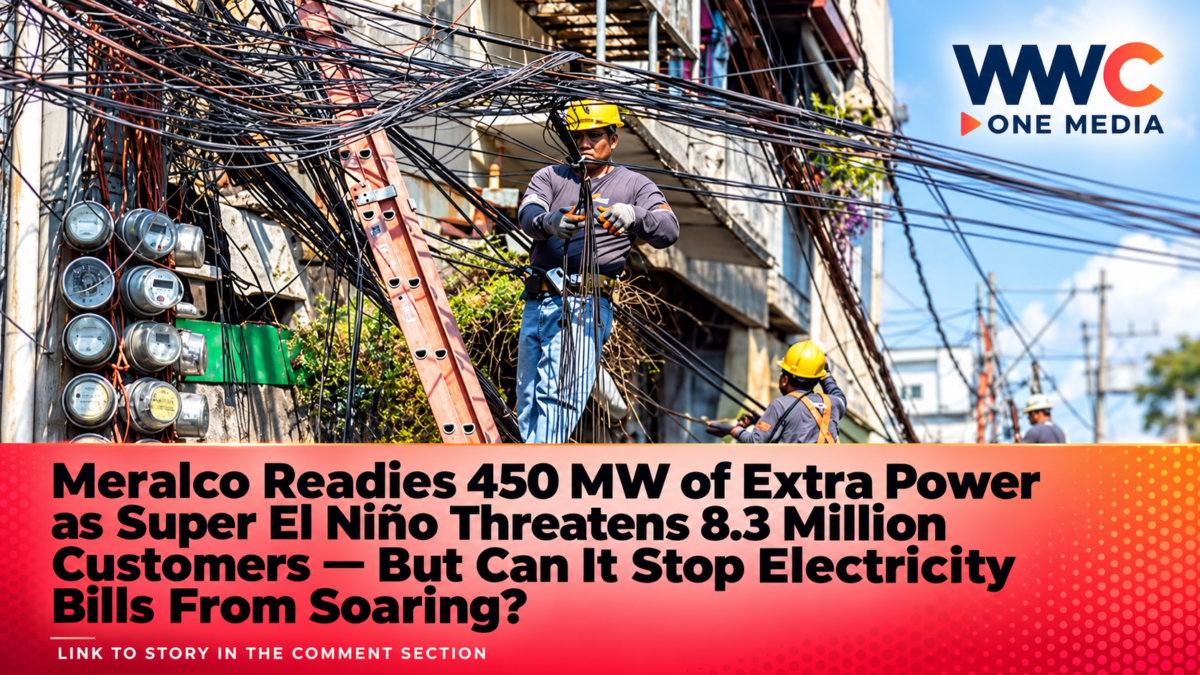
MANILA, Philippines — Millions of Filipino households could face another electricity bill shock as an intensifying El Niño threatens to send power demand soaring, prompting the Manila Electric Company (Meralco) to line up 450 megawatts (MW) of additional electricity supply and strengthen its distribution network ahead of potentially more difficult conditions in 2027.
The country’s largest electricity distributor, which serves more than 8.3 million customers, says its existing power supply contracts are sufficient to cover current requirements.
However, the company is taking additional precautions as hotter temperatures threaten to increase the use of air conditioners, electric fans and other cooling appliances.
The key question for consumers is whether these preparations will be enough to protect them from another wave of higher electricity costs.
Meralco’s latest measures, reported on October 29, come as government agencies and industry officials warn that a strong to very strong El Niño could place additional pressure on electricity demand, power generation and household budgets.
450 MW in additional power: Where will it come from?
Meralco is expecting two major sources of additional capacity:
- 200 MW from a completed competitive selection process for power supply.
- 250 MW associated with the MTerra Solar project, expected to become available in summer 2027.
Meralco vice president and head of utility economics Lawrence Fernandez identified the additional capacity as part of the company’s preparations for increasing electricity demand.
However, there is an important qualification.
The 200-MW procurement package was still awaiting approval from the Energy Regulatory Commission (ERC), according to Meralco’s October 13 briefing.
Meanwhile, the additional 250 MW from MTerra Solar is expected in summer 2027 rather than immediately.
This means the planned 450-MW augmentation should not be interpreted as newly available electricity already flowing into the distribution network.
Nor does it represent a guarantee that power rates will decrease.
Its value will depend on when the supply becomes available, its cost and whether it can reduce the system’s exposure to tighter market conditions.
Super El Niño could send electricity demand soaring
The Philippine Atmospheric, Geophysical and Astronomical Services Administration (PAGASA) has warned that the ongoing El Niño could bring prolonged periods of below-normal rainfall and hotter conditions.
Reports in October indicated that the weather phenomenon could persist into the first half of 2027.
As temperatures increase, households and commercial establishments typically use more electricity for cooling.
Higher demand can place pressure on power plants, transmission facilities and distribution networks, particularly when electricity supply becomes constrained.
Meralco corporate communications head Joe Zaldarriaga warned during the company’s October 13 briefing that strong demand could put upward pressure on electricity prices.
The concern is particularly serious in the Wholesale Electricity Spot Market (WESM), where electricity prices can rise sharply when available supply becomes tight relative to demand.
The consequences could extend beyond household budgets.
Businesses may also face additional expenses for refrigeration, manufacturing, equipment cooling and day-to-day operations.
Such increases could eventually influence the cost of goods and services, although the scale of any impact will depend on market conditions.
El Niño is becoming a broader inflation threat
The potential electricity price shock is part of a larger economic concern.
Dry weather can threaten agricultural production and affect water supplies while increasing demand for energy.
A prolonged period of weak rainfall may also limit hydropower generation, potentially increasing reliance on alternative electricity sources.
WWC ONE MEDIA previously examined these risks in El Niño Emerges as Biggest Threat to Philippine Inflation as Prices Surge.
The interconnected risks highlight why power supply planning has become increasingly important for both consumers and policymakers.
Electricity rates already increased in October
The warning arrives as Meralco customers are already paying higher electricity rates.
For October 2026, Meralco announced a ₱0.3191 per kilowatt-hour increase, bringing the overall residential electricity rate to ₱15.0615/kWh from ₱14.7424/kWh in September.
That means a household consuming 200 kWh would face approximately ₱63.82 in additional charges for the same amount of electricity, before accounting for changes in individual usage or other adjustments.
The increase was primarily driven by higher generation charges and elevated wholesale electricity prices.
According to the Philippine News Agency, Meralco’s generation charge rose by ₱0.4973/kWh, while the WESM-related rate increased by ₱3.5167/kWh.
Lower charges from other supply arrangements and transmission services partly offset the increase.
The figures illustrate how wholesale-market volatility can affect consumers, even when distribution infrastructure remains operational.
Why bills can rise even without a higher Meralco distribution charge
Electricity bills contain several components, including generation, transmission, distribution, taxes and other regulated charges.
The generation charge accounts for the largest portion.
Meralco’s published bill breakdown indicates that electricity generation represented approximately 64% of the average bill, based on its 2025 figures.
As a result, higher power purchase costs can cause overall electricity rates to increase even without an equivalent adjustment to the distribution charge.
In another related report, Meralco Power Rates Fall Again — But the Relief May Not Last Long, WWC ONE MEDIA examined how regulatory refunds had temporarily reduced bills without eliminating the underlying risk of future price increases.
That distinction has become increasingly relevant as El Niño threatens to drive up electricity consumption.
Meralco strengthens power network to prevent outages
Beyond arranging additional supply, Meralco is reinforcing its distribution infrastructure to better withstand periods of heavier electricity demand.
The company’s preparations include replacing aging transformers, upgrading overloaded circuits and installing additional feeders.
It is also stockpiling repair materials and preparing field personnel for faster restoration work when interruptions occur.
These measures are intended to strengthen network reliability and reduce the consequences of localized equipment failures.
During particularly tight supply conditions, Meralco has also encouraged businesses with available backup generators to consider using them when appropriate.
Such measures may help reduce demand on the distribution system, although generators involve fuel expenses, emissions, technical limitations and safety considerations.
The company is not claiming that power interruptions can be entirely eliminated.
Related coverage: Meralco Turns Power Lines Into a Smart Grid With New Metering Tech — What It Could Mean for Outages, Solar and EVs.
MTerra Solar could provide additional energy security
The planned 250-MW contribution from MTerra Solar is another component of Meralco’s preparations.
The large-scale solar and battery storage development is intended to provide additional clean electricity while supporting a more diversified generation mix.
Solar power can reduce dependence on fossil-fuel generation when sufficient sunlight is available.
Battery storage can also help deliver stored energy when solar production is lower or during periods of higher demand, subject to system operating limits.
However, renewable energy capacity does not automatically eliminate electricity price volatility.
Actual benefits depend on generation availability, storage performance, power purchase arrangements and the timing of electricity delivery.
The broader challenge is to build an energy system that remains dependable during periods of extreme weather.
That concern is reflected in WWC ONE MEDIA’s report on Philippines Moves to Secure Oil Reserves Abroad as Middle East Conflict Threatens Fuel Supply — But Will It Prevent Another Price Shock?, which also discussed the potential consequences of El Niño for Philippine electricity generation.
Consumers could receive refunds, but price pressures remain
Regulatory refunds may help ease some of the impact of higher electricity costs.
Earlier in October, the ERC ordered Meralco to return approximately ₱2.64 billion in excess collections through a six-month refund program.
The residential refund rate was set at ₱0.1733/kWh under the regulator’s provisional determination.
For a household consuming 200 kWh, that represents a potential credit of about ₱34.66 per month while the applicable refund is being implemented.
However, refunds should not be confused with permanent reductions in generation costs.
They are regulatory adjustments designed to return amounts collected above authorized levels.
In September, WWC ONE MEDIA reported on the earlier proposed refund in Meralco Seeks Approval for ₱2.64-Billion Refund to More Than 8 Million Customers.
The ERC has since taken action on the application, underscoring the importance of updating earlier proposed refund figures with subsequent regulatory decisions.
For consumers, the latest relief may partly offset higher charges, but it does not remove uncertainty surrounding future electricity prices.
How Filipino households can reduce electricity consumption
Meralco is also encouraging customers to manage their electricity use ahead of hotter weather.
The utility recommends setting air conditioners at around 25 degrees Celsius, maintaining appliances and using energy-efficient lighting.
According to the Department of Energy guidance cited in the company’s announcement, increasing an air conditioner’s thermostat setting by one degree may reduce operating costs by approximately 5% to 7%, depending on conditions.
Households can also reduce unnecessary electricity consumption by cleaning air-conditioner filters, improving ventilation when conditions permit, using efficient appliances and switching off unused devices.
Actual savings will vary depending on appliance specifications, operating hours, room temperature and individual electricity rates.
Importantly, consumption efficiency can reduce the amount of electricity used but cannot prevent increases in the per-kilowatt-hour rate charged by suppliers.
Can Meralco protect consumers from another electricity price shock?
Meralco’s preparations demonstrate that the company is anticipating more difficult operating conditions as El Niño intensifies.
Additional supply contracts and stronger distribution facilities can help reduce the risk of power shortages and service disruptions.
But they cannot eliminate every factor that influences electricity prices.
Wholesale-market volatility, fuel costs, foreign exchange movements, weather conditions and generation availability remain important risks.
Even with 450 MW of additional planned capacity, the financial impact on consumers will depend on the timing, approval, price and actual delivery of the electricity.
For millions of households already coping with elevated living expenses, the coming months could become another test of affordability.
Meralco is preparing for El Niño. But whether that preparation can prevent another wave of higher electricity bills remains the question that matters most to Filipino consumers.