
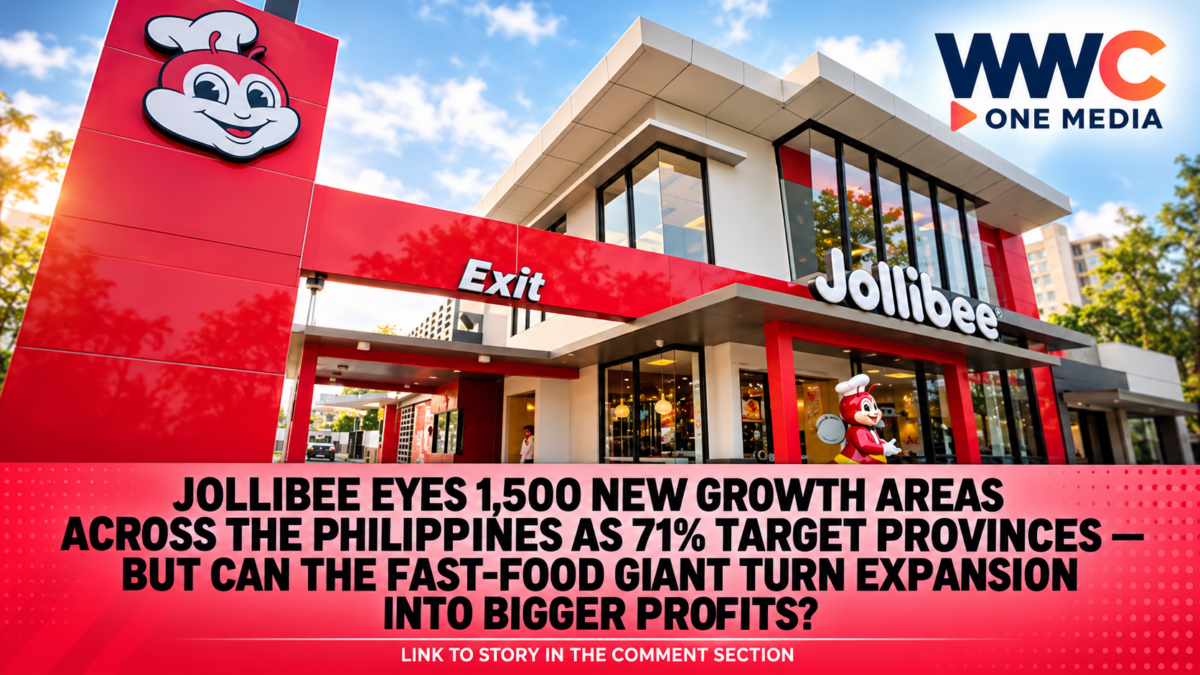
MANILA, Philippines — Jollibee Foods Corporation (JFC) is preparing for another major chapter in its Philippine growth story, identifying more than 1,500 potential expansion areas nationwide between 2027 and 2030, with the majority located outside Metro Manila.
The homegrown fast-food giant, founded by billionaire Tony Tan Caktiong, is looking beyond the capital region as it searches for new customers, stronger sales and opportunities to expand its popular restaurant brands.
But behind the ambitious expansion strategy lies a major challenge: Can Jollibee open more profitable restaurants while rising operating costs and slower same-store sales growth put pressure on its business?
According to the company’s October 2026 announcement, approximately 71% of the identified trade areas are outside Metro Manila, suggesting that provincial cities, developing communities and other underserved markets could play a significant role in the group’s next phase of expansion.
The strategy covers three of the company’s most important brands: Jollibee, Mang Inasal and Chowking.
However, the 1,500-plus figure represents potential trade areas, not a confirmed number of restaurants scheduled to open.
Actual expansion will depend on commercial feasibility, suitable locations and expected investment returns.
Jollibee looks beyond Metro Manila for its next growth engine
For decades, Jollibee has built its reputation through familiar Filipino favorites, accessible locations and a restaurant network that stretches across the country.
Now, the company sees opportunities to reach customers who may still have limited access to its major chains.
As of the first half of 2026, Jollibee Group operated more than 3,500 stores across the Philippines.
Its identified opportunities for 2027 through 2030 suggest the company believes there is still significant room for domestic growth despite its already extensive presence.
Joseph C. Tanbuntiong, chief executive officer of Jollibee Group Philippines, said the business intends to expand aggressively but with financial discipline, prioritizing viable locations and sustainable returns.
The geographic strategy could bring new restaurant investments into provincial communities, potentially supporting employment, property development, local suppliers and franchising activity.
However, the company has not announced specific employment figures or investment commitments for the identified expansion areas.
For provincial economies, the opportunity is substantial, but the eventual economic impact will depend on how many projects move forward.
Three powerhouse brands will lead the expansion
Jollibee, Mang Inasal and Chowking are expected to anchor the company’s domestic growth strategy.
Together, the three restaurant chains contribute nearly 90% of Jollibee Group Philippines’ systemwide sales, making them essential to the company’s performance.
Jollibee itself accounts for approximately 62% of domestic systemwide sales.
Mang Inasal continues to pursue opportunities for its grilled-chicken and rice-focused dining concept, while Chowking aims to expand its Chinese-style fast-food offerings into more communities.
Each brand serves a somewhat different consumer segment, allowing JFC to assess locations based on local purchasing behavior and market demand.
The wider strategy also depends on attracting customers more frequently, not simply adding another restaurant to the map.
Related WWC ONE MEDIA coverage: Jollibee Turns Dating Red Flags Into Spicy Chickenjoy Campaign Across 54 Stores — But Can Viral Humor Drive More Sales?
Sales are growing, but the figures reveal a warning sign
Jollibee’s latest expansion announcement follows two years of strong domestic systemwide sales growth.
The Philippine business reported:
- 2024: 10% systemwide sales growth and 8% same-store sales growth.
- 2025: 10% systemwide sales growth and 5% same-store sales growth.
- First half of 2026: Continued positive systemwide and same-store sales growth, according to the company’s October announcement.
The figures highlight an important difference between total sales expansion and productivity at existing restaurants.
Systemwide sales can increase because a company opens additional locations, while same-store sales growth measures how established outlets are performing.
The slowdown from 8% to 5% in annual same-store sales growth does not mean the company’s existing restaurants are collectively losing sales.
It does, however, suggest more moderate growth at comparable outlets.
That makes restaurant productivity, consumer demand and operating costs increasingly important as Jollibee considers new investments.
In another WWC ONE MEDIA report, Jollibee Set for Four More Price Hikes This Year — But the Next Increase May Not Be the Last, the company faced scrutiny over its pricing strategy amid pressure from food ingredients, logistics and other operating expenses.
If restaurant prices rise faster than household spending power, Jollibee could face greater difficulty balancing affordability with profitability.
Mang Inasal drive-thru success offers a promising signal
Jollibee’s future does not depend entirely on conventional dine-in restaurants.
The company is also experimenting with alternative formats, including drive-thru facilities, digital ordering, delivery services and more flexible restaurant configurations.
One particularly notable development involves Mang Inasal.
The brand opened its first drive-thru restaurant in Santa Maria, Bulacan, in December 2025.
By the first half of 2026, eight Mang Inasal drive-thru locations were operating.
According to Jollibee Group, their average daily sales were approximately 40% higher than the average sales of other Mang Inasal stores.
That early performance suggests drive-thru formats may create additional opportunities in locations where convenience and vehicle access influence purchasing decisions.
However, higher sales do not automatically establish higher profits.
Construction expenses, property costs, operating margins and other factors must also be considered when assessing the return on new formats.
For Jollibee, the challenge will be determining which restaurant models work best in particular provincial markets.
Rising costs complicate Jollibee’s expansion ambitions
The latest domestic growth strategy comes as Jollibee manages wider financial pressures.
In August 2026, GMA News reported that the restaurant group had reduced its full-year global gross store-opening target from 1,200–1,300 locations to 1,000–1,100.
The company also adjusted its planned capital expenditure range to ₱13 billion–₱15 billion, compared with its earlier upper limit of ₱16 billion.
The revised targets reflected portfolio optimization, changes in the timing of store openings and closures, and a challenging cost environment.
Jollibee’s first-half 2026 net income attributable to parent shareholders also declined by approximately 13.3% to ₱4.87 billion, even as its second-quarter results showed improving operating performance.
These figures demonstrate why identifying attractive restaurant locations is only one part of a successful expansion.
Actual profitability will depend on investment costs, pricing, sales productivity and execution.
The group must also manage its substantial international operations alongside its growing Philippine network.
Related reading: Jollibee Makes a Major Listing U-Turn — Why Hong Kong Could Beat the U.S. for Its Global Business.
Can provincial markets become the next battleground for fast-food chains?
Jollibee’s planned shift toward provincial opportunities also raises questions about competition in the Philippine restaurant industry.
As communities develop new commercial centers and consumers seek convenient food options, both local and international brands have incentives to pursue additional locations.
The challenge for established operators is not merely to be present in a market, but to attract enough customers to justify their investment.
Provincial expansion may involve different levels of purchasing power, transportation access, labor availability and supply-chain costs.
Jollibee’s established network gives it a platform for expansion, but the profitability of each new location still needs to be evaluated individually.
WWC ONE MEDIA previously explored growing international competition in US and Chinese Fast-Food Chains Are Crossing Into Each Other’s Markets — And the Food Fight Is Getting Bigger.
The global restaurant industry increasingly competes on convenience, affordability, digital services and brand loyalty — factors likely to influence how Jollibee approaches its future Philippine investments.
Beyond expansion: What will the strategy mean for Filipino communities?
Additional restaurants could create opportunities extending beyond the fast-food industry.
Depending on where new outlets are eventually developed, economic activity could benefit construction contractors, food distributors, logistics providers, commercial landlords and local workers.
More accessible stores could also bring established dining brands closer to families in smaller provincial markets.
But these potential benefits should not be confused with confirmed economic outcomes.
Jollibee has not released a province-by-province opening schedule or specific job creation estimates for the more than 1,500 identified trade areas.
Other homegrown food companies are also pursuing regional expansion strategies.
For example, Lemon Square Opens 150th Store in Batangas as New Mega-Factory Targets 2,000 Jobs — But Can Its Biggest Expansion Pay Off? examines how another Philippine food business is investing in manufacturing and distribution capacity.
Together, these developments highlight the continuing importance of regional markets to the country’s consumer economy.
The bigger question: Can Jollibee turn 1,500 opportunities into profitable growth?
Jollibee’s latest announcement reflects confidence in the long-term potential of the Philippine fast-food market.
With more than 3,500 domestic outlets, three powerful local restaurant brands and thousands of possible new trading locations, the group has an established platform for further expansion.
Its push into the provinces could strengthen brand accessibility while reducing dependence on established urban markets for incremental growth.
Yet the plan comes with unresolved questions.
Will new provincial outlets generate enough customer traffic to justify construction and operating expenses?
Can drive-thru, delivery and digital formats increase sales without undermining margins?
And will Jollibee maintain its appeal to price-conscious Filipino consumers while managing higher business costs?
For now, the more than 1,500 identified trade areas represent opportunities rather than commitments.
Jollibee has mapped where it might grow next. The real test will be how many of those locations become profitable businesses — and whether provincial expansion can sustain the company’s next decade of growth.










