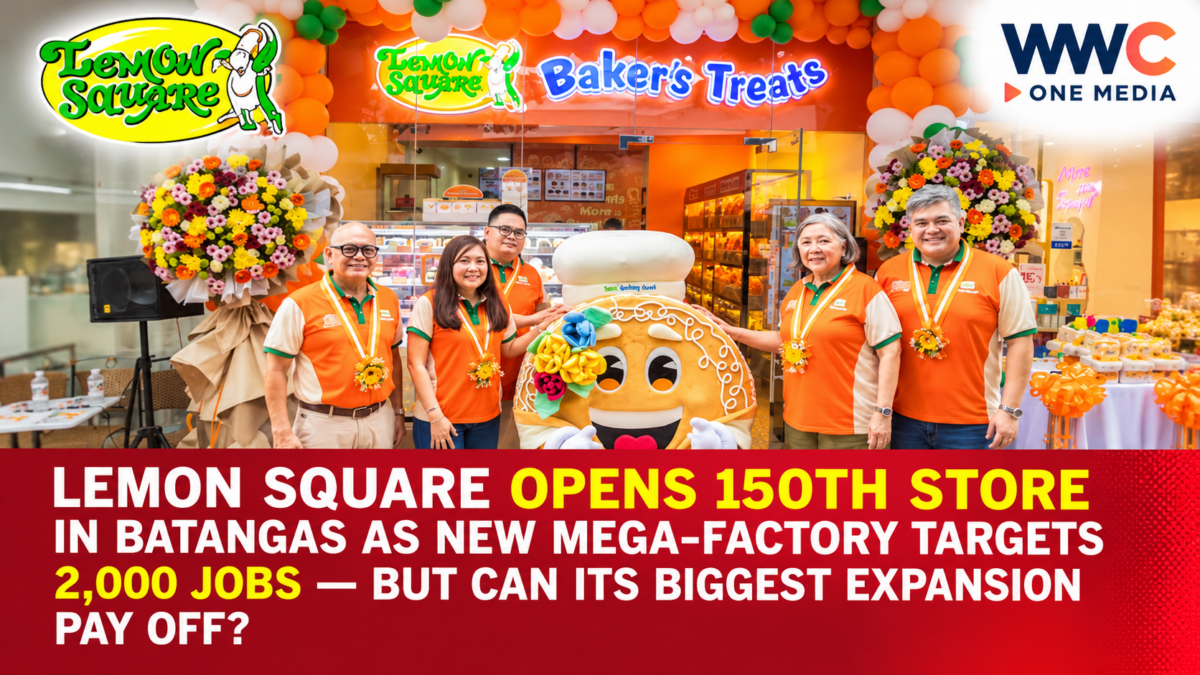
BATANGAS, Philippines — One of the country’s familiar homegrown snack brands is making a bigger push into Philippine retail and food manufacturing, opening its 150th Lemon Square store while expanding production through a massive new facility in Batangas.
Big E Food Corporation, the company behind Lemon Square cakes, pastries and other snack products, has opened its milestone retail outlet at The Outlets at LIMA Estate, an Aboitiz Economic Estates development in the Lipa-Malvar area.
The new store complements Big E’s recently inaugurated 11.8-hectare manufacturing plant within the same industrial estate.
At full operations, the factory is expected to support at least 2,000 jobs and help the company increase production, develop new products and reach more consumers in the Visayas and Mindanao.
The developments mark an important phase in Big E’s expansion from its original manufacturing base in Bulacan.
But the bigger question is whether Lemon Square can turn its expanded factory and retail footprint into stronger nationwide sales, lasting jobs and more efficient distribution.
Lemon Square Reaches 150-Store Milestone
The opening at The Outlets at LIMA Estate brings Lemon Square’s retail network to 150 stores.
The milestone strengthens the brand’s consumer-facing presence while placing a store close to an important center of industrial employment and residential development.
Lemon Square products are already distributed through supermarkets, convenience stores and neighborhood retailers nationwide.
The direct retail network provides another channel through which customers can purchase the company’s products.
For Big E, operating a store within the same economic estate as its factory also creates a visible connection between production and retail.
However, the 150-store figure should not be interpreted as 150 newly opened outlets in Batangas.
It represents Lemon Square’s broader retail network after the latest addition.
The company has not disclosed the number of additional stores it plans to open during the remainder of 2026.
Big E Food Strengthens Its Batangas Manufacturing Base
The latest store opening follows a much larger industrial investment.
On July 8, 2026, Aboitiz Economic Estates announced the opening of Big E Food Corporation’s largest manufacturing plant at LIMA Estate.
The facility covers 118,132 square meters, equivalent to approximately 11.8 hectares.
It is the company’s second major production base, complementing its longstanding factory in Bulacan.
The additional manufacturing space is intended to increase production capacity for existing products while supporting the development of new food offerings.
Big E also plans to use the facility to strengthen distribution to customers in the southern Philippines.
The project represents a significant geographic expansion of the company’s manufacturing operations.
However, the size of the property is not the same as the total floor area of its factory buildings.
Nor does the 11.8-hectare figure establish a specific number of cakes or other snack products that the plant can produce daily.
The company has not publicly disclosed a verified production-volume target associated with the October retail milestone.
Factory Expected to Support at Least 2,000 Jobs
Employment is one of the most important potential benefits of the new manufacturing development.
Big E and Aboitiz Economic Estates expect the facility to support around 2,000 jobs when it reaches full operations.
The company also plans to introduce technical skills training to help employees develop manufacturing-related capabilities.
Food production requires workers across different functions.
These can include production-line operations, quality control, equipment maintenance, warehousing, logistics and administration.
As the business expands, training may become increasingly important for maintaining consistent product standards.
But the projected 2,000 positions are not the same as 2,000 confirmed new employees already hired.
The company has not published a verified October 2026 headcount for the Batangas plant.
Its actual employment contribution will depend on production ramp-up, business demand and operational requirements.
For local communities, the important next milestone is whether the projected jobs materialize and provide sustained employment opportunities.
Lemon Square’s Manufacturing Expansion Began in 2024
The Batangas facility was not created overnight.
Big E Food Corporation and Aboitiz Construction held a groundbreaking ceremony on May 10, 2024.
The construction project involved a production plant, an operations and maintenance building, and ancillary structures.
Aboitiz Construction served as the design-and-build contractor.
Earlier announcements described a seven-hectare construction or site-development scope and a peak construction workforce of more than 200 workers.
The broader completed manufacturing development is now reported as spanning approximately 11.8 hectares.
These figures relate to different scopes and stages of the project and should not be treated as contradictory measurements of one identical area.
Similarly, the earlier construction workforce estimate is separate from Big E’s longer-term projection of approximately 2,000 jobs at full factory operations.
The plant’s July 2026 opening marked the transition from a construction initiative to an operational manufacturing development.
Why Big E Chose Batangas Instead of Another Bulacan Expansion
According to Aboitiz Economic Estates, Big E considered multiple sites across Laguna and Batangas before selecting LIMA Estate.
The company identified several reasons for its choice.
These included industrial infrastructure, site security, estate management and the ability to own the property instead of leasing it.
Its original factory in Bulacan already supports the northern part of its production and distribution network.
Establishing a second base in Batangas gives Big E a stronger location for serving southern markets.
That can be important for a company distributing food products to many retail channels across the country.
Transport distance, warehouse operations and production scheduling all influence distribution efficiency.
However, the company has not disclosed a verified amount of logistics savings resulting from the Batangas expansion.
The potential advantages will need to be measured through actual operating performance.
Visayas and Mindanao Are Key Growth Markets
One of the principal objectives of the new factory is to improve service to southern Philippine markets.
The facility is intended to strengthen Big E’s ability to distribute products across the Visayas and Mindanao.
The Philippines’ geographic structure creates logistical challenges for manufacturers shipping goods between islands.
Companies must coordinate land transportation, ports, shipping schedules, warehousing and retail distribution.
For packaged snacks and baked goods, inventory management is particularly important because products have defined shelf lives.
A strategically located manufacturing facility may help a company manage production and distribution more effectively.
But the opening of a Batangas plant does not eliminate the need for shipping or distribution infrastructure.
The impact will depend on production planning, customer demand and coordination with logistics partners.
Big E has not released a verified timetable for opening additional manufacturing plants in the Visayas or Mindanao.
The confirmed initiative is the expansion of its production network through Batangas.
New Factory Could Support More Lemon Square Products
Big E is known for a portfolio of packaged cakes, pastries, cookies and other snack products sold to Filipino consumers.
Its flagship Lemon Square brand is widely associated with affordable baked snacks.
The larger Batangas facility is designed to support existing product lines and provide room for developing additional offerings.
It also creates opportunities for the company to explore categories beyond its traditional lineup.
That flexibility matters in the food industry, where consumer preferences and competition can change.
Manufacturers must continually assess product demand, pricing, packaging and distribution.
But having space for future product development does not mean Big E has already announced a confirmed lineup of new products.
The October reporting does not disclose specific new brands, commercial launch dates or production volumes.
The opportunity lies in additional capacity and operational flexibility rather than a finalized product expansion timetable.
Big E Grew From a Family Bakery Into a Nationwide Manufacturer
Big E Food Corporation traces its history to 1985, when it began as a family-run bakery.
Over the following decades, it expanded into an established Philippine food manufacturing business.
Lemon Square became a recognizable name in grocery stores, convenience shops and neighborhood retailers.
The brand’s success illustrates how local food businesses can develop national distribution networks over time.
That journey also explains the significance of the Batangas investment.
A company that began with a small bakery now operates a manufacturing development covering nearly 12 hectares.
However, the size of the facility alone does not establish the company’s market share or annual revenue.
Big E has not disclosed current revenue or profit figures in the October announcement.
The expansion demonstrates manufacturing ambition, but its financial success will depend on future performance.
Retail and Manufacturing Could Reinforce Each Other
The latest development combines two different business activities.
Manufacturing allows Big E to produce food products at scale.
Retail outlets provide another way to reach customers directly.
The new Lemon Square store at The Outlets at LIMA Estate brings the brand into the commercial side of the industrial development.
This could strengthen visibility among employees, residents and visitors.
Retail locations may also help companies understand consumer preferences and evaluate new offerings.
But a milestone store opening is not automatically proof of rising same-store sales or improved profitability.
The company’s October announcement does not provide store-level revenue, sales growth or customer-traffic figures.
The commercial value of its retail expansion will depend on actual customer demand and operating costs.
LIMA Estate Has Become a Major Manufacturing Community
LIMA Estate is an industrial development spanning approximately 1,100 hectares across the Lipa-Malvar area of Batangas.
According to the latest reporting, the estate hosts more than 200 companies and supports approximately 75,000 jobs.
Its manufacturing community includes businesses involved in electronics, automotive components, precision manufacturing and consumer products.
Aboitiz Economic Estates has also developed commercial and support facilities within the area.
These include retail, offices, hospitality, housing and education-related developments.
The approach is intended to create an integrated environment where industrial operations and daily commercial activity can coexist.
For Big E, the estate offers manufacturing infrastructure and access to a substantial surrounding community.
But LIMA’s 75,000 jobs represent employment across the estate, not Big E’s workforce.
It would be misleading to combine those figures or attribute the entire estate’s employment to Lemon Square.
Skills Training Could Strengthen Local Employment
The company plans to support technical skills training as part of its manufacturing expansion.
Such programs can help employees adapt to production equipment, quality standards and changing operational requirements.
In April 2026, Aboitiz Economic Estates and Batangas State University reported that 21 participants from several LIMA companies, including Big E, completed an industry-based data management microcredential program.
That separate initiative illustrates the broader estate’s effort to connect manufacturing businesses with educational institutions.
For Big E, workforce development may help build the skills needed to operate increasingly sophisticated production systems.
However, the 21 participants were drawn from multiple companies, not exclusively Lemon Square.
The program also does not represent the entire number of workers Big E expects to train.
Future training outcomes will depend on the programs actually implemented by the company and its partners.
Community Programs Form Part of the Expansion
Big E has also identified community involvement as a priority.
The company says its initiatives include school feeding activities and scholarships for employees’ children.
These programs aim to support families and communities surrounding its operations.
For an industrial employer, local engagement can influence relationships with workers and nearby residents.
But public statements about social responsibility should not be confused with independently verified outcomes.
The October announcement does not disclose new spending commitments, scholarship counts or targets for the number of beneficiaries.
These details would be needed to evaluate the scale of the company’s community programs.
The broader significance is that Big E is positioning its Batangas development as a long-term operation rather than a temporary production project.
Batangas Is Attracting More Food Manufacturing Investment
Lemon Square’s expansion is part of wider industrial activity in Batangas.
In August 2026, Universal Robina Corporation inaugurated its Malvar Mega Plant, described by the company as a major investment in its manufacturing network.
The projects are separate and involve different businesses, sites and products.
But they reflect the attractiveness of Batangas for large consumer-goods manufacturing.
Industrial infrastructure, access to transportation routes and proximity to major consumer markets can influence these investment decisions.
The concentration of food manufacturing facilities may also increase demand for logistics services, technicians and industrial support businesses.
However, the opening of multiple factories does not automatically mean all manufacturers will achieve higher profits.
They still face competition, production costs and changing consumer demand.
The Biggest Challenge Is Turning Capacity Into Sales
An expanded factory can create opportunities, but capacity must be matched with commercial demand.
Big E will need to manage production volumes, inventory, distribution and retailer relationships.
Food manufacturers also face costs involving ingredients, packaging materials, electricity, transportation and labor.
These expenses can affect profitability even when sales increase.
The company’s 150-store milestone may help strengthen its consumer reach.
But direct retail remains only one part of the wider distribution network.
The business also depends on supermarkets, convenience stores and neighborhood retailers.
Successful expansion will require reliable operations across all those channels.
The publicly available reports do not establish a guaranteed increase in revenue or profits from the Batangas development.
Those results remain to be demonstrated.
What Happens Next for Lemon Square?
The new retail outlet is already open, and Big E’s Batangas manufacturing development was inaugurated in July.
The next phase concerns operating performance.
The company is expected to continue increasing production capability, developing new offerings and expanding distribution.
Employment and workforce development will also be important priorities as the plant progresses toward full operations.
Future developments may reveal more about production volumes, new products, additional retail locations and the actual number of workers employed.
Those are the figures that will help determine whether the expansion is achieving its business objectives.
The combination of manufacturing and retail investment gives Big E a wider foundation for growth.
But it does not remove the need for effective execution.
The Bigger Test: Can Lemon Square’s Expansion Deliver Lasting Growth?
Lemon Square’s 150th retail store and Big E’s 11.8-hectare Batangas manufacturing facility represent significant milestones for a homegrown Philippine food company.
The factory expands production beyond Bulacan and provides a base for serving southern markets.
The retail outlet strengthens the brand’s presence inside a major industrial and commercial community.
And the company’s plan to support at least 2,000 jobs at full operations offers the prospect of additional employment in Batangas.
But the real measure of success will be whether these commitments become lasting business results.
Lemon Square has reached 150 stores while Big E strengthens its production network through its biggest factory. The bigger question is whether its Batangas expansion can deliver the projected jobs, open new markets and sustain growth in an increasingly competitive Philippine food industry.