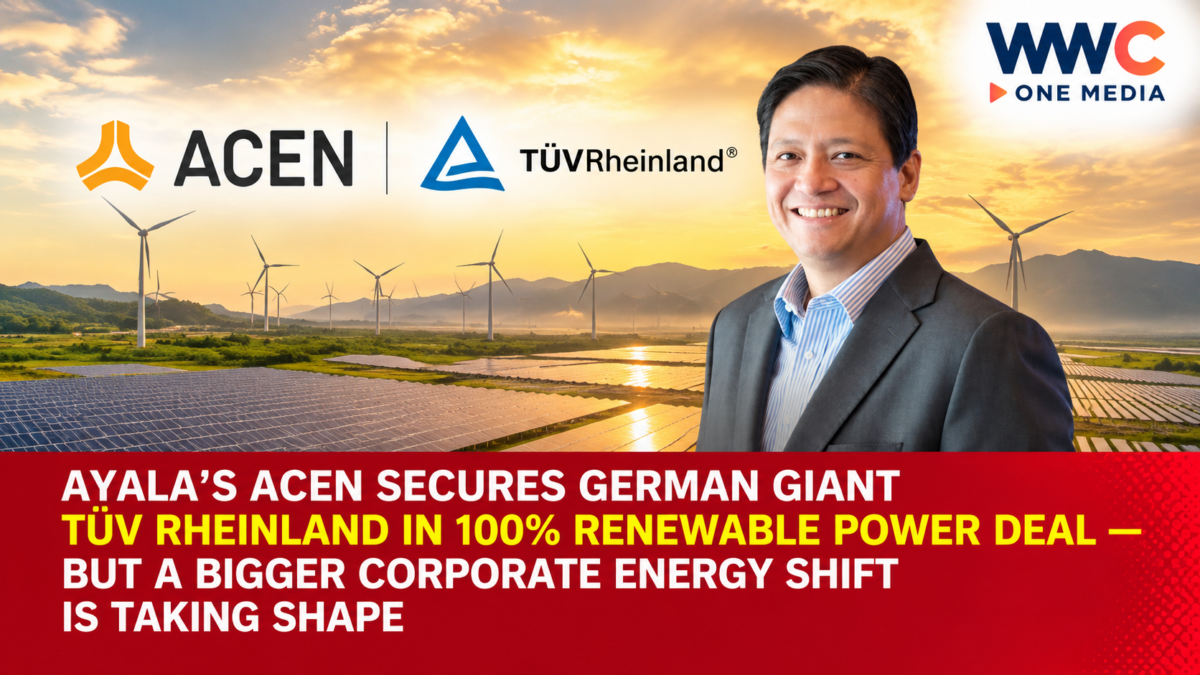
MANILA, Philippines — Ayala-led renewable energy giant ACEN Corporation is strengthening its grip on the Philippines’ expanding corporate clean-energy market after securing an electricity supply partnership with German testing and certification firm TÜV Rheinland Philippines.
The agreement will power TÜV Rheinland’s main office in Magallanes, Makati City, with 100% renewable electricity, marking another corporate customer win for ACEN as Philippine businesses increasingly look for ways to reduce their carbon footprint and meet sustainability commitments.
Announced on October 19, 2026, the partnership was facilitated through the government’s Retail Competition and Open Access (RCOA) program, which allows qualified commercial and industrial electricity consumers to select their preferred power suppliers.
For ACEN, the agreement represents more than another electricity customer. It demonstrates how corporate demand for cleaner energy is creating new opportunities for renewable power suppliers in the Philippines.
But as more companies turn toward renewable electricity, an important question emerges: Can the country’s energy market deliver enough competitively priced clean power to support a much larger corporate transition?
German Certification Giant Moves Makati Headquarters to Renewable Power
TÜV Rheinland Philippines, part of the international testing, inspection, and certification group, is putting its sustainability principles into practice by changing how its Philippine headquarters sources electricity.
Under the agreement, the company’s main office in Magallanes will obtain renewable power through ACEN Renewable Energy Solutions, ACEN’s retail electricity business.
The move is intended to reduce emissions associated with the company’s electricity consumption while supporting its global environmental objectives.
For TÜV Rheinland, the transition carries particular significance because the organization evaluates other businesses against safety, quality, technical, and environmental standards.
Its own electricity procurement decisions will now more closely reflect the sustainability practices it encourages among clients.
Tristan Arwen “Bobbit” Loveres, managing director of TÜV Rheinland Philippines, emphasized that practicing the environmental standards the company evaluates is an operational priority.
By transitioning its Makati facility to renewable electricity, the company aims to demonstrate its commitment to reducing its operational carbon footprint.
The partnership also highlights how corporate sustainability commitments are increasingly influencing electricity procurement decisions across the country.
ACEN Targets Growing Demand From Philippine Businesses
ACEN, the listed renewable energy platform of the Ayala Group, has been expanding its clean-power portfolio across the Philippines and other Asia-Pacific markets.
The company reported approximately 7.5 gigawatts of attributable renewable energy capacity, covering projects already operating, under construction, and included in signed agreements.
Importantly, that total does not represent electricity generation capacity that is entirely operational today.
Through ACEN RES, the company supplies renewable electricity to eligible business customers seeking alternatives to conventional power arrangements.
The TÜV Rheinland agreement reinforces ACEN’s efforts to build a corporate customer base while supporting the growing adoption of renewable power among commercial and industrial users.
Tony Valdez, ACEN senior vice president and head of market transformation and retail, said the partnership aligns with businesses’ efforts to achieve environmental targets while supporting the wider use of renewable energy in the Philippines.
The agreement’s commercial value, contract duration, and electricity supply volume were not disclosed.
As a result, the financial contribution of the TÜV Rheinland deal to ACEN’s earnings cannot yet be determined.
How the Government’s RCOA Program Is Changing the Electricity Market
A key part of this agreement is the government’s Retail Competition and Open Access program.
Traditionally, electricity consumers have depended on their local distribution utilities for power supply arrangements.
Under RCOA, eligible large electricity users can choose among qualified retail electricity suppliers instead of relying exclusively on their distribution utility’s default supply.
This creates opportunities for businesses to evaluate power suppliers based on pricing, contractual terms, energy sourcing, and sustainability objectives.
For renewable energy providers such as ACEN RES, the framework creates a route to serve corporate customers directly.
It also introduces greater competition among electricity suppliers seeking long-term relationships with commercial and industrial users.
However, access to competitive retail electricity arrangements depends on eligibility requirements and applicable market regulations.
Small businesses and ordinary residential consumers do not automatically have the same electricity supplier choices available to qualified large users.
The distinction is important as the government continues developing a more competitive electricity market.
Clean Energy Is Becoming a Corporate Business Strategy
For many businesses, renewable electricity is increasingly about more than environmental branding.
Companies may view clean-power procurement as one element of managing long-term energy exposure, meeting customer expectations, satisfying sustainability requirements, and supporting corporate emissions-reduction targets.
International companies operating in the Philippines may also face pressure to demonstrate improvements in their environmental performance across offices, factories, warehouses, and service facilities.
The increasing importance of sustainability reporting and supply-chain emissions creates another reason for companies to examine the source of their electricity.
Renewable supply agreements can help businesses address emissions associated with purchased electricity, commonly referred to as Scope 2 emissions.
But a 100% renewable electricity arrangement does not necessarily mean a facility operates independently of the grid or receives physically renewable electricity every minute.
Such claims depend on the contractual arrangements, energy sourcing methods, and accounting framework used.
Businesses must also consider electricity reliability, contract terms, and pricing before committing to renewable supply agreements.
ACEN Is Not Alone in the Race for Corporate Renewable Energy Customers
Competition in the Philippine renewable electricity market is expanding.
Other companies, including First Gen and various licensed renewable electricity suppliers, are pursuing customers interested in cleaner power arrangements.
The trend is increasingly visible in sectors such as retail, manufacturing, property development, logistics, and food services.
ACEN itself has announced additional corporate renewable electricity partnerships.
In September 2026, the company disclosed a renewable energy supply arrangement with ACS Manufacturing, the producer of several well-known Filipino household brands.
Earlier that month, ACEN also reported that 23 Conti’s and Wendy’s Philippines stores were transitioning to renewable electricity.
These transactions demonstrate that the market is extending beyond office buildings into restaurants and manufacturing operations.
The business opportunity could grow as more eligible companies evaluate whether renewable electricity can support their sustainability targets without compromising operational needs.
What the TÜV Rheinland Deal Means for the Philippines
The ACEN–TÜV Rheinland partnership illustrates a wider transformation in Philippine energy procurement.
Corporate electricity customers are increasingly considering not only how much power they consume, but also where that electricity comes from.
For renewable energy developers, corporate demand may support opportunities to contract electricity from existing and future projects.
For participating businesses, renewable supply agreements can help address sustainability commitments while introducing additional choices in electricity procurement.
For the broader economy, stronger demand for renewable electricity could encourage further investments in generation and related infrastructure.
However, sustained expansion will depend on adequate transmission capacity, reliable supply, competitive pricing, and effective market regulation.
The country must also continue developing an electricity system capable of accommodating growing renewable generation.
The Bigger Question: Can ACEN Turn Corporate Demand Into Long-Term Growth?
ACEN’s latest partnership strengthens its position in a market increasingly shaped by corporate sustainability ambitions.
By securing TÜV Rheinland as a customer, the company gains another commercial relationship while reinforcing its role in supplying renewable electricity to Philippine businesses.
But one office transitioning to renewable power does not, by itself, establish how quickly the wider corporate market will change.
The more meaningful indicators will be the number of new corporate customers, the electricity volumes contracted, the commercial terms secured, and whether renewable electricity remains competitive with alternative supply arrangements.
With 7.5 GW of attributable renewable capacity across various development and operating stages, ACEN has an expanding portfolio positioned to serve demand for cleaner electricity.
The real test is whether ACEN can turn a growing collection of corporate sustainability commitments into lasting electricity sales—and whether the Philippines’ energy infrastructure can keep pace with that ambition.