MANILA, Philippines — The Office of the Solicitor General (OSG) plans to challenge the Supreme Court’s ruling declaring key provisions of the 2024 and 2025 national budgets unconstitutional, setting the stage for another major legal battle over how the government allocates and spends public funds.
The development follows the high court’s decision invalidating budget increases that it found violated constitutional limits on congressional spending authority. The ruling also struck down certain provisions governing unprogrammed appropriations under the 2026 national budget.
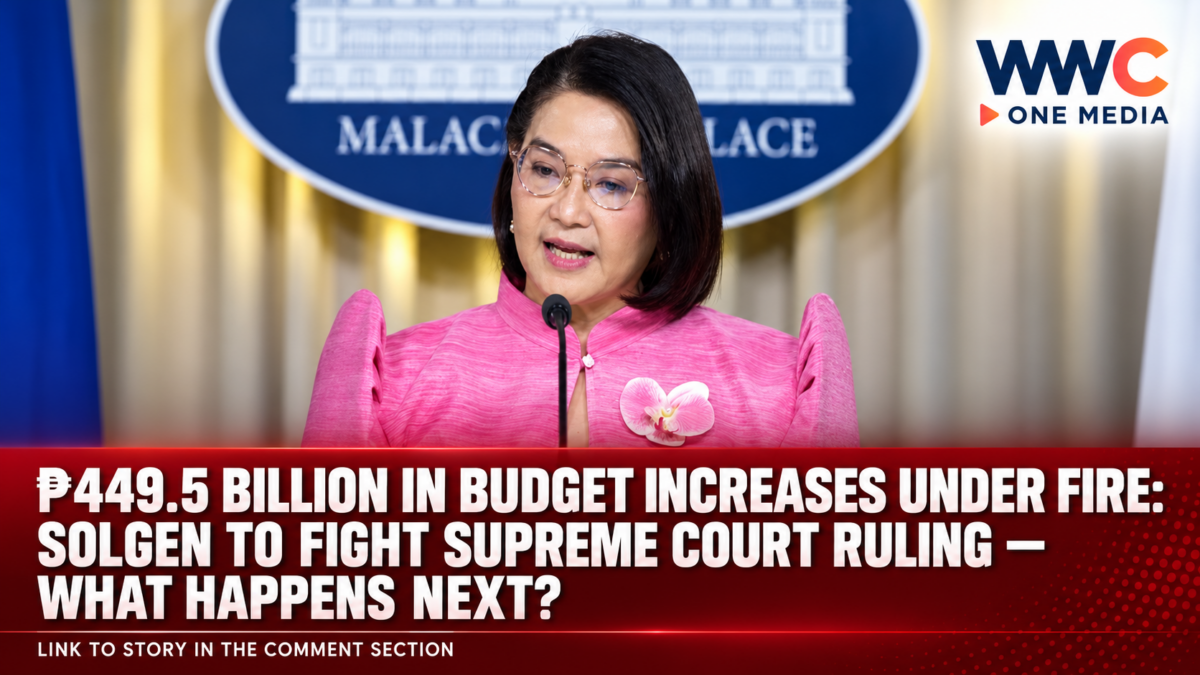
The Inquirer reported on October 21 that Solicitor General Menardo Guevarra’s office intends to appeal the ruling. The precise grounds and eventual outcome of the challenge remain subject to further legal proceedings.
Why did the Supreme Court strike down the budget provisions?
The Supreme Court’s decision centered on whether Congress exceeded its constitutional authority by increasing certain appropriations beyond the total amount recommended by the President.
In its ruling, the high court found that Congress increased the 2024 budget’s unprogrammed appropriations by ₱449.5 billion, raising concerns about fiscal discipline and compliance with the Constitution.
Unprogrammed appropriations are standby funds intended for specific circumstances, such as when additional revenues become available. Unlike ordinary programmed expenditures, their release depends on conditions established by law.
The Court emphasized that these funds are not automatically unconstitutional. However, they must operate within the government’s overall fiscal program and have sufficient safeguards to prevent excessive discretion over public spending.
GMA News and Philstar.com reported similar details about the ruling and the constitutional concerns surrounding the budget adjustments.
The ₱17.99-billion increase in the 2025 budget
The Supreme Court also declared the 2025 General Appropriations Act unconstitutional in connection with a ₱17.99-billion increase in the Department of Public Works and Highways’ Special Road Fund.
The Court found that the increase pushed the total appropriations beyond the amount recommended by the President, contrary to constitutional and statutory restrictions.
The ruling also addressed a separate ₱12.75-billion increase involving Special Accounts in the General Fund, which the Court found inconsistent with provisions of the Administrative Code governing congressional changes to special appropriations.
These findings place the budget approval process, including changes made by the congressional bicameral conference committee, under renewed scrutiny.
What about the 2026 national budget?
The decision also invalidated specific provisions of the 2026 General Appropriations Act that governed the release of unprogrammed funds.
According to the Supreme Court’s findings reported by GMA News, the challenged provisions lacked adequate limits and prioritization standards, potentially giving the Executive branch excessive discretion over spending.
The Court established safeguards for unprogrammed appropriations, including prohibiting lump-sum allocations and requiring clearer rules on how additional revenues may be used.
It also criticized the lack of sufficient documentation explaining certain changes made during the bicameral conference committee process.
Will government programs and beneficiaries be affected?
The ruling does not automatically mean that every government project funded under the affected budgets must stop or that every expenditure has been invalidated.
The Supreme Court applied the doctrine of operative fact to protect certain irreversible programs involving beneficiaries who acted in good faith. However, that protection does not automatically shield the officials who authored, proposed, or implemented the unconstitutional provisions from potential civil, criminal, or administrative liability.
Any such liability would depend on the applicable legal proceedings and findings of the proper tribunals.
The practical effects of the ruling will depend on the decision’s implementation, the scope of the affected provisions, and any subsequent action by the Court.
What happens next?
The Solicitor General’s planned challenge could bring the legal questions surrounding the national budgets back before the Supreme Court.
A motion for reconsideration would ask the Court to revisit its decision, although the filing itself would not guarantee that the ruling would be reversed. The outcome would depend on the arguments presented and the Court’s assessment of the constitutional and legal issues.
For now, the case highlights a central question in Philippine governance: how can Congress exercise its authority over the national budget without exceeding constitutional limits or weakening safeguards over public money?
The next legal developments could clarify the boundaries of congressional budget adjustments and the conditions under which standby funds may be released.
For taxpayers, government agencies, and lawmakers, the issue goes beyond a legal dispute over budget figures. It concerns transparency, accountability, and the constitutional rules governing how public funds are allocated and spent.