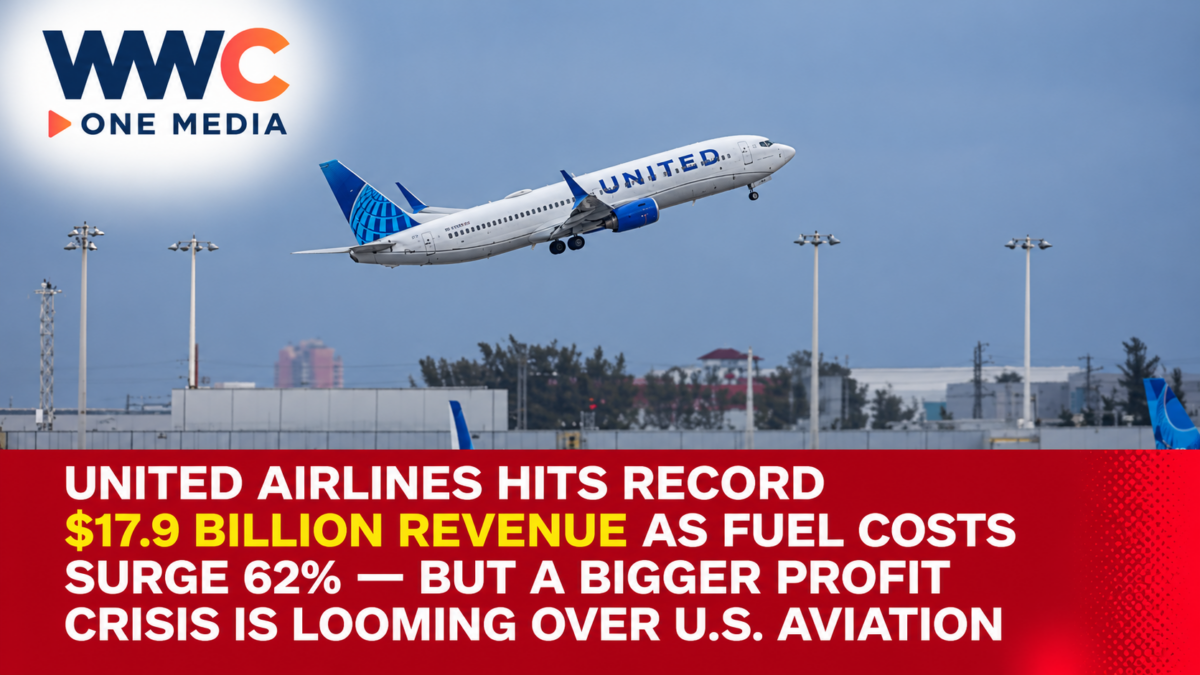
CHICAGO, United States — United Airlines has delivered its highest quarterly revenue in history, carrying nearly 50 million passengers and generating $17.9 billion in sales, but an alarming 62% jump in fuel expenses is raising serious questions about how much profit the airline can earn from booming travel demand.
The U.S. aviation giant reported on October 20, 2026, that third-quarter operating revenue climbed 17.4% from a year earlier, supported by stronger ticket pricing, premium travel, corporate bookings, and customer demand.
But beneath the record sales, the financial picture was more troubling.
Adjusted earnings fell to $2.54 per share, missing Wall Street’s approximately $2.57 estimate, as jet fuel costs climbed by roughly $1.8 billion compared with the same period last year.
United’s fourth-quarter outlook was even more concerning. The airline projected adjusted earnings of only $0.50 to $1.50 per share, significantly below the approximately $1.76 expected by analysts.
The disappointing forecast highlights a growing contradiction in the aviation industry: airlines are collecting more money from passengers, but soaring operating costs are consuming much of the benefit.
The bigger question is whether airlines can continue raising ticket prices without eventually discouraging the very travelers driving record demand.
United Airlines Breaks Revenue Records With $17.9 Billion in Sales
United’s third-quarter results demonstrated the resilience of passenger demand despite higher airfares and economic uncertainty.
The airline generated approximately $17.9 billion in operating revenue, compared with $15.23 billion in the third quarter of 2025.
The 17.4% increase marked a company record.
United also carried approximately 49.5 million revenue passengers during the quarter, its highest third-quarter passenger total.
Overall capacity increased only 1.3%, meaning revenue growth was driven largely by stronger revenue generation rather than a substantial increase in available seats.
Total revenue per available seat mile, an important airline performance measure, rose 15.9%.
For investors, the figures illustrate United’s ability to command higher revenue from its existing flight network.
The airline also reported strength across multiple business categories.
Premium cabin revenue increased 17%, while Basic Economy revenue climbed 16%.
Loyalty revenue rose 17%, cargo revenue advanced 23%, and contracted corporate travel revenue surged 26%.
Economy cabin unit revenue increased 17%, extending a three-quarter improvement.
These results suggest travel demand remains strong across different customer groups, even as fares rise.
Fuel Costs Surge 62% and Eat Into Airline Profits
The biggest problem in United’s latest earnings report was the cost of jet fuel.
The company reported fuel expenses of approximately $4.84 billion during the third quarter, compared with roughly $3 billion a year earlier.
That represents an increase of about 62%.
United paid an average of $3.90 per gallon for aircraft fuel during the quarter.
Although revenue rose sharply, the additional $1.8 billion fuel bill put substantial pressure on profitability.
Adjusted pretax earnings reached approximately $1.1 billion, with an adjusted pretax margin of 6.2%.
That margin was down from approximately 8% in the comparable quarter of 2025.
In other words, United generated record revenue but retained a smaller share of those sales as adjusted pretax profit.
The airline’s adjusted net income was $833 million, while reported net income reached approximately $1.03 billion.
This distinction is important because United’s reported net profit increased from a year earlier, even as its adjusted earnings performance weakened.
The deterioration in adjusted profitability helps explain why investors were more focused on costs and the company’s future outlook than on the headline revenue record.
United Misses Wall Street Earnings Expectations
United reported third-quarter adjusted diluted earnings of $2.54 per share.
That was slightly below analysts’ consensus estimate of around $2.57 per share.
The company also fell marginally short of revenue expectations, with its approximately $17.88 billion result coming in below forecasts of about $17.89 billion.
While those quarterly misses were relatively small, the airline’s outlook for the final three months of 2026 created greater concern.
United expects fourth-quarter adjusted earnings of $0.50 to $1.50 per share.
That forecast is below the roughly $1.72 to $1.76 per share analysts had anticipated, depending on the data provider.
The airline expects average jet fuel costs to reach approximately $4.80 per gallon in the fourth quarter.
According to Reuters, that assumption is around 45 cents higher than prevailing market expectations, creating a potential earnings impact of approximately $1 per share.
The higher fuel-cost assumption indicates that United expects significant financial pressure to continue into the final quarter.
Following the announcement, shares of United Airlines Holdings fell approximately 2% in after-hours trading on October 20.
The reaction suggests investors were more concerned about future margins than the company’s record-breaking sales.
CEO Scott Kirby Defends United’s Growth Strategy
Despite the disappointing profit outlook, United CEO Scott Kirby emphasized the resilience of the airline’s business model.
Kirby credited the company’s employees and its focus on customer loyalty for supporting performance under difficult operating conditions.
United has invested in premium cabins, onboard technology, loyalty benefits, aircraft modernization, and service improvements to attract travelers willing to choose the airline repeatedly.
Management argues that these investments can help United build stronger customer relationships and generate more revenue per passenger.
The strategy has shown results in premium seating, corporate travel, and loyalty revenue.
However, the latest financial performance illustrates that even successful revenue initiatives cannot completely offset sharp changes in fuel prices.
Kirby’s longer-term challenge is to maintain the company’s competitive position while controlling costs across an expanding international operation.
Record Passenger Demand Shows Travelers Are Still Flying
United’s third quarter demonstrated that higher ticket prices have not yet caused a broad collapse in travel demand.
The airline carried 49.5 million customers and recorded six of its ten busiest travel days of the year during the quarter.
It also operated its largest-ever domestic schedule, serving 241 airports across the United States and Canada.
The company reported its lowest seat cancellation rate among the three largest U.S. carriers during the period.
Its July operation was particularly busy, with approximately 18.4 million passengers carried.
These results provide evidence that consumers and businesses remain willing to fly despite rising prices.
However, continued fare increases may eventually create resistance among passengers, particularly budget-conscious travelers.
Airlines must therefore manage a difficult balance between recovering operating costs and preserving demand.
Delta, Alaska and Other Airlines Face the Same Fuel Crisis
United is not alone in dealing with the impact of expensive jet fuel.
Across the U.S. airline industry, higher energy prices have forced carriers to reassess their profit expectations.
Reuters reported that U.S. airlines spent approximately $42.9 billion on fuel during the first eight months of 2026, about $13.2 billion more than during the comparable period in 2025.
Delta Air Lines has warned of an approximately $6 billion increase in its annual fuel bill.
Alaska Air Group has also projected an adjusted fourth-quarter loss of between $2 and $2.50 per share, with higher fuel expenses putting pressure on operations.
The situation reflects broader disruption in global energy markets, where geopolitical tensions and supply concerns have increased the price of aviation fuel.
Fuel is one of the largest expenses for airlines, and substantial price increases can quickly erode margins.
Carriers may respond by raising fares, reducing less profitable routes, slowing capacity growth, or adjusting their fleet strategies.
But each option carries risks.
Higher fares can discourage customers, while capacity reductions can limit revenue opportunities.
United Bets on Starlink, Premium Cabins and Aircraft Upgrades
Even as fuel prices squeeze earnings, United continues investing in the passenger experience.
One of its most significant initiatives is the installation of SpaceX’s Starlink satellite internet service across its aircraft fleet.
As of the October earnings announcement, United had installed Starlink on more than 640 aircraft.
The service was available on approximately half of United’s flights, including regional operations.
The airline expects Starlink availability to reach 61% by the end of 2026 and eventually cover its fleet by the end of 2027.
United says onboard connectivity is becoming a meaningful competitive advantage.
In September alone, more than 5.4 million passengers used Starlink-equipped United flights.
The airline has also introduced Airbus A321XLR aircraft into service and continues modernizing its premium international cabin offerings.
These investments are designed to encourage customer loyalty, improve the onboard experience, and support long-term revenue growth.
However, they also involve substantial spending at a time when fuel and operating costs are elevated.
United expects approximately $7.5 billion in adjusted capital expenditures for full-year 2026.
That creates another important financial challenge: maintaining investment in future growth while protecting the company’s balance sheet and cash generation.
United Plans New International Routes Despite Profit Pressure
United is continuing its international expansion even as the airline industry faces higher costs.
The company has announced plans to launch services to ten additional international destinations during summer 2027.
The proposed destinations include Catania, Ibiza, Ljubljana, Luxembourg, Marseille, Okinawa, Olbia, Terceira, Toulouse, and Valencia.
The routes remain subject to relevant government approvals.
United has also been expanding selected long-haul services across Asia and Europe.
The additions demonstrate its intention to strengthen its global network and capture international leisure demand.
Yet the financial outcome will depend on passenger traffic, ticket yields, fuel prices, and operating efficiency.
Launching new routes may support revenue growth, but the airline must ensure that expansion does not weaken profitability.
What the Earnings Mean for International Travelers
For international passengers, including travelers from the Philippines, United’s results point to an increasingly important development in global aviation.
Airlines are facing pressure to recover higher operating expenses while maintaining competitive fares.
That could translate into more expensive tickets on certain routes, particularly when demand is strong.
However, United has not announced a blanket airfare increase specifically linked to its third-quarter earnings.
Ticket prices will continue to depend on route demand, competition, travel dates, cabin class, and the airline’s pricing decisions.
The company is also expanding services and improving onboard connectivity, developments that may benefit travelers using its international network.
For passengers, the key trade-off may increasingly involve price, convenience, service quality, and available flight options.
The Bigger Question: Can Record Revenue Protect United From an Aviation Profit Squeeze?
United’s third-quarter performance presents two different stories.
On one side, the company is carrying record numbers of passengers, generating unprecedented revenue, expanding premium services, and maintaining strong demand.
On the other, fuel prices have increased dramatically, adjusted margins are shrinking, and its fourth-quarter earnings forecast has disappointed Wall Street.
The airline expects fourth-quarter revenue to increase by more than 20% year-on-year, suggesting that sales momentum may remain strong.
But the outlook also shows that record sales do not necessarily translate into record profitability.
The challenge for United is to keep attracting passengers while managing higher fuel expenses, operating costs, and ongoing aircraft investments.
For investors, the next earnings reports will be critical in determining whether the airline can restore its margins.
For travelers, the concern is whether carriers will increasingly rely on higher fares to compensate for rising costs.
United Airlines has proved that Americans and international travelers are still willing to fly in record numbers. But with fuel costs soaring and fourth-quarter profits under pressure, the bigger question is whether the world’s major airlines can keep growing without pricing passengers out of the skies.