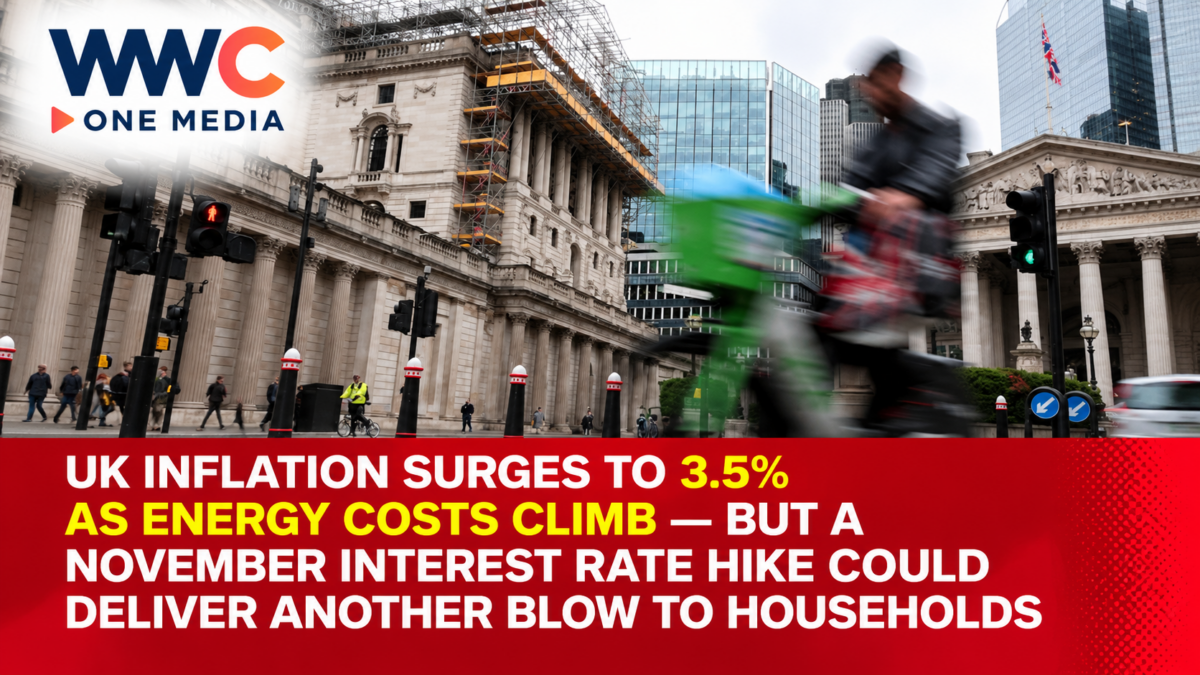
LONDON, United Kingdom — British households are facing renewed financial pressure after UK inflation accelerated to 3.5% in September 2026, raising expectations that the Bank of England could increase borrowing costs as early as November.
Official figures released by the Office for National Statistics on Wednesday, October 21, showed that annual consumer price inflation rose from 3.1% in August to 3.5% in September.
The reading exceeded economists’ forecasts of 3.4% and marked the highest annual CPI inflation rate since October 2025.
The latest increase was driven primarily by transportation costs, particularly petrol and diesel, as higher global energy prices linked to the Middle East conflict continued affecting the British economy.
Core inflation, which excludes energy, food, alcohol and tobacco, also accelerated to 2.8% from 2.6%, suggesting price pressures extended beyond fuel.
The figures arrive just two weeks before the Bank of England’s next interest rate announcement on November 5.
The biggest question is whether policymakers will raise interest rates to prevent inflation from becoming entrenched—even as households face the possibility of more expensive mortgages, credit and everyday necessities.
UK Inflation Rises Faster Than Expected
The Office for National Statistics reported that the Consumer Prices Index increased 3.5% over the 12 months to September.
That compares with 3.1% in August and 2.6% in June.
On a monthly basis, prices increased 0.4% in September.
A year earlier, the equivalent monthly CPI figure was approximately unchanged.
This means prices were rising more rapidly than they had been during the same month of 2025.
The September reading also remained substantially above the Bank of England’s 2% inflation target.
Importantly, a 3.5% annual inflation rate does not mean all products became 3.5% more expensive during September alone.
It measures the change in the overall consumer price basket compared with September of the previous year.
Some prices rose considerably faster, while others increased more slowly or declined.
Petrol and Transport Costs Drive the Increase
Transport was the largest contributor to the increase in annual inflation.
The ONS reported that the annual inflation rate for transport reached 6.6% in September, compared with 4.6% in August, using its CPIH classification.
Motor fuels were particularly important.
The ongoing Middle East conflict has contributed to higher international oil prices and greater volatility in energy supplies.
Britain’s motorists have faced sharply higher fuel prices as global supply disruptions feed into domestic petrol and diesel costs.
The Guardian reported that diesel had exceeded £2 a litre, while petrol had risen above £1.70 a litre.
Higher fuel prices have consequences beyond the petrol station.
Transport operators, delivery businesses and manufacturers may encounter higher operating expenses.
Some of those costs can eventually be passed to customers.
However, the size and timing of any increase depend on business pricing decisions, contracts and market competition.
Core Inflation Also Moves Higher
The inflation figures were not limited to volatile energy costs.
Core CPI increased to 2.8% in September from 2.6% in August.
Core inflation excludes food, energy, alcohol and tobacco to provide a clearer view of underlying price pressures.
Meanwhile, services inflation reached 3.7%, up from 3.4%.
This matters because the Bank of England closely monitors service-sector costs when assessing whether inflation might remain elevated.
Services include activities such as hospitality, personal care and other labor-intensive businesses.
Their prices can be influenced by wages, rents and operating expenses.
A simultaneous rise in headline, core and services inflation may strengthen the argument for tighter monetary policy.
But it does not prove that inflation will continue rising indefinitely.
Future developments will depend on energy prices, wages, consumer demand and other economic conditions.
Bank of England Faces a November 5 Decision
The Bank of England’s benchmark interest rate currently stands at 3.75%.
At its September meeting, the Monetary Policy Committee voted 6–3 to keep the rate unchanged.
Three policymakers supported a quarter-percentage-point increase to 4%.
The division highlighted growing concern about the risk that higher energy costs could produce lasting inflation.
The bank warned that the longer energy prices remain elevated, the greater the possibility that businesses and workers will adjust their pricing and wage expectations.
Its next scheduled decision is November 5.
Many economists expect the bank to raise its policy rate by 0.25 percentage points to 4%.
However, that decision has not yet been made.
The September inflation figures add to the evidence policymakers will assess, but they do not automatically trigger a rate increase.
Economists Increasingly Expect an Interest Rate Hike
A Reuters survey conducted October 12–14 found that 54 of 63 economists expected the Bank of England to increase its benchmark rate by 25 basis points in November.
That would take the rate from 3.75% to 4%.
The poll was conducted before the latest September CPI data were released.
With inflation now exceeding forecasts, the argument for a rate increase has become stronger.
Analysts cited by the Financial Times believe the next meeting is increasingly likely to produce monetary tightening.
But forecasts remain forecasts.
Policymakers could still respond differently if economic indicators change or if they conclude that higher energy costs will prove temporary.
The central challenge is balancing the need to control inflation against the risk of weakening economic activity.
Why Interest Rate Hikes Could Hurt Households
Higher benchmark interest rates influence the cost of borrowing throughout the economy.
Mortgage rates, business loans and other financial products can be affected, although the timing varies according to contract terms.
For households with variable-rate or tracker mortgages, an increase can feed relatively quickly into payments.
Borrowers on fixed-rate deals may be unaffected until their existing contracts expire.
Higher financing costs can also make it more expensive for companies to fund expansion, investment and day-to-day operations.
At the same time, savers may benefit from higher deposit rates if banks pass through the increase.
The impact therefore differs across households.
For policymakers, the difficult reality is that interest rates can reduce inflationary demand but cannot directly increase global oil supplies or resolve geopolitical disruptions.
Britain’s Inflation Problem Is Linked to the Middle East Conflict
Energy markets have remained volatile amid conflict involving Iran, the United States and Israel.
Oil and gas prices have been particularly sensitive to threats affecting production and shipping routes.
The Strait of Hormuz is a strategically important route for international energy supplies.
Disruptions can influence global prices even in countries far from the conflict.
The United Kingdom is vulnerable to these pressures partly because it depends on imported energy, including natural gas.
Higher imported energy costs can affect household utilities, transportation, industrial production and commercial activity.
This creates a difficult policy environment.
Raising interest rates can restrain some domestic inflation pressures, but it cannot remove the geopolitical causes of higher energy prices.
Inflation Could Rise Above 4% in 2027
The current inflation reading may not represent the peak.
Bank of England projections and independent forecasts suggest that inflation could exceed 4% in early 2027 if energy prices remain elevated.
Such forecasts reflect scenarios rather than guaranteed outcomes.
Oil and gas prices could decline if supply conditions improve.
Alternatively, further disruption could produce additional pressure.
Policymakers are particularly concerned about so-called second-round effects.
These occur when an initial shock, such as rising energy prices, influences wages and prices across the wider economy.
For example, businesses may increase prices to recover higher operating costs, while workers seek higher wages to protect purchasing power.
That process can make inflation more persistent.
The Bank of England has said evidence of such effects remained limited in September, although the risk was increasing.
UK Government Faces Its Own Budget Challenge
The inflation figures arrive just ahead of Britain’s October 28 government budget.
Finance Minister John Healey faces pressure to support households affected by high energy prices while maintaining confidence in public finances.
Separate data reported by the Financial Times indicate that government borrowing reached £24.5 billion in September.
Higher public borrowing and debt interest costs can limit the resources available for new assistance measures.
The government may consider targeted support for households most exposed to rising living expenses.
However, any additional spending must be weighed against fiscal constraints.
A large, unfunded support package could also raise concerns about borrowing costs and market confidence.
That means the government and central bank face related but different challenges.
Fiscal policy can direct support toward affected households.
Monetary policy aims to bring inflation back toward the 2% target.
What Rising UK Inflation Means for Global Markets
Britain’s latest inflation figures add to a wider international problem.
Energy-price increases are affecting countries across Europe and Asia as global commodity markets respond to geopolitical instability.
Central banks must determine whether to tolerate temporary price shocks or tighten policy to prevent more persistent inflation.
Financial markets are watching how the Bank of England responds because its decision can influence British government bond yields, mortgage pricing and the pound.
A higher policy rate does not guarantee a stronger currency or rising stock prices.
Markets also consider economic growth, investor expectations and the likely path of future interest rates.
For international investors, the November decision will provide another indication of how aggressively major central banks are responding to the energy crisis.
What Happens Next?
Three developments will be particularly important for the UK economy.
The October 28 budget could clarify the government’s plans for household support and fiscal management.
The November 5 Bank of England meeting will determine whether the benchmark rate remains at 3.75% or increases.
The next official inflation report, scheduled for November 18, will show whether annual price growth continued accelerating in October.
For households, the immediate concern remains the impact of energy and transport costs on monthly budgets.
For businesses, higher prices and borrowing costs could complicate operating decisions.
And for policymakers, the task is to reduce inflation without imposing unnecessary additional damage on an economy already facing external shocks.
The Bigger Test: Inflation or Interest Rates?
The United Kingdom now faces a difficult economic balancing act.
Annual inflation has risen to 3.5%, above both economists’ expectations and the Bank of England’s 2% target.
Petrol and transport costs are major contributors, while core and services inflation are also moving higher.
Markets increasingly expect a November rate increase to 4%.
But higher borrowing costs could create new pressures for mortgage holders and businesses.
The next decision will reveal whether policymakers believe inflation has become a greater risk than the economic damage associated with tighter monetary policy.
UK inflation has climbed to 3.5% as the Middle East energy crisis pushes up transport costs. But the bigger question is whether the Bank of England’s likely next interest rate increase will bring prices under control—or leave households facing higher bills and more expensive borrowing at the same time.