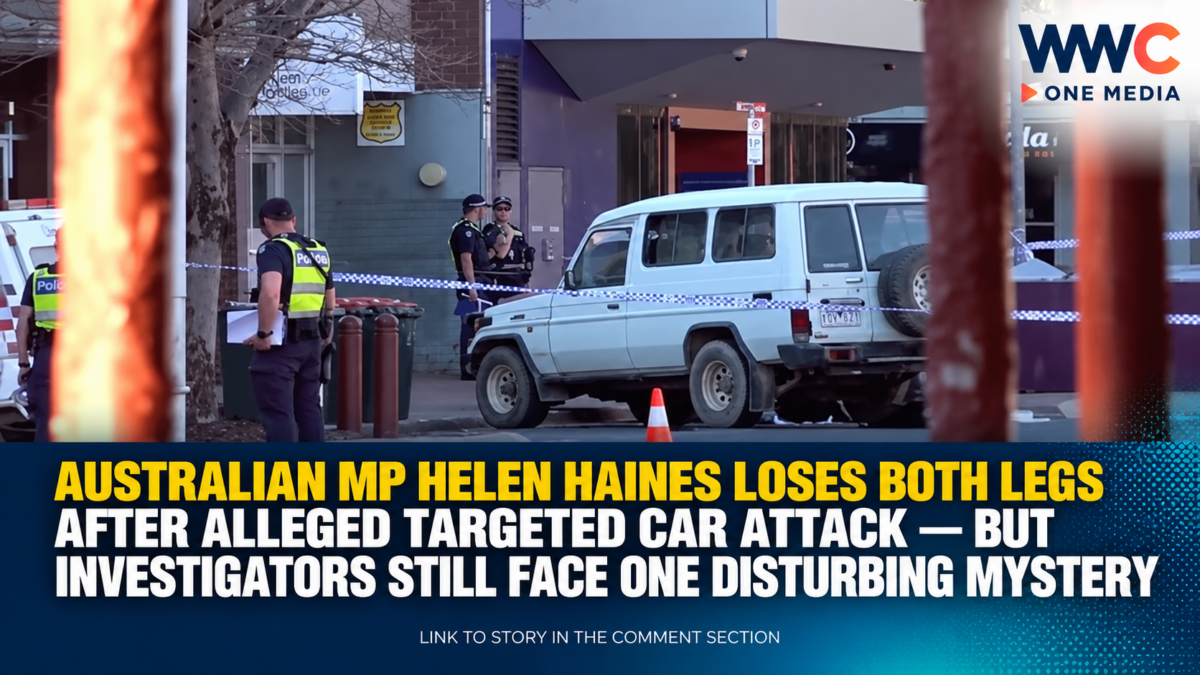
MELBOURNE, Australia — October 21, 2026. Australia is reeling from a shocking attack on independent federal lawmaker Helen Haines, who has undergone the amputation of both legs after allegedly being deliberately struck by a vehicle outside her electoral office in regional Victoria.
The 65-year-old politician remains in hospital following the devastating incident, which has triggered a major police investigation and renewed concerns about the safety of elected officials.
Her husband, Phil Haines, confirmed on Wednesday that surgeons had been unable to save either of her legs despite extensive medical efforts.
The news comes as a 43-year-old man appeared in court over the alleged attack, which authorities believe specifically targeted the MP.
But the investigation has raised an even more troubling question: Why was Haines allegedly singled out when police say there was no known previous connection between her and the accused?
Husband Confirms Devastating Injuries but Shares Hopeful Update
Speaking to reporters at Melbourne’s Alfred Hospital on October 21, Phil Haines confirmed that his wife had lost both legs.
Doctors amputated her left leg following the incident on Monday, October 19. Medical teams then spent days attempting to save her right leg, but those efforts were ultimately unsuccessful.
Despite the severity of her injuries, her husband shared encouraging news about her immediate condition.
“The good news in all this is Helen is alive and she’s stable,” he said.
He expressed gratitude that his wife’s heart and mind remained in good condition as she continued receiving treatment.
The statement brought a measure of relief amid an otherwise devastating announcement.
Haines remains under close medical care, with her family focused on her survival and recovery.
What Happened Outside Helen Haines’ Electoral Office?
The alleged attack occurred in Wangaratta, a regional Victorian city northeast of Melbourne, on the afternoon of October 19.
Investigators allege that a man driving a four-wheel-drive vehicle deliberately struck Haines outside her electoral office.
According to police accounts and witness reports, the driver allegedly reversed the vehicle and struck the lawmaker a second time.
Haines sustained catastrophic injuries and was transported to hospital for emergency treatment.
Members of the public rushed to help her, while other bystanders restrained the alleged driver until police arrived.
Authorities have described the incident as an apparently targeted attack rather than an ordinary road accident.
However, investigators have not established a publicly confirmed motive.
Brendan Nugent Appears in Court as Police File Multiple Charges
Police identified the accused as Brendan Nugent, 43, from Tarrawingee, a rural community within Haines’ electorate.
Nugent appeared before the Wangaratta Magistrates’ Court on October 21.
He faces charges including:
- Dangerous driving causing serious injury.
- Intentionally causing serious injury.
- Causing harm to a Commonwealth public official.
- Additional offences involving alleged cannabis cultivation and possession.
The allegations have not been proven in court.
According to Australian media reports, Nugent did not apply for bail during his appearance, and proceedings were adjourned until February 4, 2027.
His lawyer told the court that Nugent had a neurological condition known as idiopathic transverse myelitis, was receiving treatment for concussion and had mental health concerns.
Those statements were presented as part of the court proceedings and do not establish the reason for the alleged attack.
Authorities have not publicly identified a confirmed motive.
Police Investigate Whether the Attack Was Politically Motivated
The investigation has drawn the attention of multiple Australian law enforcement agencies, including officers specializing in counterterrorism.
Police believe Haines was deliberately targeted, but they have also indicated that the incident appears isolated.
Australian Federal Police Commissioner Krissy Barrett said authorities had received no specific intelligence warning of an imminent threat to the MP.
Victoria Police Chief Commissioner Mike Bush said investigators had not identified a direct previous connection between Haines and Nugent.
Determining the accused man’s motivation remains a central priority.
Police are examining the circumstances surrounding the incident to understand why the lawmaker was targeted.
Importantly, the involvement of counterterrorism investigators does not mean the incident has been legally classified as terrorism.
No established terrorist motive has been announced.
Ordinary Australians Become Heroes During the Attack
Amid the horrifying circumstances, the response of people at the scene has attracted national attention.
Witnesses and nearby residents intervened to help Haines and prevent the alleged attacker from leaving.
Australian media identified bystanders Jacob Evans and Jacklyn Black as among those who provided urgent assistance.
Evans reportedly retrieved a tourniquet from his vehicle and used it to help control severe bleeding, while Black assisted Haines and helped coordinate the emergency response.
Other members of the community helped restrain the accused driver.
Their intervention has been praised as an example of extraordinary courage during a rapidly developing emergency.
The incident has also highlighted the importance of immediate first aid in traumatic injury situations.
Prime Minister Anthony Albanese Condemns Violence
The attack has drawn condemnation from Australian political leaders, including Prime Minister Anthony Albanese.
The prime minister expressed concern about the growing hostility directed at public officials and warned about the wider consequences of increasingly aggressive political debate.
Haines is widely known as an independent parliamentarian with a strong connection to regional communities.
She has advocated for climate action, regional housing, government accountability and issues affecting rural Australians.
The attack has therefore prompted discussion not only about her personal circumstances but also about the vulnerability of elected representatives who regularly meet members of the public.
Political leaders across different parties have expressed support for Haines and her family.
More Than 1,000 Threats Against Australian Politicians
The incident comes amid growing concern about intimidation and harassment involving politicians.
According to Australian Federal Police figures cited in local reporting, authorities recorded more than 1,000 reports involving threats against political leaders during the 2025–26 financial year.
The broader pattern has raised questions about whether existing protections are sufficient, particularly for politicians whose work involves regular contact with constituents.
Australia has traditionally maintained a comparatively accessible political culture in which elected representatives attend community events, visit local businesses and interact openly with residents.
But the attack on Haines has intensified debate over how to preserve that accessibility without exposing public officials to unacceptable risks.
Greater security measures, improved threat assessment and earlier intervention in potentially dangerous situations may now face renewed scrutiny.
Who Is Helen Haines?
Helen Haines represents Indi, an electorate covering communities in northeastern Victoria.
Before entering federal politics, she worked in nursing, midwifery and academia.
She was first elected to Australia’s House of Representatives in 2019 and subsequently retained her seat in the 2022 and 2025 federal elections.
As an independent lawmaker, Haines became associated with efforts to strengthen government integrity, improve regional services and address challenges facing rural communities.
Her background in healthcare and her local advocacy helped establish a public profile centered on community service.
The assault has shocked constituents who are accustomed to seeing their representative participate in ordinary community activities.
What Happens Next?
Police investigations are continuing as prosecutors prepare for the next stages of the criminal case.
The accused faces serious allegations, but the presumption of innocence remains in place until the charges are resolved by a court.
Investigators must still determine what motivated the alleged attack, whether there were warning signs and whether any broader security concerns require attention.
Meanwhile, Haines continues receiving medical care following life-changing injuries.
Her husband’s latest statement has offered a measure of hope, even as the full extent of her recovery journey remains uncertain.
Australia now faces two difficult questions: How can the country protect its elected representatives from targeted violence, and what led to an apparently deliberate attack on a politician whom police say had no known previous relationship with the accused?
For Haines and her family, however, the immediate priority is much more personal: recovery, survival and the long road ahead.