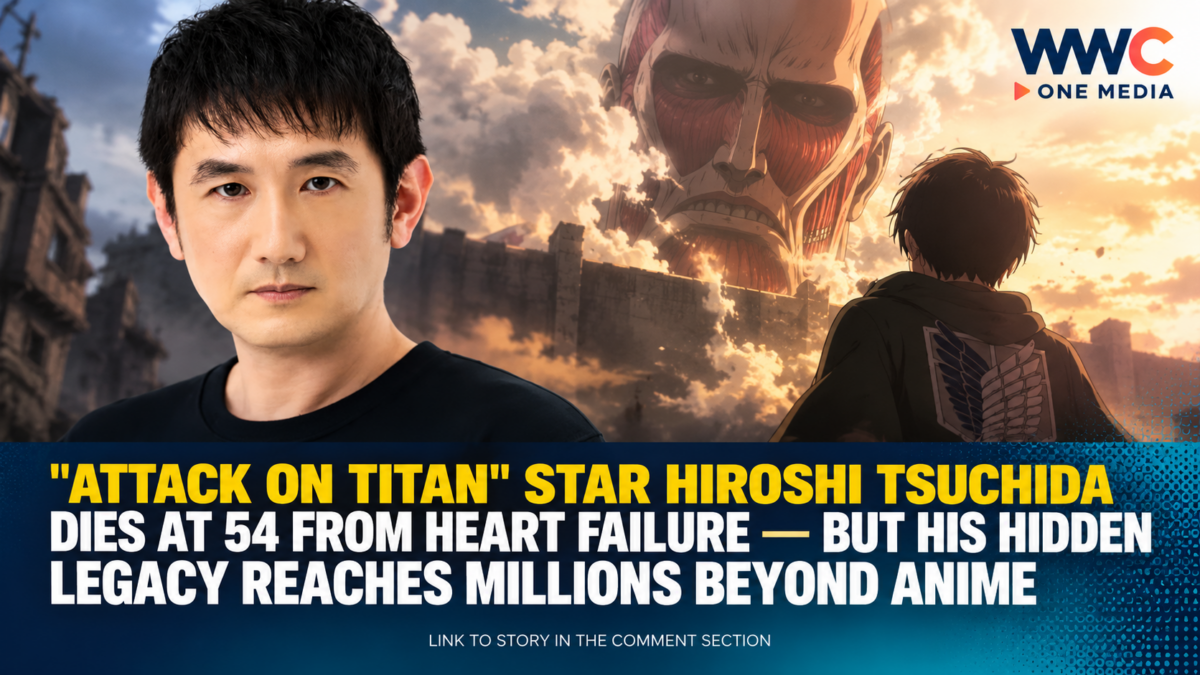
TOKYO, Japan — October 21, 2026. Japan’s anime and entertainment industry is mourning the death of veteran actor and voice performer Hiroshi Tsuchida, whose unforgettable performances in Attack on Titan, Ninja Sentai Kakuranger and numerous internationally recognized productions made him a familiar presence across generations of Japanese entertainment.
Tsuchida died from heart failure on October 11 at the age of 54, according to an official announcement issued by his talent agency, 81 Produce, on October 20.
The news has sparked an outpouring of tributes from colleagues and fans, particularly those who remember him as Grisha Jaeger, the father of Eren Jaeger in the global anime phenomenon Attack on Titan.
But Tsuchida’s career extended far beyond one anime franchise. From superhero television to Hollywood film dubbing and major video game productions, his contributions helped shape more than three decades of Japanese popular culture.
Agency Confirms Hiroshi Tsuchida’s Death — Family Holds Private Funeral
81 Produce confirmed that the actor passed away on October 11, revealing his death publicly nine days later.
According to the agency, Tsuchida’s funeral was conducted privately, with only family members in attendance, in accordance with the wishes of his relatives.
The agency also expressed its appreciation to the people who had supported him throughout his career.
Japanese media outlets, including TV Asahi, Oricon News and Cinema Today, independently reported the announcement and confirmed heart failure as the stated cause of death.
The agency did not publicly provide details about any underlying medical condition.
The announcement marked the loss of an entertainer whose career connected anime audiences, live-action superhero fans, video game players and international film viewers.
The Voice Behind Grisha Jaeger in Attack on Titan
For millions of anime viewers, Tsuchida will be remembered for portraying Grisha Jaeger, one of the most consequential characters in Attack on Titan.
As the father of series protagonist Eren Jaeger, Grisha plays a crucial role in the story’s central mysteries, family relationships and devastating revelations.
Tsuchida’s emotionally intense performance gave the character a combination of authority, regret and vulnerability.
Although Grisha was not the central protagonist, his actions and backstory became essential to understanding the anime’s wider narrative.
That importance was acknowledged by fellow voice actor Yuki Kaji, who portrayed Eren Jaeger.
Following news of Tsuchida’s death, Kaji publicly paid tribute to his colleague, praising the strength, conviction and emotional depth of his performances.
Kaji said Tsuchida’s portrayal of Grisha had been fundamental to bringing Eren’s story to life.
The tribute quickly became one of the most poignant responses to the actor’s passing, underscoring the professional bond between two performers whose characters shared one of anime’s most complicated father-and-son relationships.
From Ninja Blue to Tokusatsu History
Long before Attack on Titan became an international phenomenon, Tsuchida had already established himself among Japanese superhero television audiences.
In 1994, he portrayed Saizo, also known as Ninja Blue, in Ninja Sentai Kakuranger, part of Japan’s long-running Super Sentai franchise.
The series introduced a ninja-themed superhero team and developed a dedicated following among viewers of Japanese action television.
For fans who grew up watching Kakuranger, Tsuchida was more than a recognizable actor. He represented an era of tokusatsu entertainment whose characters continued to attract attention decades after their original broadcasts.
His work in the franchise remained a prominent part of his public identity, and he later returned to the role for anniversary-related productions.
Following his death, fellow Kakuranger cast members shared emotional tributes reflecting their long-standing friendships.
Actor Teruaki Ogawa paid his respects, while former co-star Shu Kawai remembered the experiences the cast shared through difficult and joyful moments.
Kawai’s tribute emphasized that the bond among the show’s five original heroes would endure, even after Tsuchida’s death.
Fans Discover His Unexpected Hollywood and Video Game Legacy
Beyond his two best-known television roles, Tsuchida built an extensive career as a Japanese dubbing performer.
One of his most recognizable international roles was providing the Japanese voice of Lightning McQueen in Pixar’s Cars franchise.
He also voiced characters in major anime productions such as Naruto, One Piece, Pokémon and Initial D.
His work extended into Japanese versions of international television and film projects, where voice actors play a crucial role in bringing overseas entertainment to local audiences.
Tsuchida also contributed to the video game industry, voicing characters in major gaming franchises including Tekken and Yakuza, also known internationally as Like a Dragon.
His work as Feng Wei in Tekken and Kazuki in the Yakuza series further expanded his reach beyond traditional television.
For fans familiar with Japanese-language entertainment, the news highlighted just how frequently they may have encountered his voice without immediately recognizing the performer behind it.
The ‘Today Is Friday in California’ Meme Gave Kakuranger a New Audience
In an unexpected chapter of his career, Tsuchida also became associated with internet meme culture.
A scene from Ninja Sentai Kakuranger featuring his character Saizo gained renewed online popularity through the phrase “Today Is Friday in California.”
The unusual line and the accompanying action sequence circulated widely as a meme, introducing the decades-old superhero series to a younger generation of internet users.
What began as a moment from a 1990s television episode evolved into a recognizable example of how older Japanese entertainment can find new audiences through social media.
The meme became another unexpected element of Tsuchida’s legacy, connecting longtime Super Sentai followers with viewers who had never watched the original show.
More Than Three Decades of Japanese Entertainment
Born in Tokyo on February 8, 1972, Tsuchida developed a career encompassing television acting, anime voice performances, film dubbing, narration and video games.
His versatility allowed him to transition between physically demanding live-action roles and emotionally complex vocal performances.
That adaptability became a defining feature of his professional life.
While international audiences may primarily associate his name with Attack on Titan, Japanese fans recognized a broader body of work spanning some of the country’s most enduring entertainment franchises.
His passing has drawn attention to the contributions of voice actors whose performances become inseparable from beloved characters, even when the performers themselves remain less publicly recognizable than the productions they help bring to life.
A Legacy That Will Continue Across Generations
Hiroshi Tsuchida’s death at 54 brings an early end to a career that connected multiple generations of fans.
His portrayal of Grisha Jaeger remains part of one of anime’s most internationally successful stories. His time as Ninja Blue preserves his place in Super Sentai history. His extensive dubbing work ensures his voice remains familiar to viewers of major animated films and television series.
For colleagues and fans, his passing represents not only the loss of a respected performer but also a reminder of the people behind the characters audiences have followed for decades.
Tsuchida may be gone, but the characters he brought to life — from Grisha Jaeger to Ninja Blue and Lightning McQueen — will continue introducing his work to generations of viewers who may never have known his name.
And that may be the most enduring part of his legacy: a career that continues to speak to audiences even after its voice has fallen silent.