ROME, Italy — October 21, 2026
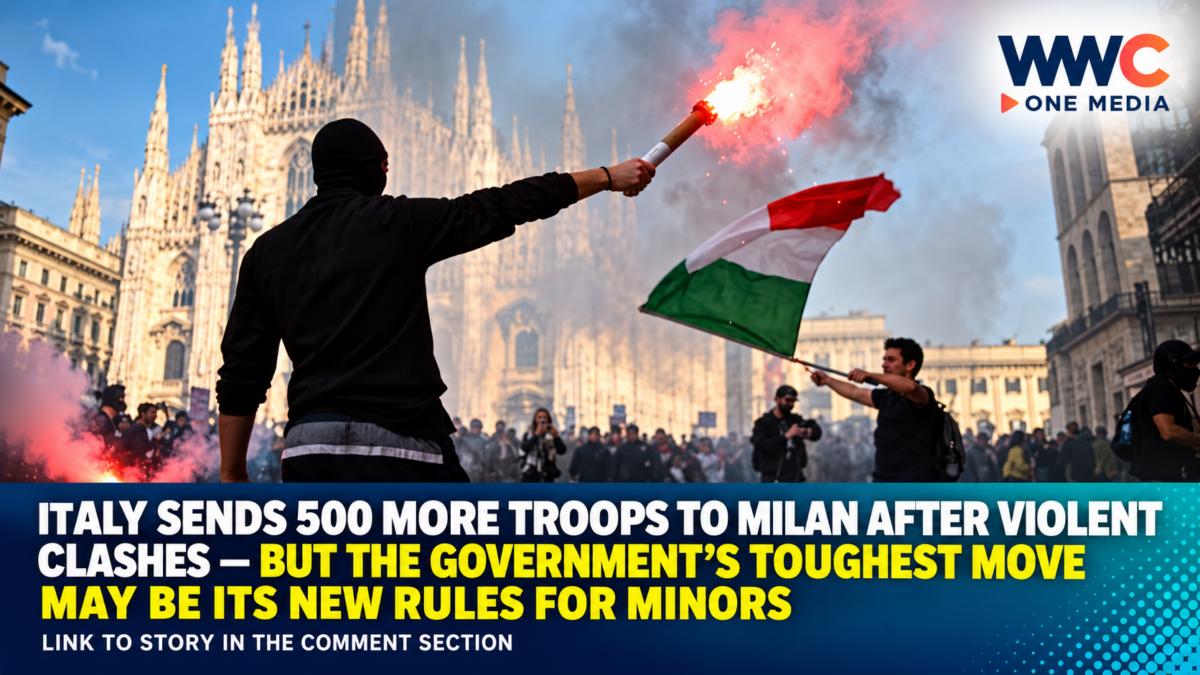
Italy has approved the deployment of 500 additional soldiers to Milan and adopted tougher security measures following violent clashes, looting and vandalism that erupted during demonstrations over the rising cost of living and deteriorating public services.
Prime Minister Giorgia Meloni’s government approved the security package on Tuesday, October 20, following days of unrest that damaged businesses and brought demonstrators into confrontations with police in Milan and other northern Italian cities.
The measures include additional military support, stricter penalties for violent participation in demonstrations, provisions allowing parents to be held financially responsible for damage caused by their children, and expanded powers to intervene when minors are considered a threat to public safety.
The crackdown reflects the government’s determination to restore order as Italy faces mounting public frustration over living costs and economic pressures. However, the expanded powers also raise questions about civil liberties, the treatment of young people and the limits of state intervention during protests.
500 Additional Soldiers to Reinforce Milan Security
The deployment will reinforce security operations at key locations across Milan, including areas vulnerable to further disturbances.
The additional personnel are expected to remain in place until December 31, 2026, working alongside police and Carabinieri, Italy’s national gendarmerie force.
The move follows a weekend of unrest during which groups of young people reportedly smashed shop windows, looted commercial establishments, set fires and threw objects at law enforcement officers.
The disturbances also prompted businesses in central Milan’s upscale shopping district to close early, remove merchandise from display windows or cover storefronts to reduce the risk of further damage.
According to reporting by Reuters and other international news organizations, the government accelerated its response amid concerns that further demonstrations could trigger renewed violence.
Importantly, the final package did not grant soldiers the additional judicial police powers that had been considered during the discussions. The approved deployment is intended to strengthen security operations alongside existing law enforcement, rather than give the military unrestricted policing authority.
New Rules Target Violence During Demonstrations
One of the most consequential elements of the package is the creation of an offense covering violent participation in demonstrations.
Under the approved measures, participation in a group of at least five people that engages in violence endangering public safety can carry a prison sentence of up to five years and a fine of as much as €20,000.
Penalties may become more severe when circumstances such as concealed faces or injuries are involved.
The provisions distinguish violent conduct from peaceful assembly. Demonstrations remain a legitimate form of democratic expression; the crackdown focuses on conduct that crosses into violence, looting and destruction.
The government has also strengthened provisions concerning compensation for property damage, including circumstances in which parents may be held financially responsible for damage caused by their minor children.
Minors Face Greater Scrutiny Under New Measures
The involvement of young people in the unrest has become a central issue in the government’s response.
The new rules expand authorities’ ability to intervene when there is evidence that minors pose a danger to public safety. Under the approved framework, police may detain young people aged 14 to 17 under specified preventive conditions, even when they have not yet committed an offense.
Such measures are not the same as a criminal conviction, and their application remains subject to the applicable legal requirements.
The package also provides for stronger enforcement against youth violence and additional resources for the juvenile justice system.
The government argues that these steps will make it easier to prevent repeat offenses and hold those responsible for violence accountable. Critics of Italy’s broader security policies, however, have questioned whether increasingly punitive measures adequately address the social and economic pressures that contribute to unrest.
Cost-of-Living Anger Behind the Unrest
Although the government has emphasized violence and public order, the demonstrations emerged against a wider backdrop of economic frustration.
Protesters have raised concerns about rising fuel and energy costs, expensive housing, low wages and shortcomings in public services. These grievances have added to broader tensions over whether ordinary households can keep pace with living expenses.
The unrest in Milan also echoed disturbances elsewhere in northern Italy, including reports of clashes in cities such as Turin and Bologna.
International coverage has drawn comparisons with protests in neighboring France, where anger over economic conditions and public policy has also contributed to major demonstrations.
However, the presence of violent groups does not mean that every demonstrator participated in criminal activity. Peaceful protesters and those accused of looting or attacking police must be distinguished when assessing the events and the government’s response.
Meloni’s Law-and-Order Agenda Faces Another Test
The latest measures are part of a broader law-and-order agenda pursued by Meloni since she took office in 2022.
Reuters has documented a series of security decrees and legislative initiatives under her administration covering illegal gatherings, migration-related offenses, juvenile crime and protest-related conduct.
Supporters argue that tougher laws are necessary to protect residents, businesses and public infrastructure. Opponents warn that expanding detention and punishment powers could restrict civil liberties or fail to address the underlying causes of social unrest.
The Milan response therefore carries implications beyond one city. Its implementation will test whether stronger enforcement can prevent further violence while preserving the right to peaceful protest.
What Happens Next?
The immediate priority for Italian authorities is to maintain public order, protect businesses and prevent another outbreak of violence.
The additional troops will reinforce the security presence in Milan through the end of December, while police and judicial authorities will apply the new legal provisions.
The longer-term question is whether the government’s approach will ease tensions or deepen divisions over economic hardship, youth alienation and the limits of state power.
For now, Italy has sent a clear message that attacks on people and property will face a tougher response. Whether that strategy delivers lasting stability will depend not only on enforcement but also on how authorities address the grievances that brought people into the streets.